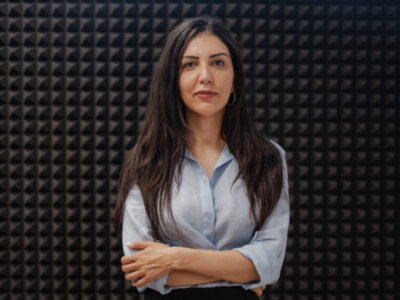
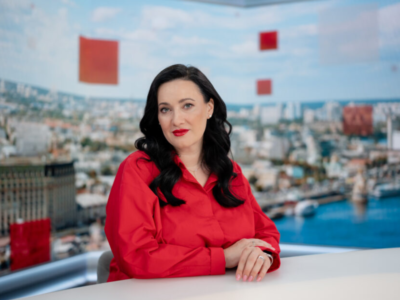
The third heroine in a series of materials on war reporters from Women in Media is Iryna Sampan, a journalist at Butusov Plus and the editor-in-chief of news at Hromadske Radio. She reflects on whether journalists in war can balance their work with volunteering and helping others, explaining why it is important for her to look good on camera, even when the audience might find it inappropriate.

Previous stories in this series include interviews with Aliona Yatsyna, co-founder of Kordon.Media, and a conversation with Diana Butsko, war correspondent for Hromadske.
“Every report hurts me”
Iryna Sampan has been covering Russia’s war against Ukraine since 2015. She reports from the front for Butusov Plus and has held the position of Chief News Editor at Hromadske Radio since August 1, 2024.
“I went to war for the first time in the spring of 2015. I probably had too high standards to start my career in order to pursue another type of journalism. I realized it was crucial for me to be where things are burning, exploding, and where there is injustice. After the Revolution of Dignity, volunteers from Maidan went to war, and I left as a war correspondent,” Iryna Sampan recalls the beginning of her journalistic career. Since then, she has focused on topics such as war, conflict, life, and death.
When asked whether it is possible to ultimately overcome the injustice, Iryna Sampan responds that Russia’s attack on Ukraine and the loss of lives in this war are profoundly unfair. She wants to believe that with each of her reports, the balance of this injustice is somewhat addressed.
“I want people who think they are not connected to the war to still get involved, change their perspective, and increase their commitment to the Ukrainian language and the Ukrainian army,” says the war correspondent. “If we talk about a global audience, the goal of our work is to showcase the subjectivity and strength of our army. It is not some abstract entity fighting; it is real people who are dying. And, of course, we aim to increase assistance and engagement from a foreign audience.”
Iryna Sampan recalls attending a journalistic conference in Tallinn, Estonia, where many active European youth and representatives of civil society were present. Almost everyone had a stance on the war in Ukraine, often expressing it with the phrase, “the situation is not ambiguous.” For example, they genuinely believed that Ukraine had not yet managed to end the war because it “has not yet figured out how to do it.” They thought that if Ukraine could just come up with a magical solution, the war would come to an end. The conference also featured a Latvian participant who was the most radical in expressing the sentiment that “the situation is not ambiguous.” After speaking with Iryna Sampan, he expressed a desire to come to Ukraine and engage in discussions.
“I arranged for him to volunteer with the Red Cross after the liberation of Kherson, when the region was heavily bombed, and the shelling was relentless. On his first day at the Red Cross, he came under fire and witnessed Russia targeting humanitarian organizations. The word “surprise” doesn’t even begin to describe his reaction,” Iryna Sampan shares the story of that man. “He then traveled through the surrounding area, visiting de-occupied villages and seeing everything with his own eyes. He became pro-Ukrainian and brought this truth back with him to Latvia. He wrote articles, even though he was not a journalist. He is deeply affected by this injustice and now finds it difficult to communicate with his Russian friends living in Latvia, insisting that “the situation is not ambiguous.” The situation is ambiguous. People need to see that, trust us and our content.”
Iryna Sampan also discusses how foreign journalists perceive the war in Ukraine, concluding that for many of them, it is primarily just another conflict to cover for monetary gain. Therefore, we should not harbor any illusions that the foreign media coming to work in Ukraine are truly feeling our pain. The war correspondent reflects on her experience working in Israel following the HAMAS attack in October 2023.
“I understood that the Israelis were suffering, especially on October 7-8, when villages were attacked, and people were killed. It was horrifying, but I didn’t feel any pain that would prevent me from working and objectively assessing the situation, because I was witnessing someone else’s war. In our war, every report hurts me,” says Iryna Sampan.
According to her, during the war in Ukraine, journalists are often compelled to engage in more than just their journalistic duties—they also volunteer, organize meetings, and provide assistance. For example, during one of her recent trips to the Kharkiv region, Sampan encountered an elderly woman who refused to leave her home because of her four dogs. She took it upon herself to help find volunteers who could evacuate the dogs alongside their owner, away from the shelling:
“According to classical standards, a journalist should not do this. In someone else’s war, you definitely wouldn’t take such actions. But in this war—your war—you do.”
Moral and ethical dilemmas in war
The war correspondent discusses the biggest challenges of working in a conflict zone, placing security issues at the forefront. Like her colleague Diana Butsko, Sampan notes that drones pose a significant danger when working directly on the front line. She also mentions that journalists often must purchase their own clothing and equipment to operate effectively in these conditions.
“We don’t have any contract with the editorial staff ensuring that if I die, they will assist my family or my child. I don’t have insurance to cover my life while working in a war zone. Of course, there are friends and colleagues who assure me they would never leave my child in a difficult situation or without financial support if something were to happen to me. I trust them, but these are just words that aren’t legally binding,” says Iryna Sampan. She adds that she struggles to prepare her own will, even though she recognizes its importance, especially for those facing a high risk of death or disability.
After Iryna Sampan took on the role of Chief News Editor at Hromadske Radio, she began to visit the front lines less frequently. However, when she does go, it is mostly to the units that are familiar with her and invite her personally—as if to their own. Yet, even among those she knows well, unpredictable events can occur in war, says Sampan:
“For example, in Lyptsi, in the Kharkiv region, we unexpectedly found ourselves in a gray zone. We ended up there by accident due to a lack of information—Russian forces were present, and we didn’t know. Things could have gone very badly if we hadn’t left quickly. But ultimately, all such situations are my own responsibility.”
She also points to another category of challenges in her work—moral and ethical dilemmas. One such challenge is the inability to publish all information due to a level of self-censorship imposed by wartime conditions. Another is the frustration of being unable, as a journalist, to assist those who have been captured or are in other difficult situations.
“When people write to me saying that our soldiers are being sent to the front as “cannon fodder,” I don’t respond to these urgent pleas in my work. I don’t take on such topics because they require thorough, in-depth journalistic investigation—you have to go and verify everything firsthand, understanding all perspectives involved. Likewise, when relatives of prisoners of war reach out, I can’t commit to searching for them; I simply don’t have the physical or emotional resources for that,” notes Iryna Sampan. She recalls Maksym Butkevych, a journalist, human rights activist, and public figure who has been held captive in Russia since June 2022. She emphasizes that despite all the efforts of his colleagues, even a public figure like him cannot be freed from captivity.
“Take her away, she distracts from the military”
Iryna Sampan also discusses how often she encounters gender discrimination or sexism in her work. She notes that over her ten-year career as a war correspondent, she has built a strong professional reputation, which has nearly eliminated gender bias from her interactions with people within the army.
“Occasionally, certain moments slip through—a sort of unsolicited male guardianship. They’ll say things like, “Oh no, I wouldn’t let my girlfriend come here.” But thankfully, this is very rare,” says Iryna Sampan. She also recalls how during a recent trip, the guys on the front line asked what media she represented, because they didn’t know her. When people heard “Butusov Plus,” they asked, “Why didn’t Yura come himself?” The journalist responded simply: “He’s in the Kursk region, and I’m here.”
On the other hand, there are comments from social media users and YouTube viewers under Iryna Sampan’s videos. For example, some might remark, “Take her away; she’s distracting from the military.”
“I don’t pay attention to this. Even though the audience of Butusov or Hromadske Radio is generally respectful and well-mannered, there are always a few random people,” the journalist comments. “I like to look presentable on camera—styled, well-dressed, with my hair looking good, especially for studio interviews. I won’t make myself appear more masculine, distort my appearance, or pretend to be someone I’m not just to avoid those comments.”
Throughout her career, Iryna Sampan has frequently faced online abuse due to her professional work and public stance; Russian propaganda has labeled her an “escort,” a “Nazi,” and “Zaluzhny’s mistress.”
“When you Google my first and last name, those materials appear at the top of the results—my Facebook page, then various posts, and finally, mentions of the “awards” I supposedly received from Russian propaganda. Because of this, I ask people not to Google me, but rather my reports,” says Iryna Sampan.
She emphasizes that, following these incidents, she has not recently experienced public hate speech or bullying directed at her. However, she notes that, in addition to Russian propaganda, Ukrainian radical groups can also engage in such actions, particularly in the form of online bullying:
“I am concerned that law enforcement agencies are doing nothing about them. Secondly, they continue to grow in strength and are even celebrated as national heroes. They are invited to interviews and given a platform for their views—though not necessarily for what they promote in their communities, such as anti-LGBT sentiments, anti-feminism, or hostility towards certain groups. In these interviews, they discuss their so-called brave actions. What worries me is that society does not grasp the implications of this. When another scandal arises, they will likely receive the command to attack once again.”
This story was developed with the support of the Dutch Ministry of Foreign Affairs as part of the project ‘Building Resilience of Women Journalists in Ukraine: Tackling Online Violence and Gender Disinformation,’ implemented by the NGO Women in Media