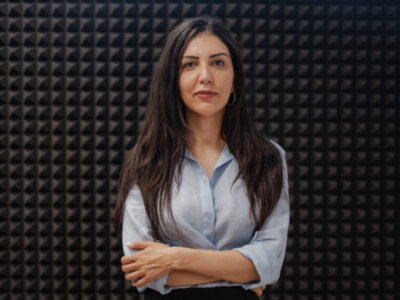
Women in Media continues its series of interviews with Ukrainian female military reporters, featuring a conversation with Diana Butsko, a reporter from Hromadske. She discusses her motivation to cover the war, the gender bias she faces, and the criminal prosecution by the Russian FSB for her work in the Kursk region, which is occupied by the Armed Forces of Ukraine.

A dream to change the world
War reporter and Hromadske journalist Diana Butsko was in the U.S. at the start of the full-scale war, earning her master’s degree at Southern Illinois University. Her program was set to end in May 2022, but Butsko describes those three months as morally challenging for her:
“According to the program, I was obligated to return to Ukraine after completing it. When the full-scale invasion began, some of the students I studied with applied for refugee visas. So, there were ways to stay in the U.S. But I watched what was happening in Ukraine and thought it was strange to be a journalist in America during such a time. I wanted to cover the war, to experience these historic moments with my country. I wanted to be here, see it with my own eyes, and write my own story.”
The reporter recalls that even in school, she dreamed of changing the world, fighting corruption, and stopping genocides. At the time, discussions in the media often focused on events like the 1994 Rwandan genocide and the lingering impact of concentration camps from World War II, such as Auschwitz. She was always drawn to such topics, but in 2011, when she finished school, war still felt distant and hard to fully grasp in the context of Ukraine.
“I loved writing and, like many, dreamed of becoming a writer. Where else could I go to change the world and write if not journalism? So, I pursued it and began my difficult journey. Who would have thought I’d encounter a war here in Ukraine,” says Diana Butsko.
Over time, she believes many people lose faith in journalism’s ability to truly make a difference. However, she says she hasn’t lost that belief; in fact, it only strengthened after her studies in the U.S. “Media is a powerful and decisive tool around the world,” the reporter adds, quoting the well-known phrase: “He who owns information owns the world.”
Diana Butsko recalls the words of photojournalist Max Levin, who was killed by Russian forces during the offensive in Kyiv region in the spring of 2022. Levin, who had been covering the front since the start of the Russian offensive in Donbas in 2014, often said that every photographer dreams of capturing a photo that will stop the war.
“Perhaps we won’t stop the war, but I am sure we are influencing many things,” Butsko says. “It seems to me that people somewhat underestimate the importance of journalism in Ukraine. Here, a post by an influential journalist on Facebook can lead to a minister being fired or an investigation being launched. There is a reaction, and I believe we are not insignificant in this country after all.”
The most important reports
After completing her studies in the U.S., Diana Butsko returned to Ukraine after the Kyiv region had been de-occupied. Thus, the first location she worked in after the liberation was the Izium district. This is why she holds her reports from Izium close to her heart, noting that everything recorded by journalists in Ukraine quickly becomes history.
“We worked in the cemetery, and the smell from that day still lingers with me at times. Sometimes I encounter it as a phantom smell,” says Diana Butsko. “These were iconic stories for me. For instance, we created a piece about the medics who stayed during the occupation. They were very frightened and hesitant to talk to people. It had a profound impact on me because these were my first impressions and interactions with people under occupation, in liberated towns.”
Diana Butsko also holds Avdiivka close to her heart. Since the beginning of the war, different film crews at the Hromadske team have been responsible for various regions, she explains. She was in charge of the Donetsk region, so she produced several reports from Avdiivka and witnessed the city literally disappearing before her eyes.
“During the first months, I wasn’t fully aware of what was happening. Now, sometimes I watch those videos or reflect with my colleagues, and I realize that while we were working in Bakhmut, the shelling was just 50 meters away from us, yet we continued to film. In the final days, we were still heading to Bakhmutka — I look at the map, and the Russians were only a kilometer away. The Wagner fighters were present, creating a gray area. Yet we still went in, and it seems to me that it was quite dangerous,” Diana Butsko shares as she recalls her experiences.
War, along with its associated risks, changes significantly, the journalist emphasizes. In the past, it could have been frightening due to loud explosions nearby, but now there are drones. During a recent trip to Chasiv Yar, she remembers having to run every ten meters from tree to tree because of the high concentration of drones in the area. As they approached the location, artillery shelling began, and they had to sit in the bushes for about an hour, waiting:
“Then, for the first time in my life, I was very, very scared. Drones were constantly flying, and artillery was firing. But that feeling of fear is fleeting. You hear it, you worry about it, and you’re scared, but then you somehow create your material. It goes on, and you realize you need to produce new content. That fear fades away.”
Speaking about fear, Diana Butsko distinguishes between physical fear and mental or existential fear. However, she adds that she is grateful not to experience the latter: “For example, some people say, “I left Ukraine because I’m very afraid of explosions. I can’t stand it.” That’s very difficult for some. I don’t have that fear. I know I will survive; it’s a physical fear, not a mental one. And I will create my next piece.”
“Little fragile girl”
In response to a question about whether she has faced gender bias in her work, Diana Butsko admits that initially, she tried to ignore her gender. She was focused on her work and perhaps didn’t notice if her gender had any impact. However, she later realized that this aspect cannot be completely ignored.
“When you, for example, arrive at a training session with 50 men and you’re the only woman, it inevitably affects your communication and how the process is structured. We have a format where we try to create reports with the journalist as the main focus. So, I believe these interactions are noticeable. Dialogues with a male reporter would be completely different. Sometimes this dynamic works for me, and sometimes it works against me,” Diana Butsko admits.
She cites several instances from her work related to this topic. The first occurred when her film crew was told they couldn’t access a location because “your little, fragile girl is not allowed there.” In contrast, there are situations where her gender can play a significant role in persuading people to allow her where she needs to be. Butsko emphasizes that many soldiers know her and her team and follow their reports, so when they arrive at a position, they are recognized:
“They can say: “Oh, we watch your reports, you are so brave, and also a girl, so small, here you are driving, running in these trenches.” One said, like, «I love watching you run landings, it’s so cool.” There are always such comments,” – the journalist gives examples, and adds that she is already used to this environment.
She also recounts an incident during one of her reports where her interlocutor, an adult male farmer, told her, “What are you doing here? You should be having children.” In response, she quipped, “And cooking borscht.” However, he merely repeated her phrase affirmatively, not grasping her irony.
“On the other hand, this farmer is quite old, and I viewed his comment as a manifestation of parental concern. I doubt he even understands what the word “sexism” means,” says Diana Butsko.
Report and Suja and the FSB criminal case
On August 15, 2024, a report by Diana Butsko was released on the Hromadske YouTube channel from Suja, a city in the Kursk region of Russia under Ukrainian Army control. She became one of the first female journalists to access the area after Ukrainian troops entered the Kursk region. To reach Suja, she negotiated extensively with the military to secure a ride with them.
She recalls that as she walked around the city, she had a strange impression because she didn’t fully grasp all the risks and dangers. Before the trip, her editors were uncertain about whether it was worth going there to work, particularly due to this uncertainty. Recommendations for journalists regarding coverage of events in the Kursk region, published by the Institute of Mass Information on August 13, 2024, proved helpful.
Many comments — some from Russians — appeared under the report from Suja on YouTube. These comments were aggressive in nature, containing direct threats, sexualized hints, and hate directed particularly at the journalist. Diana Butsko notes that a significant portion of the audience for their videos — 10-20%, depending on the report — is from Russia. Therefore, the comments from Russians are not new to her. Most often, they write things like, “Where did you shoot? Is this Dovzhenko’s studio?” or add negative remarks about the Ukrainian military. However, the report from Suja, along with another from Pokrovsk in the Donetsk region released around the same time, attracted a considerable amount of personal insults and threats against Butsko.
“Am I going to do something about it? I took a few screenshots, and that’s it. They seem to be just people from Russia. I don’t think they will look for me — I hope not. I also doubt that our police, for example, will pursue them. I won’t report this to the police,” Butsko answered when asked if she plans to respond to these comments in any way.
Instead, on August 22, 2024, it was reported that the Russian FSB had opened criminal cases against Diana Butsko, fellow Ukrainian journalist Olesia Borovyk, and CNN reporter Nick Paton Walsh for “illegal border crossing,” declaring them wanted.
A sense of security while working at the front
Diana Butsko and I also discuss whether Ukrainian journalists working in the war zone have adequate material and technical support, as well as other resources, to feel protected and self-confident. She responds that they have some equipment, such as bulletproof vests, provided by journalistic organizations, including the aforementioned IMI. This year, the Hromadske newsroom was also able to purchase new helmets for its reporters. However, there are still deficiencies, such as the need for high-quality tourniquets and comprehensive first-aid kits.
“In the newsroom, they try to allocate resources for this whenever possible. However, there are aspects you might not consider at first glance. For instance, a portion of my salary now goes toward clothing. No one provides money for pants, shoes, or other essentials, and while working at the front, you need everything because it wears out quickly,” Diana Butsko explains.
Another important issue is health insurance for journalists. According to Diana Butsko, during the first two years, Hromadske offered insurance from American donors with a substantial coverage amount. However, this funding has now ended. There is a new insurance option available, but the coverage amount is significantly smaller. The editors have made it clear that while reporters can apply for this insurance, they understand if some choose not to go to the front lines with such limited coverage.
“Foreign journalists working in the war in Ukraine earn significantly higher salaries and receive additional payments for working in dangerous zones. For example, we don’t have that; I have a fixed salary, as do all our journalists. Whether I report from Kyiv or Hrodivka in the Pokrovsky direction, it doesn’t affect my pay. We do receive per diems for business trips, which amount to UAH 200 when going to the front,” says Diana Butsko, discussing the differences between American and Ukrainian media workers during the war. “Additionally, foreign newsrooms have security advisors, but they often seem more like a hindrance. They can be foolish and fail to fully assess risks.”
Foreign editorial offices provide good armored vehicles, which are incredibly helpful in conditions where drones are actively used at the front. It can be dangerous to approach the contact line even from a distance of 10 kilometers. Unfortunately, such vehicles are usually unavailable in Ukrainian media. On the other hand, Diana Butsko emphasizes that it’s not uncommon to see foreign colleagues arriving to cover the war in white sneakers and “incomprehensible vests” while on the front lines.
The journalist from Hromadske expresses that she always views her profession as a beloved vocation, one that can be changed at any time. She believes journalists have a choice — to work in a war zone or, conversely, in a quiet office away from the front lines. However, she personally does not understand why she would stay in Kyiv when there is a war in her country and she works as a journalist:
“There is a strong journalistic interest: I want to witness it with my own eyes. For instance, we are losing cities, and we want to see them one last time, to experience them once more. I believe that covering the war is now the most important thing, above all else.”