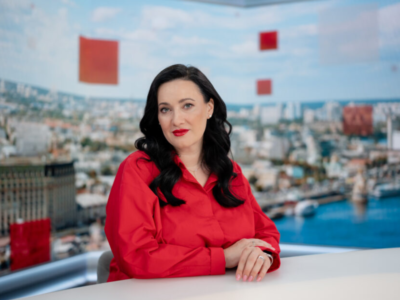
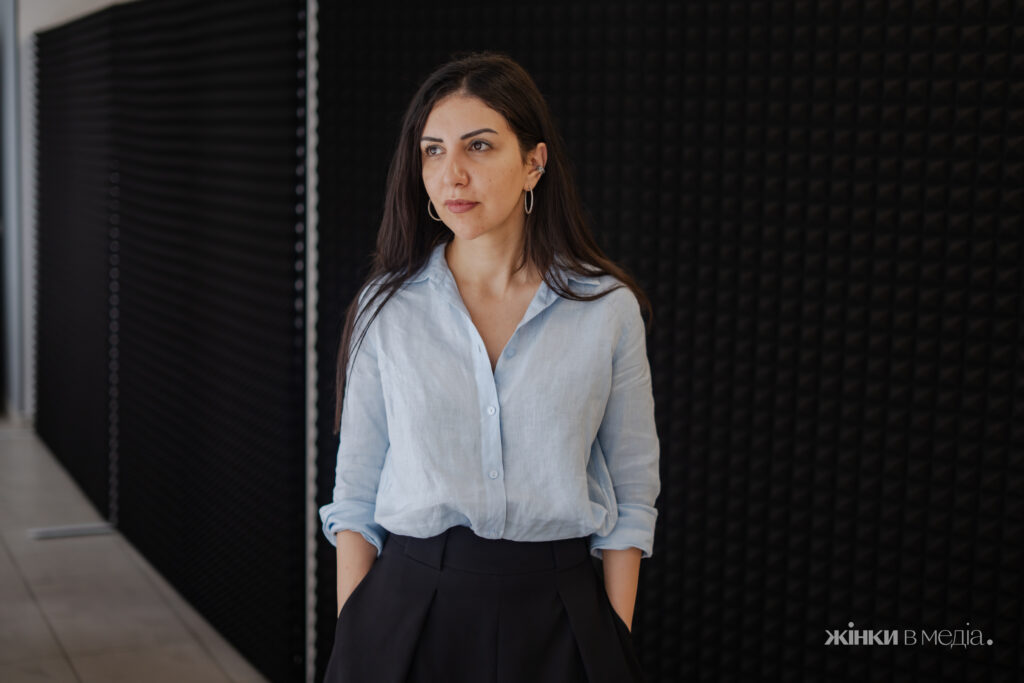
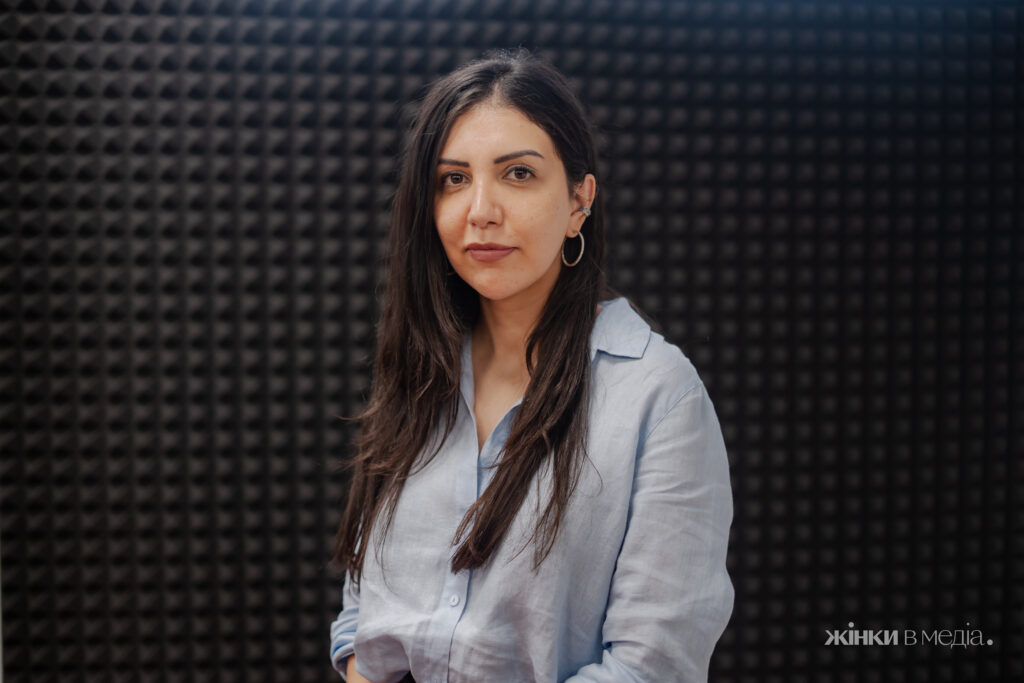
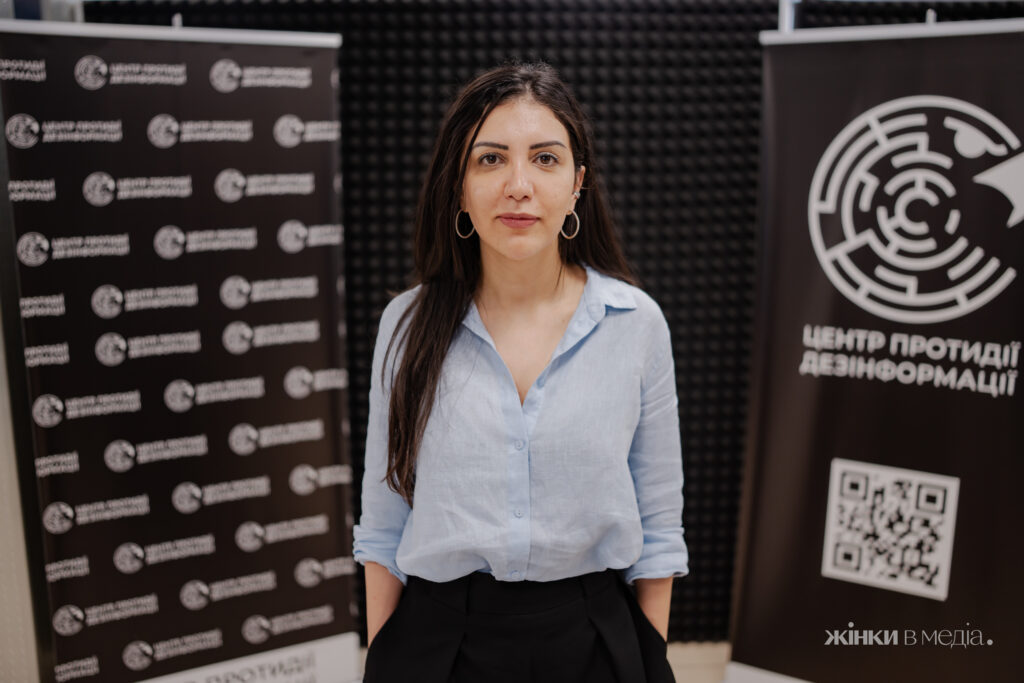
Anayit Khoperiya is Deputy Head of the Center for Countering Disinformation, National Security and Defense Council of Ukraine. The Center identifies, analyzes, and debunks hostile propaganda, produces research and reports, and runs training in cybersecurity, OSINT tools, and other specialist areas for people working in the field.
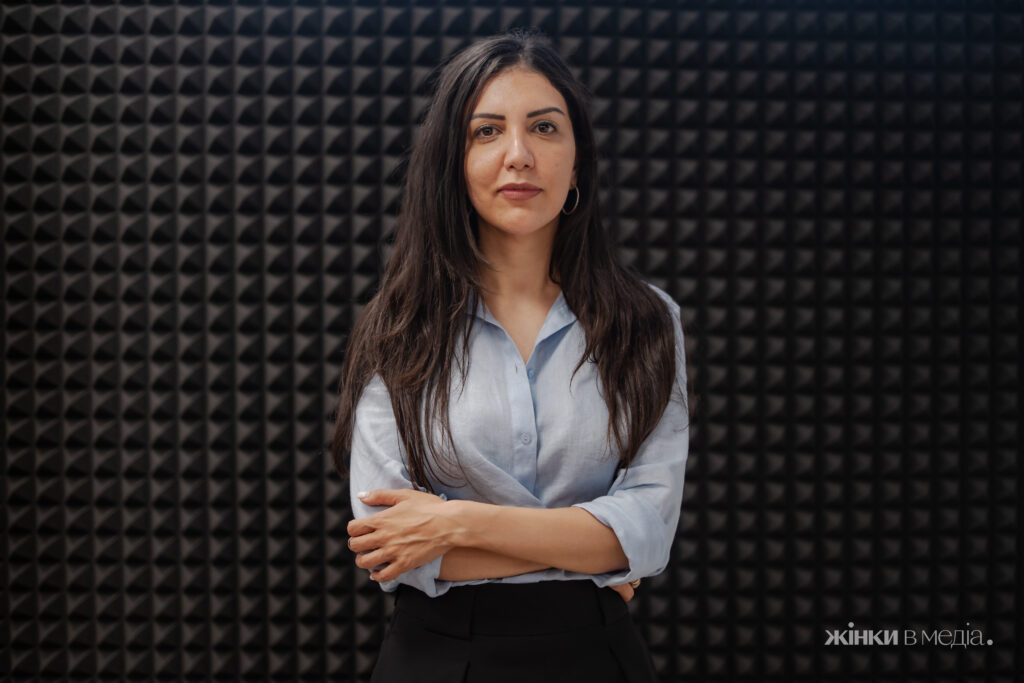
Among the subjects the Center deals with is gender-based disinformation — fakes about the mobilization of women, for example, and about women serving in Ukraine’s Armed Forces.
In this interview with Women in Media, Anayit Khoperiya explains which narratives Russian propaganda most often uses to discredit women in public life, what newsrooms can do to protect their staff from online attacks, and how artificial intelligence is changing the character of those attacks.
Women in Media recently published a study on how gender-based online attacks against women journalists are becoming part of Russia’s information war against Ukraine. How widespread is gender-based disinformation in Russian information operations?
Let me put it this way: it isn’t that we focus exclusively on gendered rhetoric, but we do record it, because its various aspects keep surfacing in the wider body of data we collect. The mobilization of women, for example, comes up in waves in Russian propaganda on a regular basis. They frame it in ways designed to devalue our women and undermine trust in them.
I liked your study very much — it brought all of this into clear focus. We had seen the same thing ourselves: well-known TV presenters whose names were attached to AI-generated smear content circulating on TikTok. I understand how systematic this is. Gender-based disinformation is an amplifier of Russia’s hostile campaigns.
So yes, we record it. We see manipulative videos of all kinds involving women — Ukrainian women in general, and specific individuals such as the First Lady, or media professionals and journalists.

Which narratives does Russian propaganda use most often to discredit Ukrainian women in public life? Do you see recurring scenarios?
Broadly speaking, the enemy looks for our country’s pressure points and uses women and videos featuring them to broadcast invented threats and destabilize the situation from within.
There was a story involving the women’s veteran movement around International Women’s Day. The movement’s leader called for raising funds for the military and strengthening the role of women in the army. Russian outlets twisted this into: “total mobilization of women is being prepared, brace for catastrophe.”
I also remember the videos featuring what we came to call the “black widows.” These were AI-generated clips in which actresses advised Ukrainian women to seek out servicemen as husbands so that they could collect large compensation payments once those men were killed. It was entirely synthetic content. When the videos appeared, I noticed at once that this practice is in fact widespread in Russia itself. They simply projected their own reality onto Ukraine, to suggest that our women hold their defenders in low regard.
I wouldn’t say that hostile information operations target gender as such. It’s more that propagandists use images of Ukrainian women — including those living abroad — to discredit both the women themselves and important processes inside the country, mobilization among them. Gender, for them, is one instrument for carrying out information operations, not the end goal.
The way Ukraine is discredited differs from country to country. We look not only at the new narratives being spread in a given place, but also at the cultural context.
We recently published a joint report with the European External Action Service — effectively the European Union’s diplomatic service. In it we analyzed how the Russians discredit the subject of Ukraine’s EU accession, both here and in European countries. We decided to prepare the report because we had noticed strikingly similar narratives and an identical structure for distributing disinformation.
Take the Pravda network of websites, which targets European countries in a range of languages. In one of these networks, content is generated by artificial intelligence every two minutes. We identified a similar network within the so-called Portal Kombat campaign, called ZOV, which operates directly against us. All of it is run from a single center.
As for other regions, everything depends on the level of support. In Africa, for example, there are more than 50 countries, and the approach differs in each one. Ukraine, for its part, has opened around ten new embassies there to strengthen our presence. The Russians immediately began attacking us in those countries, pushing the well-worn line that Ukrainians are corrupt.
The enemy’s key grand narratives are the same everywhere: that Ukraine does not exist as a state, that it is historically part of Russia, that it is overrun by Nazism and total corruption. These grand narratives branch out into smaller ones, all building a negative image of our country — the suggestion being that we are not worthy of independence and that our European choice was made under someone else’s external pressure.
In Africa, there is also active promotion of the myth that Russia is really fighting NATO there. In Europe, that narrative is less prominent, because European countries have a better grasp of reality and support us. We carry out this kind of analysis with partners from time to time so that they can show their own societies that all this negativity about Ukraine is a manufactured story.
Why, in your opinion, do women in particular — journalists, servicewomen, politicians, civic activists — so often become a separate target of information attacks?
If we’re talking about women who have stayed in Ukraine, they are active consumers of information content. Especially anything to do with mobilization, since they follow the fate of their relatives and loved ones on social media. People sometimes say that women are more emotional, but personally I don’t believe that.
It’s also important to understand the specifics of each platform: on some social networks the audience is predominantly female — Instagram, for example, as research in Ukraine shows. That makes it easier to target disinformation at women there, simply because of their numerical majority.
From time to time, absurd fakes appear. There was a lie circulating that women biologists and chemists would be forcibly conscripted into the army. Here the propagandists tried to fuse the theme of women’s mobilization with their long-standing narrative about “secret biological weapons.” The more complex and emotionally charged the context they construct, the more vividly they can carry out their information attacks.
This synchronicity, this monotony, this scaling through Kremlin Telegram channels — all of it shows that Russia is prepared to repeat the same lie dozens of times over. That is their tactic. We understand it, but we have to keep talking about it. I was very glad that your study gathered these cases together and demonstrated their pattern and their tactics so clearly. We need to analyze the entire process by which such attacks are built if we are to counter them effectively.
How often does the Center for Countering Disinformation record coordinated campaigns aimed specifically at Ukrainian women journalists or media outlets?
We are currently developing cooperation mechanisms with TikTok so that videos of this kind can be removed entirely. If we achieve good results, we will certainly report on them. The materials documented by Women in Media have been extremely helpful to us. We have taken them into our work.
These attacks need to be talked about far more, alongside the blocking and moderation of content. Audiences trust well-known media figures. And when people see an AI-edited video with a familiar face, they think: “Well, Solomiia Vitvitska certainly wouldn’t lie.” We often turn a blind eye to this, but society needs to be taught to recognize such threats.
Women in Media regularly documents online attacks against Ukrainian women in the media on Telegram, Facebook, Instagram and other social networks. What response mechanisms genuinely exist today, given that platforms don’t always remove harmful content quickly?
The legislative process of adapting European acts, the Digital Services Act among them, is underway in parallel, and it will open up new regulatory possibilities for us. But even now we are achieving decent results through direct contact with the administrations of platforms such as TikTok and Google. Our Center holds official Trusted Partner status on these platforms. Through the Ministry of Digital Transformation of Ukraine, we also engage actively with Meta.
This isn’t a matter of pressure. Pressure is not our method. Our task is to provide clear, verified data based on monitoring of the information space. What matters to the platforms is being shown that the attacks are systematic and that they have real consequences.
For example, during the wave of mass AI attacks on our soldiers — videos in which troops supposedly weep or call on the army to surrender to the enemy — we handed TikTok a large dataset. That allowed them to go beyond blocking individual accounts one by one and to tune their artificial intelligence algorithms to detect and remove such content automatically, before it is even published. It is painstaking work.
With YouTube the mechanics of engagement are somewhat different, but we find common ground with every platform. We respect their internal rules and policies, while pointing clearly to violations: where there is hate speech, where there is defamation of an individual or the use of a fully generated deepfake. I hope that in the near future, possibly next year, we will also have the relevant Ukrainian legislation adopted.
How often do the platforms review your submissions and conclude that no violation has occurred?
The truth is that you need to know their rules inside out, and they are set out in great detail. Google, for example, often requires additional legal grounds — that the subject is under sanctions, say — otherwise nothing will be blocked.
Refusals happen when platforms don’t see a formal breach of their community standards. In those cases, we gather additional facts that might influence the decision. With the military cases, we were turned down at first as well, but once we demonstrated a large-scale, coordinated pattern of systematic attacks, the attitude changed. We hope the same approach will work for AI-generated imagery of journalists.
Deepfakes and other AI-generated content have become one of the newest threats. How actively is Russia already using these technologies to discredit Ukrainian women?
We have witnessed a remarkable technological progression. At the start of the full-scale invasion in 2022, we saw a very low-quality AI video of Ukraine’s President Volodymyr Zelenskyy announcing capitulation — a fake even a child could have spotted.
Today the technology has advanced to the point where generated characters speak Ukrainian with the right accents, in authentic-sounding voices and with natural facial expressions.
We recorded information campaigns to discredit Ukraine in Africa, for example, built in the form of pseudo-journalistic investigations. One of those clips featured a supposed journalist from Germany. The video was made very professionally; the only tell was that the character blinked slightly unnaturally. The level of personalization now is such that when you are scrolling quickly through a feed, a fake is easy to miss.
Does the Center have tools or methods that allow it to identify and debunk such material quickly?
We are constantly learning and mastering new OSINT tools for metadata analysis and software-based content analysis. Sometimes Russian propagandists are lazy enough to leave the watermarks of AI generation tools on the video.
We always run comprehensive checks across different platforms, because the problem isn’t confined to the video file itself. There was a fake, for example, claiming that First Lady Olena Zelenska had bought an expensive Bugatti in France. Besides analyzing the video of the “salesman,” we looked into the original source of the story. It turned out to be a fly-by-night French website created literally two days before the fake was launched — a clear marker of manipulation.
Another fake claimed that Zelenska had bought two million dollars’ worth of jewelry in New York, as supposedly recounted by an employee of a Cartier boutique. Using OSINT tools we established the identity of this “saleswoman”: she turned out to be a real young woman who in fact lives in St. Petersburg. There is no universal verification algorithm. Every case requires its own investigation.
Information security, cybersecurity and OSINT are traditionally seen as technical fields. How, in your view, is the role of women in these professions changing? Are there more of them?
We regularly run training on countering information threats for various government bodies. On the OSINT side, we are currently working out in detail how best to structure the educational process, and we are constantly learning ourselves to keep track of new technological trends. Every year, with our partners’ support, we bring in international experts to train the civil servants responsible for information security.
About 50% of the staff at our Center are women. And they are not in support roles — they work directly on OSINT research, analysis, monitoring, and strategic communications. We have no gender preferences; what matters is professional knowledge and the drive to develop.
At the senior level, though, women are still not represented enough. I have been at information security meetings where, among dozens of men, only two women were present. Strategic decision-making is still dominated by men.
But it is all in our hands. We need to bring girls into this field. I am often invited to speak to young people — at Capture the Flag competitions, for example, or at special events for girls in cybersecurity. I always encourage them to join our profession, because our women analysts are in no way inferior to their male colleagues.
What mistakes do users themselves most often make when they encounter disinformation or become its target?
First, people react too emotionally. You need to take a breath, ground yourself and assess the situation critically. A serious mistake is for a journalist to repost a fake on her own page out of outrage — all that does is help it spread. It is far better to publicly expose the mechanism and the pattern of the manipulation.
Second, users often fail to preserve evidence. To work with law enforcement or with platform administrations later, an attack has to be documented carefully: take screenshots, save the links, download the video, because the original source may be removed very quickly. On TikTok, this is a serious problem — provocative videos disappear very fast once they have done their job.
Third, there is the neglect of basic digital security. I won’t repeat myself yet again about two-factor authentication — that much is obvious. Ignoring the rules of online hygiene during a war, when the enemy is attacking us not only at the front but in cyberspace, is unacceptable.
The sequence of steps should be clear: document the attack, analyze it, seek help from the relevant authorities if needed, and only then come out with a considered public response.
What can newsrooms and media organizations themselves do to better protect their women staff from coordinated online attacks?
When an online attack is launched against a particular journalist, the ultimate goal is not simply to discredit that person but to undermine trust in the outlet as a whole. Every newsroom should therefore have a clear internal protocol for responding to crises of this kind.
That protocol should set out digital security rules and a step-by-step algorithm for crisis communications, although every case still requires an individual approach.
Support within the team is critically important. Any attack is a heavy psychological blow to the person on the receiving end. You need to listen to your colleague, analyze the situation, and work out a response strategy together. Consolidated public solidarity from the media community is also very effective. Our people are excellent at coming together in the face of a threat.
But the newsroom’s public reaction and its support for a colleague have to be measured. Sometimes it is better not to go public at all, if the attack burns itself out within a few hours. And sometimes — as with the spread of deepfakes of television presenters — going public is essential, to explain the truth to the audience.
Who should be responsible for raising public awareness of this issue? The public sector? Civil society organizations?
It is a joint effort. The state should unquestionably play the leading role. Citizens need to know that the Center for Countering Disinformation, the Ministry of Culture, and other relevant institutions exist, and what they do.
But the role of civil society is no less important. Ukraine has excellent fact-checking organizations that produce high-quality research and accessible analysis for a broad audience.
We need to look for creative teaching formats. Ukraine’s own OSINT specialists should be drawn into this work — their expertise is unique enough that even Western colleagues come here to learn from it. I am convinced that media literacy and information hygiene should become a mandatory part of educational curricula.
What legislative or policy changes does Ukraine most need today to counter gender-based online violence and information attacks more effectively?
The Council of Europe’s recommendations pay particular attention to strengthening institutional capacity to counter online violence against women and girls. We need to adapt our legislation to the new information realities.
Five years ago the term “artificial intelligence” was barely used in public discourse, and to this day our legal framework has no clear definitions of “disinformation,” “fake” or “doxing.” We have to start with terminology and its proper legal qualification.
As for liability, I am in no way calling for restrictions on freedom of speech. But there must be clear legal consequences for unlawful acts such as doxing, with corresponding amendments to Ukraine’s Code of Administrative Offenses and Criminal Code.
For every state body, raising the level of media literacy should become a priority task, with the funding to match so that regular training can be held. Implementing European legislation will also help us considerably in this process.
Looking a few years ahead, what do you think will be the main threat to Ukraine’s information space?
We are on the front line of the information war, and we are the first to encounter technologies that other countries will only see later. Since gendered attacks are amplifiers of the enemy’s broader campaigns to split society along our vulnerable points, the main threat of the future will be an even deeper personalization of disinformation through AI. It will be aimed at specific groups and individuals far more precisely than anything we see today.
This material was made possible by International Media Support (IMS) as part of the project “United for Equality in the Media: Promoting Gender Equality Through Cooperation Between Public Organizations, Media, and Authorities” implemented by the NGO “Women in Media.” Any views expressed here belong to the authors and do not necessarily reflect those of the IMS.