
Analytical material for the Temporary Investigative Commission of the Verkhovna Rada of Ukraine on the investigation of crimes committed by armed groups of the Russian Federation against journalists and other employees of media entities (TIC).
Gender-based online attacks against Ukrainian women journalists increasingly not only bear the hallmarks of individual digital violence but can also be seen as part of broader informational influences with potential links to Russia or pro-Russian information networks. In times of war, these attacks can serve several functions simultaneously: discredit journalists, intimidate them and their families, undermine trust in Ukrainian media, and reinforce anti-Ukrainian propaganda narratives.
Online attacks take on many forms. These can be aggressive comments under war-related videos on YouTube and “exposing” posts in pro-Russian Telegram channels. Other forms may be smear campaigns based on potential coordination, and waves of threats of physical and sexual violence.
Such attacks are often accompanied by the dissemination of anti-Ukrainian narratives, manipulations, and disinformation. They may aim for the so-called “chilling effect.” The point is to intimidate women journalists, oust them from the public space, discredit their professional activities, and ultimately undermine public trust in the Ukrainian media. This is especially important given that a significant portion of the Ukrainian media sector today is made up of women.
Note on Methodology
This material relies on cases documented by the Women in Media NGO as part of the organization’s monitoring of gender-based online violence against women journalists and media workers in Ukraine. The analysis is based on open sources, journalists’ testimonies, archived screenshots of online publications, and data recorded on the Online Attack Map by the Women in Media NGO and the Incident Database.
Note. In international and Ukrainian contexts, different terms are used simultaneously to refer to violence committed through digital technologies and having a gender-based nature. In particular, the Council of Europe in Recommendation CM/Rec(2026)2 uses the phrase “technology-facilitated violence against women and girls,” while the term “technology-facilitated gender-based violence” (TFGBV) is also common in international practice. In the Ukrainian context, another common term is “gender-based online violence.” In this publication, these terms are used synonymously to describe interrelated forms of violence, harassment, and abuse that are committed through digital technologies and have a gendered nature.
The assessments and findings herein do not aim to replace any formal law enforcement investigation or judicial assessment. The material also does not establish any criminal or otherwise legal liability of specific individuals or entities but rather aims to document observed practices and trends.
Grounds for Consideration by the TIC
On December 4, 2025, the Verkhovna Rada of Ukraine issued Resolution No. 4706-IX to establish the Temporary Investigative Commission of the Verkhovna Rada of Ukraine on the investigation of crimes committed by armed groups of the Russian Federation against journalists and other employees of media entities.
The TIC’s mandate authorizes it to consider not only physical attacks, enforced disappearance, torture, or unlawful imprisonment of journalists, but also other forms of crimes and persecution if they are related to the armed aggression of the Russian Federation.
In this context, digital and hybrid forms of attacks against women journalists may be relevant for the TIC’s attention if something points to their connection with Russian structures, occupation administrations, pro-Russian information networks, or actions that may be carried out in Russia’s interests.
Importantly, on March 4, 2026, the Committee of Ministers of the Council of Europe adopted Recommendation CM/Rec(2026)2 on ensuring accountability for violence against women and girls committed through digital technologies.
The Recommendation stipulates the need to ensure effective accountability for technologically facilitated gender-based violence and specifies that the concept of “accountability” covers not only direct perpetrators, but also individuals or entities that may facilitate, incite, or enable such violence.
The Recommendation specifically emphasizes that its provisions apply both in peacetime and in armed conflict, post-conflict, and emergency situations.
In this context, the Women in Media NGO proposes that the TIC and broader documentation efforts in the international context take into account cases of technology-facilitated gender-based online violence (TFGBV), namely, when:
- such violence targets a female journalist or another female media worker;
- the attack is connected with her professional activities;
- the attack is carried out through digital technologies or online platforms;
- the attack as a gender-based component; that is, uses the target’s gender, gender stereotypes, sexism, sexualized harassment, threats of sexual violence, gendered disinformation, or other gender-based forms of violence to pressure, discredit, or intimidate the media worker;
- there are signs of direct or indirect connections with the Russian Federation, occupation administrations, pro-Russian information networks, or campaigns that have potential links to Russian or pro-Russian information networks.
Context
The Women in Media NGO documents cases of technology-facilitated gender-based violence (TFGBV) against Ukrainian women journalists and media employees within the project “Strengthening Resilience of Women Journalists in Ukraine: Countering Online Violence and Gendered Disinformation” with the support of the Ministry of Foreign Affairs of the Netherlands.
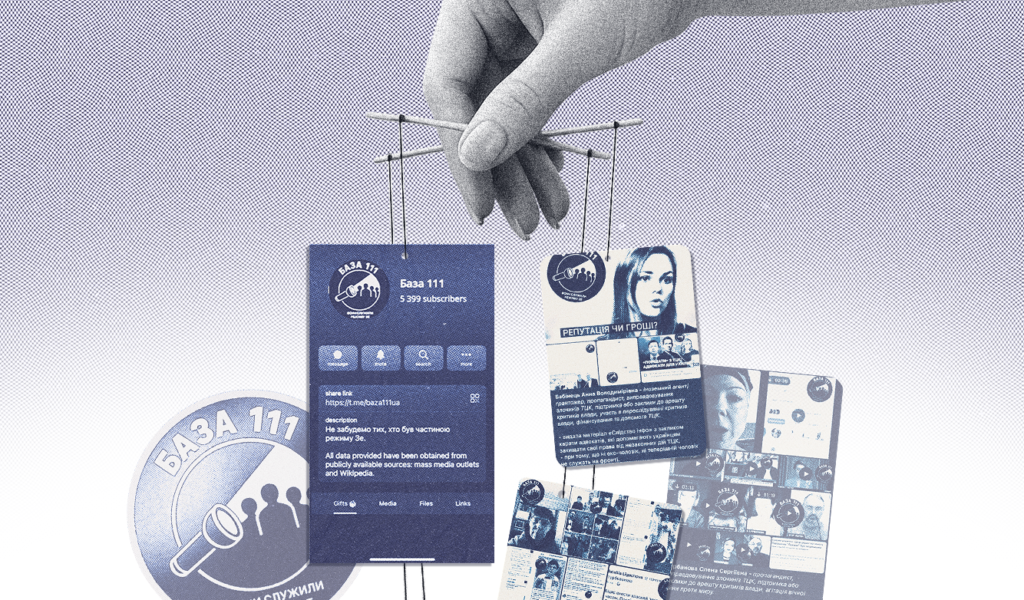
One type of attack that has apparently increased in frequency since the beginning of the full-scale Russian invasion is campaigns with anti-Ukrainian and pro-Russian narratives.
Such attacks are carried out through various digital platforms and tools: Telegram channels that show signs of connection with the occupation administrations or the information environment of the so-called “LPR” and “DPR,” comments on YouTube, Facebook and X, networks of anonymous accounts or accounts with signs of inauthentic or automated behavior, as well as content created or modified using AI technologies, in particular on TikTok.
Such campaigns frequently target women journalists who previously lived and worked in territories that are now occupied and cover the war, occupation, or Russia’s war crimes, or ones who serve as public media voices of the Ukrainian society. In many cases, it is not about isolated manifestations of online aggression but rather about systematic practices of harassment, discrediting, and psychological pressure.
News hooks, particularly manipulative or overinflated ones, often go beyond individual platforms and scale further through networks of pro-Russian resources, Telegram channels, networks of coordinated / bot accounts and even Russian propagandist talk shows. This significantly increases the reach of such attacks, integrating them into broader psychological influences on the Ukrainian media environment.
This publication analyzes individual types of such attacks, their characteristics, and tools used for organizing, coordinating, and further strengthening campaigns against Ukrainian women journalists.
Attacks Recorded on Russian and Pro-Russian Online Platforms
Online attacks carried out through Russian Telegram channels, groups, and websites are the most obvious ones in terms of identifying their sources. Cases recorded by the Women in Media NGO show that such resources usually demonstrate pro-Russian identification or loyalty to the Russian information space through channel names, the use of Russian symbols (in particular, the Russian flag in profile pictures), links to Russian domains, and the general rhetoric of posts.
On May 8, 2025, journalist Mariana Chornievych of Hromadske Radio hosted a live show where she discussed the situation on the frontlines, propaganda practices in Russia on the eve of May 9, modern teaching of the topic of World War II in schools, and the launch of an online Ukrainian language course for Ukrainians who are in temporarily occupied territories.
During the show, at around 9:20, the journalist’s personal email address received an email from an unknown user, sent from an email address registered in the mail.ru domain—a Russian service, access to which is restricted in Ukraine in accordance with the sanctions regime. The message contained obscene remarks addressed to the journalist, as well as a sexualized threat of the following content: “So, if you, you scumbag, continue to spread propaganda, I will insert your photo into porn and post it on social media.” Given the content of the message and the time it was received, the journalist assumed that the person who sent the email was possibly watching her live.
Mariana Chornievych immediately contacted the editor-in-chief of Hromadske Radio, who contacted the Women in Media NGO. This case contains elements of technology-facilitated gender-based violence (TFGBV), including sexualized online threats, gender-based intimidation, and threats to create and distribute unauthorized sexualized content with the aim of discrediting the journalist.
On the same day, an appeal was filed with the Cyber Police Department of the National Police of Ukraine requesting to take the necessary response measures. With the support of the Women in Media NGO, the individual who sent the threats was identified by the cyber police. According to the law enforcement, the man is located in the temporarily occupied territory of Ukraine. Women in Media provided a detailed description of this case on its website.
Journalist Maryna Mukhina has faced similar attacks, as she shared with Women in Media in May 2025. Before the full-scale invasion, she lived in Starobilsk, Luhansk oblast, which is currently occupied. For several years, posts with sexualized harassment and hate speech directed at her have been systematically appearing on the Telegram channel “Starobelsk Aidar.site.” The first such publications emerged in April 2022, after the journalist attended an anti-Russian rally. The channel administrators then identified her in the video and shared a post urging for her “denazification.”
Cases like hers indicate the systematic nature of the attacks: these are not a spontaneous reaction from the audience but rather bear the hallmarks of targeted harassment, combining elements of gender-based online violence, hate speech, and propaganda narratives. The repetitive and prolonged nature of the attacks, as well as the use of the same platforms, may indicate that the attacks are coordinated and part of broader information operations.
“They started tracking my activities. The posts began when I had just left the occupied city. But my family stayed there: my parents, my younger siblings, my grandmothers. With these texts, the attackers would constantly draw attention to them when they were already under scrutiny,” said Maryna Mukhina in her comment for Women in Media.
As of April 2026, the majority of such posts were removed from the Telegram channel; however, they have been preserved as screenshots captured by Women in Media before. At the same time, part of the publications are still available, including the 2023 survey proposing to vote in the so-called “C*nt 2023 Contest” (name cited for accuracy), where Maryna Mukhina is one of the “candidates.”
The Telegram channel “Starobelsk Aidar.site” systematically disseminates pro-Russian narratives and uses the necessary symbols. Its first post, from March 5, 2022, features a picture of a Russian flag raised over the occupied city. It was at the beginning of March 2022 that the city was captured by Russian troops. Later, the channel published posts on the occasion of the “great victory” on May 9, celebratory sentiments on the birthday of Joseph Stalin, as well as numerous materials with threats and ridicule of Ukrainians, united under the heading “News of the not-yet-dead universe. Befringed galaxy.”
Another journalist from a currently occupied city, Yana Chumachenko, editor-in-chief of SD.UA, previously known as Sievierodonetsk Online, found herself in a similar predicament. As the journalist shared with Women in Media in April this year, such cases have been recorded systematically since the beginning of the full-scale invasion in 2022. That same year, she left Siverskodonetsk (Sievierodonetsk), which was later occupied, with her family. Before that, she lived in Luhansk, occupied by Russia back in April 2014.
On March 30, 2026, identical publications in Russian appeared in several Telegram channels that systematically spread pro-Russian narratives and also use Russian symbols. They alleged that “a Ukrainian PSYOP Telegram channel, which posed as an LPR news aggregator, has been exposed,” referring to SD.UA.
“The Sievierodonetsk Online resource was created and supervised by Anastasiia Nidchenko. It was edited by Yana Mostova, a former employee of the Luhansk. Kommentarii website. Both traitors fled to the Ukrainian steppes a long time ago and continue to ‘work’ there under the direct supervision of the command of psychological operations and non-kinetic actions of the AFU Special Operations Forces. Essentially they have become the usual cheap minions of Kyiv propaganda,” says the post.
Yana Chumachenko also sent Women in Media screenshots of messages they received through audience questionnaires. These include direct death wishes: “so you shut up and stop lying,” “shoot yourselves and die you lying f*ggots.”
This is not the first attack on the journalist by pro-Russian channels: such a case was already recorded by Women in Media in 2024. Then a post mentioning Yana Chumachenko and her team appeared on the channel of blogger Vyacheslav Yakovenko. As of now, this post has been deleted, but Women in Media saved the screenshots. The aforementioned blogger also demonstrates his pro-Russian political affiliation, in particular by using the letter Z next to his nickname.
The above cases may indicate signs of targeted and potentially coordinated pressure from resources that systematically spread pro-Russian narratives. The regular, repetitive nature of such publications, their dissemination across similar platforms, the use of gendered disinformation, defamation, and direct death threats may indicate an intention to intimidate and pressure the target. In addition, such actions may pose a direct threat to the family members of journalists who are still in the occupied territories.
Comments and Accounts with Signs of Inauthentic or Coordinated Behavior
Another type of attack on women journalists is comments under their materials possibly made by users from Russia or from the temporarily occupied territories or by accounts disseminating pro-Russian narratives and showing signs of inauthentic or coordinated behavior. For instance, such comments can be seen under stories by war correspondents who report from frontline cities, and also traveled to film reports from the territory of Russia’s Kursk region, where control over individual localities was temporarily transferred to the Armed Forces of Ukraine.
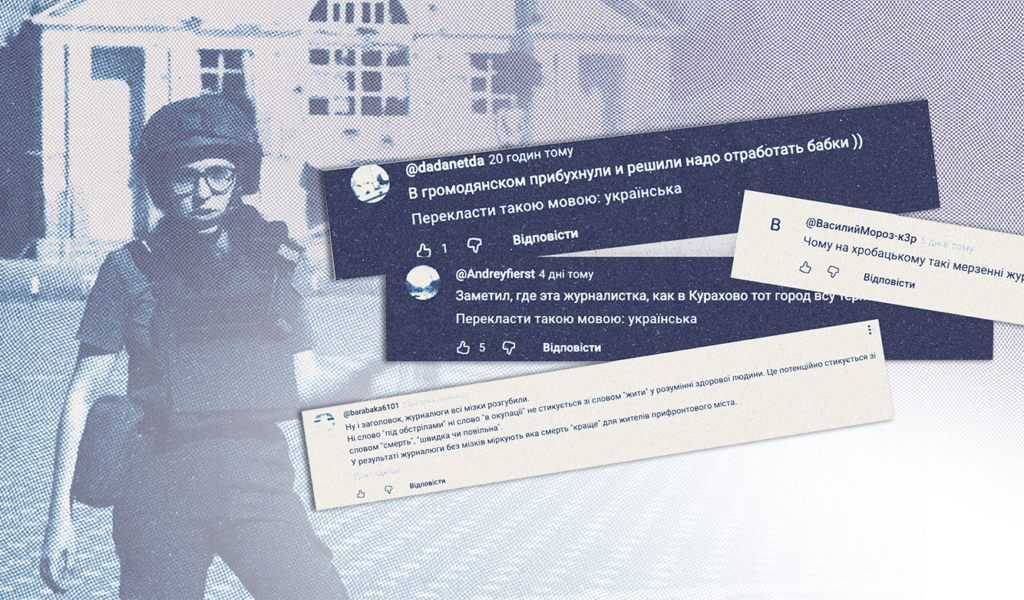
Hromaske war correspondent Diana Butsko regularly encounters such situations. The Women in Media NGO has recorded such attacks under Butsko’s news stories on YouTube in November 2025 after she visited Kherson, in August 2024 after she went to Sudzha in Russia, and in January 2024 after she reported from Pokrovsk. In August 2024, it was published that Russia launched a criminal proceeding against Diana Butsko and another journalist, war correspondent of the We Are Ukraine channel Olesia Boroyk, for illegally crossing the border.
Comments with signs of online attacks are mostly made in Russian. They contain hate speech, gendered disinformation, defamation, and sexualized harassment, as well as direct threats of death, physical and sexual violence. For instance, the following comments were made under Diana Butsko’s videos: “Soon, you will be buried there,” “She really wants to meet a Russian guy,” “Don’t worry, we’ll feed you in captivity,” “Imagine what she’s like in bed.”
In 2024, Women in Media recorded the case of journalist and host of an original YouTube project Andriana Kucher on the online attack map. After she posted a video report about the Ukrainian Armed Forces’ operation in the Kursk region, comments were filled with sexist remarks, hate speech, and physical and sexual threats, such as allusions to gang rape, capture, or something else.
Cases of war correspondents Diana Butsko and Andriana Kucher are described in more detail in the study by Women in Media NGO, “Her Voice, Their Target: Gendered Online Violence against Ukrainian Women Journalists.”
The Use of Ukrainian Women Journalists in Russian Propaganda Narratives
Russian propagandists observe work of Ukrainian women journalists, often with phrases taken out of context. In one Telegram post, Olga Skabeyeva posted a fragment of a video by the Kyiv TV channel in December 2024 with a caption: “What an apocalyptic image. It is hard to believe that this is now happening in the heart of the capital — the Ukrainian news anchor is commenting on the work of the Kyiv Air Defense Forces.”
This way of presenting information manipulates and distorts the context, since the Russian propagandist fails to mention that the work of the Ukrainian air defense is a direct response to Russia’s missile and drone attacks on Kyiv. It is the Russian missile and drone attacks that provide the context, which, when missing, a distorted version of events.
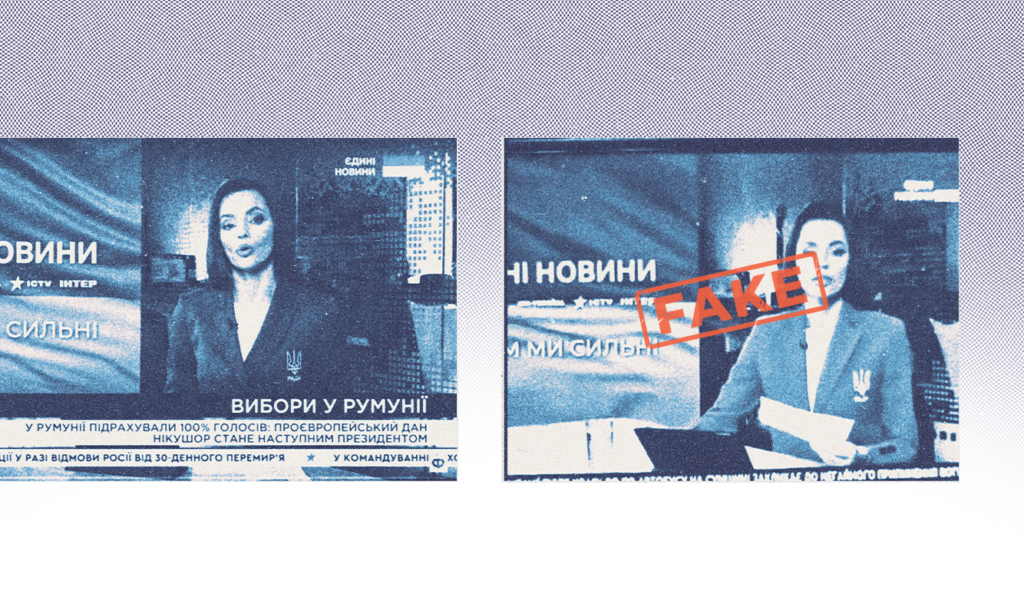
If such news hooks are lacking, Russian or pro-Russian information resources may use fake or manipulatively edited materials. For example, this happened to Olha Butko, the anchor of the United News National Telethon. Tthis case is described on the online map by “Women in Media.”
In May 2025, TikTok, YouTube, and Telegram channels “Rifmy i Panchi” published videos edited in a way to make it appear as if presenter Olha Butko called Russian president Vladimir Putin “the President of Ukraine” during the national telethon. The video uses manipulative text “Donald Trump is going to speak with president of Ukraine Vladimir Putin… Volodymyr Zelenskyy.” This video was made using AI.
Rifmy i Panchi (Rhymes and Punches) is a Russian resource that started back in 2011 as a group on the Russian social network Vkontakte (VK). The video was picked up and shared by Russian social networks and the Moskva24 media outlet with the message: “A Ukrainian news presenter made a mistake and called Putin the President of Ukraine. We are already worried about her.”
On May 19, 2025, Olha Butko was indeed the presenter of the United News telethon on the Rada TV channel, but she was wearing a brown jacket, not a red one, as in the fake video. The announcement about Donald Trump’s call was actually voiced by another presenter on the same day, Maksym Zborovskyi. Thus, the shared video is artificially generated (deepfake) and does not reflect real events.
This may indicate certain signs of a coordinated information amplification aimed at discrediting Ukrainian women journalists. Olha Butko’s case is described in detail in Women in Media’s joint research with UNESCO “When AI Turns Hostile: Gendered Threats Against Ukrainian Women Journalists.”
Beyond Individual Cases: Findings for Policy-Making
The documented cases of online attacks on Ukrainian women journalists indicate the presence of persistent and recurring practices that go beyond isolated incidents of digital violence. The combination of features—regularity, synchronization across platforms, use of similar narratives, and further scaling through media — indicates the possible coordination of such actions and their integration into broader informational influences.
The recorded cases involve a combination of several forms of harm: gender-based online violence (TFGBV), hate speech, defamatory statements, threats of physical and sexual violence, and the dissemination of personal data without consent (doxing). Such practices can create a “chilling effect” on the freedom of expression and professional activities of women journalists, and in some cases, additional risks to the safety of their families, particularly those in temporarily occupied territories.
In the context of the armed conflict, journalists are considered civilians under international humanitarian law, provided they do not take a direct part in hostilities. Online attacks against them do not in themselves constitute war crimes, but under certain conditions—in particular, if there is evidence of systematicity, targeting of civilians, or connection to an organized policy of persecution—they may be considered in the broader context of serious violations of international law. Such an assessment requires separate investigation and proof in accordance with established international standards.
The described practices may also correspond to individual elements of PSYOPs, in particular in cases where discrediting content is disseminated in a coordinated manner and further amplified through networks of accounts with signs of inauthentic or coordinated behavior or mass comments, as well as legitimized through inclusion in the propaganda agenda.
Taking into account international standards in the field of protecting journalists and combating violence, in particular the approaches of the Council of Europe reflected in Recommendation CM/Rec(2026)2, as well as Ukraine’s obligations in the context of European integration, there should be greater focus on expanding approaches to identification and legal assessment of crimes against journalists with regard to technology-facilitated gender-based violence (TFGBV).
In this context, it is advisable to further develop practices for documenting such cases, ensure interdepartmental cooperation between law enforcement agencies and the Temporary Investigative Commission of the Verkhovna Rada of Ukraine, as well as integrate a gender-sensitive approach into policies to counter online violence and disinformation.
Given the recorded cases, the TIC, law enforcement, and other national and international stakeholders should consider the following response vectors:
- Consider technology-facilitated gender-based violence (TFGBV) against women journalists not only a form of pressure on freedom of speech and the media but also a form of violation of journalists’ rights and crimes that require due documenting, legal assessment, and response, especially in cases when such attacks appear to be potentially linked to Russia, occupation administrations, or accounts which systemically disseminate pro-Russian narratives and demonstrate signs of coordinated or inauthentic behavior.
- Consider online attacks against women journalists not in isolation, but in the context of broader information campaigns, including in cases where the same or interconnected narratives are spread simultaneously across Telegram, YouTube, TikTok, X, and other platforms, as well as through Russian propaganda media or accounts that systematically broadcast pro-Russian narratives or demonstrate signs of coordinated or inauthentic behavior.
- Integrate a gender-sensitive approach into responses to crimes against journalists; in particular, address sexualized threats, gendered disinformation, doxing, threats to families, and risks to women journalists from temporarily occupied territories.
- Strengthen efforts to document digital attacks against women journalists, particularly by saving screenshots, URLs, publication dates, metadata, archived copies, and testimony of journalists targeted by online violence.
- Streamline interdepartmental coordination between the TIC, the National Police, the Cyber Police, the Prosecutor’s Office, and civil society organizations that document gender-based attacks (TFGBV) against women journalists.
Thus, gender-based online attacks against Ukrainian women journalists should be viewed not only as a digital security issue or isolated cases of hate speech but as a systemic form of pressure on freedom of speech, independent journalism, and women’s participation in public life during the war.
Their due documentation, legal assessment, and integration into the work of the TIC can serves as an important step towards overcoming impunity for crimes and violations against journalists when such crimes are potentially connected to Russia’s armed aggression, occupation administrations, or pro-Russian information networks.
Authors: Liza Kuzmenko, Oleksandra Horchynska, Women in Media NGO, members of the Expert Council under the Temporary Investigative Commission