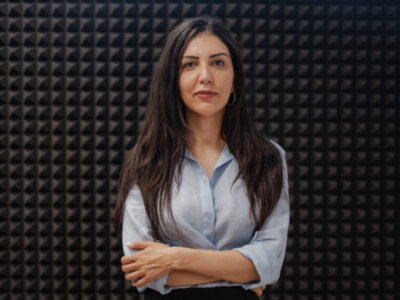
Sign language interpreters on television don’t just convey words — they convey emotion, intonation, and even music. In an interview with Women in Media, Tetiana Zhurkova, who heads the Sign Language Interpretation Department at Suspilne, talks about how this barely visible but critically important profession works, why it is dominated by women, and how she and her colleagues interpret the news, sports, and even Eurovision live.

Tetiana Zhurkova is head of the Sign Language Interpretation Department at Suspilne and director of the Sign Language Center at the Cultural Center of the Ukrainian Society of the Deaf (UTOG). She has worked as a sign language interpreter for 36 years, 20 of them in television.
Current guidelines on the proper use of inclusivity-related terms recommend using such terms as “person with a hearing impairment” instead of “deaf,” and “person with a visual impairment” or “person with total vision loss” instead of “blind.” Such recommendations are given, in particular, in the Barrier-Free Handbook.

Even so, throughout this interview Tetiana Zhurkova uses the term “deaf people.” She explains that this is how members of the community refer to themselves. Organizations both in Ukraine and globally still use the term — the European Union of the Deaf (EUD), the World Federation of the Deaf (WFD), the aforementioned UTOG, and others. The English equivalent is “Deaf.”
In her interview with Women in Media, Tetiana Zhurkova talks about the specifics of her profession, the gender breakdown within it, the accessibility of media content for people with hearing impairment in Ukraine, and the interpretation of songs and music at Eurovision.

Tell us about the specifics of your profession in the context of working on television: what does your work involve, what kind of content do you interpret?
What’s distinctive about sign language interpretation on television is that we work as simultaneous interpreters. Unlike, say, English-language interpreters on TV, who usually translate what a speaker says when they pause, we interpret continuously, the entire time the speaker is talking.
When it comes to musical events like Eurovision, in sign language we interpret the songs themselves — the lyrics and poetry — and the music as well. Much depends on each interpreter’s individual perception of a given song or performer.
Suspilne is the only national channel in Ukraine that provides full equality for Deaf viewers — our audience gets information at the same time hearing people do, from 7 a.m. to 10 p.m.
What kind of education and experience do you need to work in this specialization on television?

Sign language has just as many branches as any spoken language. There is news interpreting, current-affairs interpreting, literary, poetic, and interpreting for theatrical performances and concerts. These are very different specializations.
On television, the interpretation is live, and probably one of the most demanding kinds. You need to be at home with the terminology, and with the situation being reported on in a given story.
Education is a bit more complicated. Sign language interpretation as such — as a higher-education degree program — does not exist in Ukraine. There are individual programs, however. Ukraine University offers Ukrainian Sign Language courses through its branches, such as the Vinnytsia Social and Economic Institute and the Poltava branch. The program covers basic signs and the development of communication skills with Deaf people.
A few years ago, the Kyiv Professional College of Applied Sciences launched a degree program in Social Work and Counseling, Sign Language Interpreter, where students can earn a junior bachelor’s degree. That is a very important step in creating learning opportunities for our profession. I hope that in the future this specialization will develop into a full-fledged academic program. Both UTOG and the college have put a great deal of work into building this curriculum.

Tell us about your schedule and how a typical workday goes.
We work alternating weeks. There are 15 of us at Suspilne for the entire country. I am the head of the Sign Language Interpretation Department. We split the entire 7 a.m.-to-10 p.m. broadcast among ourselves. Some interpreters work daily, some work every other week, and some shifts work weekends.

In a 2025 piece on Suspilne, you said it was the only TV channel providing uninterrupted sign language interpretation even under the conditions of the full-scale war. Is that still the case?
If we’re talking specifically about uninterrupted interpretation, then yes, that’s still only Suspilne.
Other channels also do interpretation, but some of them only on selected content, not on everything. For example, I know for certain that the Kyiv channel does it, but its audience is primarily Kyiv viewers. I have also heard that some regional channels do this, that interpretation of selected programs was introduced on the DIM channel, and on Army TV. I have personally never come across programs with interpretation on those channels, though.
Accessibility matters. A Deaf person, just like a hearing person, should be able to choose: turn on the TV and watch one channel or another in sign language. But unfortunately, we don’t yet have that range of choice.

Very few TV channels in Ukraine today provide sign language interpretation of their content. I think Ukrainian channels really need to think harder about accessibility. Ukraine right now needs full information accessibility more than ever.
That said, viewers’ reactions to interpretation can vary widely. I have even seen YouTube comments saying things are fine but the person in the corner waving their hands is in the way. Some people don’t understand why this is needed at all and feel free to put it like that. It’s awful.

What are the specifics of interpreting different types of content at Suspilne — news programs, news, cultural events, perhaps children’s content?
When you’re interpreting children’s content, there has to be an element of acting. Sign language always involves a non-manual component — our face. It is through the face — through the visual image the Deaf person sees — that we convey not just the signs and the meaning but also the emotions and the speaker’s state of mind. So, professionalism in interpreting any given material is also about being able to distinguish between different interpretation specializations.
Over many years in this profession, I’ve come to understand that you need a comprehensive grasp of the subject — of the content, the topic you are interpreting, and, in the case of news, of the events themselves. Professionalism, practice, working on yourself, working on the material — that’s what produces the result.

What do you do to make sure the content is clear to you?
If it’s the news, we have the chance to prepare for the broadcast. We have our workstations, internet access, a laptop, and access to the news as it is being prepared, so we can read up if something is unclear. If a particular situation comes up, we can talk it through with colleagues or with journalists.
We have a wonderful news team that understands the importance of our work.
Tell us about the specifics of working during live broadcasts of major events like Eurovision or the Olympics.
Sports are a separate, demanding specialization, because sports news varies enormously. There are many sports, and a sign language interpreter has to grasp the specifics of each: the terminology, the names of key events, competitions, and so on. It’s like any profession: if you consider yourself a professional, you don’t stand still — you’re always learning something new.
As for Eurovision, the content there is entertainment — a bright, dynamic show, an entirely different emotional register. The songs are varied, the hosts are distinctive, and the music is interesting and also has to be conveyed. So it’s very engaging.
Another distinctive feature of Suspilne is our format for sign language interpretation at Eurovision — interpreters are shown full-screen so that viewers can see not only the hands and face but also the body and its movements.

If I understand correctly, at events like that you work as a team — some interpret the dialogue, others interpret the songs themselves. How does that work?
For Eurovision, yes, we work as a team. We have three interpreters who interpret the songs themselves and convey the music.
I mostly interpret the conversations, or, as we call them, talkings. Usually there are two hosts, and the viewer needs to be able to tell them apart through the way the sign language interpreter renders them. So I, as the interpreter, have to be a little different for each — I have to convey the personality and delivery of one host and then the other.
After all these years, I can sense a person’s emotion just by hearing them, and visually tell what state they are in. That’s part of the profession.
I once had a case — a very serious conversation — where the speaker was very restrained, but you could feel he was angry, because he was talking through clenched teeth. And I conveyed his emotion. Visually that state wasn’t apparent in him, so the Deaf person was getting information about his emotions through me — about the speaker’s mood, the tone he was setting. After him, another speaker came on, who spoke more calmly on the same topic, and I interpreted more calmly too. Deaf people don’t just understand the words, they also understand the emotions in which the information is delivered.

Can any sign language interpreter also interpret songs? Or is there additional qualification needed?
Not everyone can do it. To start with, I think you need courage, theatricality, and self-assurance. Those are qualities found not only in interpreters but also, in some ways, in actors. Although interpreters are, in a sense, also actors, since not everyone can step on stage and interpret in front of a live audience. You have to have nerve and confidence.
Interpreting songs is very difficult. When we interpret news and the news studio talkings at Suspilne, we sit during the work — and that’s a lot of hours, a heavy load. At Eurovision, my colleagues and I can switch off — one song, one interpreter. That gives you a chance to rest a little, to reset. And during those interpretations we stand. That’s what makes it possible to move in time with the music.
Who are there more of in your profession — women or men?
99 percent are women. I’ve thought about why that is. First, women are more empathetic than men. Second, the salaries in this field are not high — women accept that, men don’t always.

Interpreters used to be primarily so-called CODAs (Child of Deaf Adults) — hearing children of Deaf parents. They knew sign language from childhood and went into the profession because they understood the world and culture of Deaf people and served as a bridge between the Deaf and the hearing.
Sign language interpreting is a profession that calls for sensitivity. You have to understand the cultural nuances, you have to read someone’s psychological state.
A Deaf person lives among the hearing. But within the hearing world, they are invisible. Society doesn’t know sign language. When a person with hearing impairment needs to walk into a shop, buy something, and questions come up, no one knows sign language and no one can answer. Whichever way they turn, there’s a barrier. That leaves a mark on the lives of Deaf people.
Comparing Ukraine with other countries, are there places where society and services are better adapted for people with hearing impairment?
It varies by country. I know that in countries where sign language is an official state language, police officers, doctors, and social workers are required to know the basics. We don’t have anything like that. The most I’ve heard of are isolated cases — say, doctors starting to learn sign language so they can communicate with patients at a basic level.

How many young specialists do you see entering this profession now?
They have started coming in recently, because over the past few years sign language has been actively promoted in Ukraine, including through television. People have become interested in the profession.
Are there expectations in your work around appearance, emotionality, behavior? And do they differ for women and men?
There are rules of ethics and conduct for sign language interpreters — just as there are in any profession where you act as an intermediary between people.
As for differences for men and women, there aren’t any here. You need a neat appearance, an open face so the facial expressions can be read. Clothes have to be a single color, so that hands stand out clearly against the background. That’s why I have nothing in floral or polka-dot prints — hands need to read easily, and the viewer shouldn’t be distracted by bright colors and patterns.
I had a question for you about whether you’ve ever encountered sexism or discrimination because of your profession, but if you say women are the majority in this field, then perhaps you haven’t?
Sign language interpreters are people just like everyone else. No profession defines a person’s personality. Someone with the full set of qualities — ethical, emotional, professional — that we’d call good, is good in any profession. But people are different in any field.

Women in Media regularly documents online attacks on Ukrainian women in the media on its website. A few days ago, an attack of that kind, using AI, was carried out against the sign language interpreter at the Kyiv channel. Have you ever encountered anything like this?
No, this is the first case in Ukraine where someone tried to exploit the image of a sign language interpreter on television. There are so few of us. We all know one another, especially those of us working in media. And I’m very glad it didn’t blow up into a scandal that would have hurt the interpreter herself — that everyone immediately understood the video was fake.
I know it was very hard for the interpreter herself emotionally. There’s a video of her saying it’s fake, and I can see what state she’s in — angry, shaken. It’s deeply unpleasant and frightening for her. But I’m very glad our Deaf community didn’t fall for the fake at all. There’s trust in interpreters, and that’s valuable.
How visible and valued, in your view, is your work — both by audiences and within the media industry itself?
As for the media industry itself, I wouldn’t say the profession is valued — you can see that from how few channels organize sign language interpretation of their content. In general, it all comes down to the people working in the field, as it does anywhere. It depends on how much a person grasps the relevance and necessity of this kind of interpretation, how willing they are to expand and improve their product.

I know that individual projects also organize sign language interpretation. Atlas Weekend (now Atlas Festival), for example, has been interpreting music since 2019.
Yes, they’ve been doing this for several years — interpretation happens right there, on site, and that’s wonderful.
It’s important to understand that British or American Sign Language is a different language, just as spoken languages are all different. To interpret English-language songs, the festival’s organizers brought in foreign interpreters with extensive experience in this work. One of them is American Amber Galloway Gallego from Texas. She is the author of a system for adapting music for Deaf and hard-of-hearing audiences. Beyond interpreting at the festival, she also shared her experience with our interpreters and showed them how she does it.
In Ukraine, by the way, there is also the Raiduha Theater of Mime and Sign Language, but that project has a slightly different focus.
What would you say to young women who are now choosing this profession?
That it will be hard. Although if you do any job professionally, it’s never simple or easy.

The only time it can be easy is if your profession is your hobby. For example, when it comes to creative work — artists, crafters, people who create something with their hands. Lucky are those who get paid for their hobby. But any profession, if you want to be a professional in it, demands work. Above all, on yourself.
Author: Oleksandra Horchynska
Editor: Liza Kuzmenko
Photo: Valia Polishchuk, Women in Media
This material was made possible by International Media Support (IMS) as part of the project “United for Equality in the Media: Promoting Gender Equality Through Cooperation Between Public Organizations, Media, and Authorities” implemented by the NGO “Women in Media.” Any views expressed here belong to the authors and do not necessarily reflect those of the IMS.