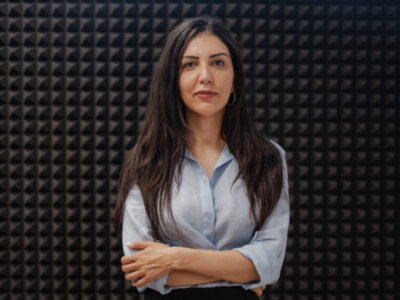
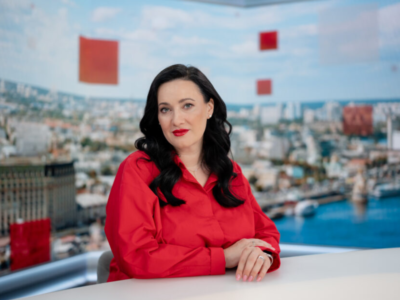
Women in Media is launching a series of interviews with Ukrainian female military correspondents. Our first interview features Aliona Yatsyna, a military reporter and co-founder of the online publication Kordon.Media from the Sumy region. She shares why the events in her region, despite constant shelling, often go underreported by journalists, reflects on her social roles, and recalls moments when she faced gender bias in her work.

Choice without choice, personal roles and war journalism
Journalist and war veteran Aliona Yatsyna was involved in investigative journalism before the full-scale war began. Later, she worked at the Sumy Regional State Administration, which became the Regional Military Administration after the invasion. She describes the moment she began covering the war as a choice without a choice:
“Now, the whole world is open to Ukrainian women. My entire family — the female members — have been scattered across the globe because of the war. I am a mother of two, and my children now live in Poland. I can’t fully explain why I stayed here; there’s no logical reason. I’ve tried to leave — to join my relatives, to be with my mother, or to visit my children in Poland. But after a few days, I always feel the need to return home.”

When asked whether it’s difficult to balance motherhood with a profession that carries increased risks to life and health, Aliona Yatsyna responds that she and the father of her children share equal responsibility — 50/50. She emphasizes that motherhood is just one of her roles, and she’s not willing to give up the others for its sake.
“I gave birth to my children, I love them, and I give them everything I can as a mother. But that doesn’t erase my identity as a person. I want to live my life — I have hobbies, different interests, friends, and work. I also want to show this to my children: I brought them into this world so they could live their own lives — in love, as happily and as fulfilled as possible. I can’t say it’s an easy choice, but I promised myself to choose myself,” Aliona Yatsyna explains.
During her first year at the administration, she served as the press officer for the Sumy Regional Military Administration. She worked with both foreign and local journalists who came to the Sumy region: “I knew my region well before, and now I know every dog in every village. The border region has become very dear to me. I realized that, in terms of media coverage, no one was interested in Sumy. But I couldn’t abandon it.”
Later, she and three colleagues founded Kordon.Media, which is entirely focused on life in the Sumy region as a border area. The website publishes local news, investigations, reports, and special projects, with nearly everything centered on the war and its direct consequences. The interlocutor is convinced that in Ukraine today, it is impossible to engage in journalism that does not relate to the war. Regardless of the field — whether it’s economics, culture, lifestyle, or finance — journalists will inevitably have to address the impacts of war.
“Personally, I rarely consume the type of content I create myself. I probably see too much of it in my life, so I don’t want to see any more on screen. However, I can’t create anything light or detached from the war or reality — I physically can’t do it,” shares Aliona Yatsyna. “If you enter journalism now, whether as a student or by switching from another profession, you must understand that you are choosing war journalism for life. With our generation and the next, the war will be a constant presence in our lives.”
“We risk losing journalism as a profession”
The work of a journalist during the war involves significant risks to life and health. Often, these consequences can have a long-term perspective; they may not be immediately felt, but that doesn’t mean they don’t exist.
Aliona Yatsyna recalls an incident when she and her colleagues while working at combat positions, came under a chemical attack by Russian forces and inhaled gas. None of the available health insurance plans cover such cases, not even the insurance provided for military personnel during work trips.
“In a month, I recovered my bronchial tubes and airways, which had been damaged, but it turned out that the effects were long-lasting. My health has been impacted by changes in my blood composition. Now, I am undergoing long-term treatment that will last at least two years, and none of the insurance plans will cover it. This condition affects all aspects of my body and, of course, my entire life,” Aliona Yatsyna shares about her experience.

She describes the psychological aspects as a “time bomb”: constant stress impacts all bodily functions, which can later manifest as failures in various systems, as shown by medical analyses. This is why regular medical check-ups — preventive examinations — are crucial. However, media workers often neglect this and skip doctor visits due to a lack of time:
“We are at war every day, and you keep postponing check-ups, thinking, “Yes, I’ll do it.” Or you make an appointment for that morning, but at night a barrage of drones comes in, and you go to work. The schedule gets disrupted, and you end up postponing the appointment for the tenth time. Then you think, “Oh, maybe some other time.”
This year, Aliona Yatsyna became one of the participants in the “Take Care of Your Health” program by Women in Media, through which she received funding for preventive health examinations and check-ups. The clear deadline for reporting on the spent funds, she emphasizes, was beneficial— it prevented her from putting it off any longer. As part of the program, she had the opportunity not only to receive examinations but also to undergo surgery.
“Doctors say that I recognized the problem in time. If I had delayed it for a few months, they wouldn’t have guaranteed the positive outcome I have now,” says Aliona Yatsyna.
Caring for the mental health of employees is one of the main principles of Kordon.Media’s work. The media organization strives to invest in not only psychologists but also retreats and team or personal trips. The interlocutor adds: I hope foreign donors recognize the importance of such expenses, and that media editors allocate some of their attention and finances to aspects related to the health of their colleagues:
“It’s not that we have a staffing crisis; we are absolutely f**ked up — I can’t find other words to express it. We risk losing the few remaining journalists we haven’t already lost many are burned out, and others are relying on pills. A lot of people say that as soon as the war is over, they will leave it all behind — they just can’t do that now because it feels like an army. The exhaustion is at an all-time high. If we — donors, editors, and public organizations that care for the media — don’t sound the alarm and pay attention to this issue, we risk losing our field altogether,” says Aliona Yatsyna.
Why do events in the Sumy region remain underreported?
While the full-scale war continues, the Russian army regularly attacks the Sumy region with missiles, anti-aircraft missiles, Shaheds, and long-range artillery. However, the scale of these shellings and their consequences for the local population and infrastructure are not adequately covered in the media, especially compared to the Donetsk, Luhansk, and southern regions of the country. One reason for this lack of coverage is the opacity of local authorities, says Aliona Yatsyna:
“For two and a half years, no event coverage algorithm has been worked out at all. Currently, the Sumy Regional Military Administration is headed by a military pensioner born in 1958 [Volodymyr Artiukh]. He received the rank of general from the Yanukovych-era defense minister, Pavlo Lebedev, and retired in 2012. His approach to information is such that he believes no one should know anything. Additionally, there are no legal regulations requiring him, or the RMA in general, to provide coverage of events, official comments, data, or summaries.”
On the other hand, the information provided by the RMA lacks complete data on the real consequences of the Russian attacks. According to representatives of the local authorities, “if the Russians know, they will attack even more.”
“That’s not true. The Sumy region shares a 563 km border with Russia, and Russian observation drones penetrate deeply into the area. They can see what is happening here and where they are striking in real-time. We often see this information on Russian Telegram channels just 15 minutes after any attack occurs. The concealment of information by official bodies directly harms the overall situation,” adds Aliona Yatsyna.
That is why local media bear a significant responsibility for disseminating information about events in the Sumy region. For example, Kordon.Media has hired a communications officer whose responsibilities include distributing materials produced by the media’s journalists. Maximizing publicity is crucial.
“You should be at home cooking dinner”
Aliona Yatsyna and I also discuss whether the female journalists at her media frequently encounter negative comments, hate, and criticism. She shares her perspective: when she sees non-constructive remarks, such as personal insults, she often blocks those users immediately. Typically, she does not read all the comments on her materials.
The journalist discusses incidents involving her female colleagues. For instance, Olesia Borovyk, the co-founder and editor-in-chief of Kordon.Media became a suspect in a Russian FSB investigation due to her reports from Sudzhi in the Kursk region. Also, Olesia Prokopenko, who serves as a military officer and editor, and works directly with a film crew in combat conditions, has faced a wave of hate because of her appearance.
“By nature, she has quite plump lips, but she decided to enhance them a little. Eighty percent of the comments under her videos focused on her lips. People in the comments were divided into two camps: some argued that it didn’t matter what kind of lips she had, as they were beautiful regardless, while others continued to hate her for it. In the end, six months later, she underwent a cosmetic procedure to reduce the size of her lips — this is a consequence of online bullying,” Aliona Yatsyna recalls.
They often face gender bias directly while working in the field. For instance, they frequently hear phrases like, “You are girls. Why are you here? You should be at home.” Despite the fact that the majority of military correspondents at Kordon.Media are women.

“For a long time, the liaison service of Civil-Military Cooperation in Sumy was led by a terrible chief who said, “You girls should be cooking dinner for the men at home, not going out to film the consequences [of the shelling].” And he really didn’t let us in,” shares Aliona Yatsyna. “We even reported him to the police, but that didn’t change his attitude. Later, we spoke to the commander, and he was removed from the department responsible for communication with journalists.”
At the same time, the military correspondent notes that her experience working with the military reveals many contrasting examples. For instance, in combat positions, there are no concessions for being women; instead, there is respect, understanding, cooperation, and camaraderie. While care and protection are often felt, they are not expressed directly.
There are practically no men at Kordon.Media, largely due to mobilization. Those who remain are reserved by the central TV channels with which the editorial office cooperates and are engaged in physically demanding work. Aliona Yatsyna explains that some tasks, particularly those requiring physical exertion, are often better suited for men. This doesn’t mean women can’t handle them, but if there’s a choice, it’s often preferable to ask a man for assistance. She cites fixing a car and changing a tire as examples, noting that women on staff can also perform these tasks independently.
After the war, Aliona Yatsyna aims to restore the gender balance in the editorial office. According to her observations, the current imbalance negatively affects the psycho-emotional state of both male and female employees.
This material was made possible by the New Democracy Fund (NDF) and International Media Support (IMS) as part of the project “Breaking Down Barriers: Bringing together public organizations, media, and state bodies to achieve gender equality in the media space of Ukraine,” implemented by the NGO “Women in Media.” Any views expressed here belong to the authors and do not necessarily reflect those of NDF or IMS.