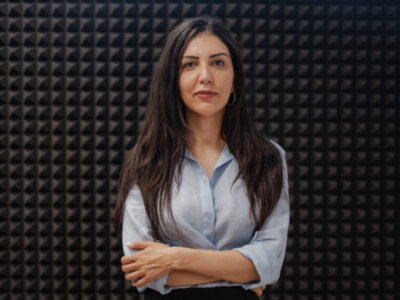
Yevheniia Kravchuk is a Member of Parliament from the Servant of the People party, Deputy Chair of the Parliamentary Committee on Humanitarian and Information Policy, and a member of Ukraine’s permanent delegation to the Parliamentary Assembly of the Council of Europe. In January 2023, she was elected Chairperson of the PACE Committee on Culture, Science, Education, and Media.
In October 2024, she became Vice-President of the European political party Alliance of Liberals and Democrats for Europe (ALDE).

In this interview with Women in Media, Yevheniia Kravchuk speaks about how she manages to draw global attention to Ukrainian journalists held in Russian captivity and reflects on women’s leadership during wartime.
The Parliamentary Assembly of the Council of Europe adopted a resolution titled “Journalists matter: the need to step up efforts to liberate Ukrainian journalists held in captivity by the Russian Federation.” Do representatives of other delegations in PACE support the Ukrainian initiative?
This is the first PACE resolution focusing specifically on Ukrainian journalists. The issue of press freedom ran like a red thread through the Assembly’s autumn session. Ukrainian journalist and human rights defender Maksym Butkevych received the 2025 Václav Havel Human Rights Prize. Then came the mentioned resolution “Journalists Matter” and the debates around it.
It was fantastic that Vladyslav Yesypenko, a freelance correspondent for Radio Liberty’s Crimean service who had been illegally imprisoned by Russia in Crimea for four years, and Dmytro Khyliuk, a UNIAN journalist who spent three years in captivity, were able to join us. This resolution actually began as a side event during the PACE June 2024 session, where Yesypenko’s wife, Kateryna, and Khiliuk’s friend and fellow journalist, Nataliia Bohuta, testified. At that time, the situation looked very grim.
Together with the Institute of Mass Information and the Council of Europe, within the project “Safeguarding Freedom of Expression and Freedom of the Media in Ukraine – Phase II” (SFEM-UA), we opened the Press in Detention exhibition to show the faces of journalists still held captive.
Of course, we also recalled the story of Viktoria Roshchyna, killed by Russia — tragically, she never returned home to Ukraine alive. Yet she will forever remain a symbol of free journalism and a reminder of why journalists are treated as a distinct category, including by the European Court of Human Rights. They consciously choose a professional path that may cost them imprisonment or death. Roshchyna went to the occupied territories because she wanted to investigate torture chambers in the Zaporizhzhia region. She had a choice — to go or not to go — and still went, because it was her job.
In occupied Crimea, a phenomenon of citizen journalism emerged — a conscious choice made by local residents. Without being professional reporters, they began attending court hearings and covering so-called extremism cases.
The key point is to keep attention on this issue, because many people know about prisoners of war but far fewer are aware of the fate of civilian hostages. And here lies a serious problem: civilians cannot be exchanged. Every release is a separate track of negotiations. Some detainees face fake terrorism charges; others are held incommunicado, meaning without any formal accusations.


It’s clear that Russia won’t comply with the resolution overnight or free all civilian hostages immediately. But it’s important that the document mentions what types of sanctions should still be imposed. I also proposed a mentorship format — that parliamentarians in different countries take a case of a journalist in captivity and speak publicly about them. For example, when we were discussing the resolution, Austrian MP Petra Bayr, Chair of the Foreign Affairs Committee and very likely the next PACE President, agreed to take on the case of Iryna Danylovych and dedicated her speech to her.
PACE resolutions usually take around two years to prepare. This one went through a fast track procedure because the issue is so urgent and important. From the initial idea to the vote, only a year and three months passed — an exceptionally fast pace by PACE standards, though for us, it felt like an eternity.
I’m now working on a new resolution, “Combating Gender Stereotypes in the Media,” which I hope to complete around June next year. It explores gender-based stereotypes in the media and on social platforms, and how they affect our everyday lives. Why are media, films, and advertising so important? Because they project social roles that shape behavior in real life. We see that social platforms are increasingly influential, especially on teenagers. As part of this work, I had an interesting trip to Ireland. Researchers at the University of Dublin conducted a study showing that when, for example, a boy registers on a social media platform like TikTok, the algorithm begins bombarding him with misogynistic and sexist content. As a result, children and teenagers start to believe that such behavior is normal. Then we see a growing conservative trend among young people — the idea that women should never work, that they belong at home, in the kitchen. But where does that mindset come from?

How has the war affected the visibility of women in the media — politicians, soldiers, community leaders?
First of all, I believe Ukrainian society is not deeply patriarchal or stereotypical and doesn’t have a particularly negative attitude toward women in various roles. I can say this because I have something to compare it with. We can observe certain trends in other countries where references to gender equality are now being removed from official documents. Meanwhile, in Ukraine, we’ve appointed a woman as Prime Minister. Think about this: in Switzerland, women only gained the right to vote at the federal level in 1971. In some cantons, it happened much later — up to 1991.
The world can look up to Ukraine. We can show others how many women we have, for example, in top management positions across media companies.
When it comes to politics, the percentage of women MPs in Ukraine is still relatively low, but it’s the highest since independence. Comparing 2019 and 2025, we can see that, proportionally, more women than men have stepped down from their mandates. Still, men remain the majority in absolute numbers. Naturally, this also affects who we see on television.
We recently recorded an interview with Maksym Onopriienko, a member of the National Council on Television and Radio Broadcasting. He mentioned that amendments to the Law on Media are awaiting their second reading in Parliament. What changes are expected, when might they be considered, and what are the chances of their adoption?
Just before our conversation, we had a Zoom meeting of our negotiation group. We agreed to take on a commitment to accelerate the integration of European legislation into Ukrainian law under Chapter 10 of the EU negotiation framework — Digital Transformation and Media. The Law on Media that we adopted already brings us very close to alignment, as do the directives we’ve implemented, including the Audiovisual Media Services Directive (AVMSD). The amendments to the Law on Media — Draft Law No. 12111 — are mentioned three times in this negotiation position, along with our obligation to adopt them. However, there’s another issue: the opening and closing of negotiation clusters are currently blocked by Hungary. We could move much faster across all clusters if not for that obstacle.
Incidentally, we’re also preparing amendments to the Law on Advertising, which should help the media sector by liberalizing the advertising market. By the end of 2025, we’ll aim to bring this draft law to the Parliament’s agenda, possibly even as part of a package together with the amendments to the Law on Media.


How will these amendments affect local media, which often work under difficult conditions and with limited resources?
Security concerns are the same for journalists and non-journalists alike. But journalists working in combat zones risk their lives no less than soldiers do.
That said, the Law on Media is about the industry itself — about the rules under which media operate — and those rules are the same for everyone.
One of the key achievements of this law is that we finally brought the internet into the legal field as part of the media ecosystem. Since audiences are increasingly moving online, it’s important to regulate not only television and radio broadcasting but also online platforms.
As for regional media, there are clear trends, especially the fact that the traditional business model of print outlets no longer works. It may still survive for glossy magazines that keep a printed version as part of their brand identity. A publication like Vogue, for example, will always have a print issue, though with a smaller circulation. But in reality, it’s not profitable: they don’t earn from it — they invest their own money just to keep it printed. At the same time, we’re seeing growing audience interest in regional news. This, in turn, draws more attention from advertisers — even if local ones. Our task now is to liberalize advertising for all registered media outlets in Ukraine, so advertisers can easily choose to work with them.
Ultimately, we should move toward a model of content production support. Grants that can be used for various purposes. This means funding the kind of content the state considers worth subsidizing — for example, children’s programs or segments about veteran-owned businesses. If the state becomes a customer and is ready to pay for such content, it will reduce the financial burden on media outlets, including local ones.
Next year, we’re expecting the launch of the “1,000 Hours of Ukrainian Content” project by the Ministry of Culture. It’s a targeted support program — effectively, a commissioning mechanism for those capable of producing different types of content. It will also include translating into Ukrainian content that currently has no Ukrainian version but is still widely consumed — for example, by teenagers who play video games. During the committee discussions, the idea emerged that popular games should be translated into Ukrainian. If a developer isn’t ready to do a high-quality translation, the state should provide a subsidy. This will help create a Ukrainian-language environment that’s seen as modern and attractive. A great example is S.T.A.L.K.E.R. 2, which features only Ukrainian and English voiceovers.

You’ve been a strong advocate for making Parliament more open to the media. How transparent do you think the Verkhovna Rada is today? And how do you respond to claims that transparency has decreased since the full-scale invasion began?
In my opinion, among all branches of government in Ukraine, the Verkhovna Rada is the most open. When was the last time, for example, you attended a Cabinet of Ministers meeting? Yes, the President holds off-the-record meetings and press conferences with journalists, but when it comes to regular direct access, Parliament is at the top.
Journalists are working, and online broadcasts of parliamentary sessions have resumed. There were debates about whether to restore official livestreams and lift restrictions preventing journalists from reporting on sessions in real time. But since some MPs already run their own livestreams from the chamber, I’m convinced journalists should also have the opportunity to do their job.
In your view, is there a need for a gender quota in media supervisory or regulatory bodies, such as the National Council or Suspilne?
First, let’s remind readers how the National Council is formed. It’s a collegial body with eight members: four appointed by the President of Ukraine and four by Parliament. We can’t tell the President whom to appoint — whether it should be two men and two women — because professional qualifications must come first.
The same applies to Parliament’s appointments: professional competence is the key criterion. However, we’ve found a compromise solution that doesn’t interfere with constitutional powers. Imagine two candidates — a man and a woman — both equally qualified and receiving the same number of votes. Our proposed amendment states that in such a case, preference should go to the gender that is underrepresented in the current composition. It doesn’t have to be a woman — but, of course, it usually is.
If we look at the quotas in the Electoral Code, it stipulates that each group of five candidates must maintain a ratio of at least 2:3 (the current version of the Electoral Code stipulates that every five must include at least two men and two women, Ed.). Let’s recall that when gender quotas were first introduced at the local level during the 2015 elections, all the women were placed at the very end of the lists.
In Ukraine’s professional media community, there’s an ongoing discussion about whether the areas of culture and strategic communications should be separated at the ministerial level. Is this purely an issue of ministry structure, or does it go deeper — to how the state’s humanitarian policy should function?
When the words “strategic communications” were added to the ministry’s title, it created a somewhat misleading narrative about what strategic communications actually are. Because they’re not about policymaking — they’re about how communication and coordination occur between different government bodies and structures. In other words, information policy and strategic communications are two very different things.
Strategic communications should have been placed under the Cabinet of Ministers from the start, since, by definition, one ministry cannot coordinate the others.

In December 2023, you took part in the presentation of the Gender Profile of Ukrainian Media — a study conducted by Women in Media in cooperation with the National Council. Why is this topic important to you as a Member of Parliament?
First of all, because we need to understand the data — what’s really happening in this sphere. The fact that we have near gender parity in management positions is more of an exception among Council of Europe member states, even compared to some of the more advanced EU countries. Overall, Ukraine demonstrates strong results.
It’s important not only to see who appears on screen, but also who works behind the scenes. During hearings we held together with the PACE Committee on Equality and Non-Discrimination, we invited the leadership of the European Audiovisual Observatory, which collects such data across Council of Europe countries. Their research showed how the gender of those working off-screen — men or women — affects what appears on-screen. In the vast majority of cases, film directors are men, as are lead producers. This results in what’s known as the male gaze — the stereotypical depiction of women in film, art, and visual media from a male perspective. It influences everything: casting, storytelling, and framing. That’s why it’s so important to encourage women to enter all kinds of media professions — not only as presenters or journalists.
The Vice President of the European Commission, formerly the Prime Minister of Estonia, once shared her experience of this bias: during her premiership, she noticed that most political journalists from Estonia’s leading media outlets were men. During interviews, they often treated her not as a politician, but as a woman — asking about her clothes, her skirts, and her dresses.
Take, for example, the meeting between the First Ladies of Ukraine and the United States — Olena Zelenska and Melania Trump. Nobody paid attention to what they discussed; everyone was busy talking about the Ukrainian First Lady’s trousers. Of course, there was a rare opposite example — when former U.S. President Donald Trump commented on the Ukrainian President’s clothing — but that’s an exception. Usually, when media discuss a politician’s appearance, it’s because she’s a woman.
What does freedom of speech mean to you in a country at war?
If we compare Ukraine with Israel, we can say that, for us, freedom of speech has not significantly changed since the war began. Yes, there are certain restrictions for security reasons — for example, not reporting the locations of missile strikes — but journalists still work at those sites and have access to them. There’s no taboo on criticizing the government.
At the same time, freedom of speech during wartime also means responsibility. The emotional climate in society, especially amid Russia’s information attacks, is fragile, and the media play a crucial role in maintaining public resilience. I understand that for many outlets, clickbait and audience reach are important, but one must not cross ethical lines just to boost readership. Quality media cannot be run the same way as anonymous Telegram channels.
Overall, Ukraine continues to function much as it did before the war: with press conferences, live broadcasts, and briefings where journalists can question MPs, ministers, and the president. The only real difference is that evening talk shows have disappeared.

What does women’s leadership mean to you today, at a time when society is fighting a war and, at the same time, forming new rules for its future?
To be honest, the phrase “women’s leadership” sounds a bit overused to me.
To be a leader, a woman has to do more than a man. To be better, to know more, to achieve more, to wake up earlier, and to go to bed later. But if a woman wants to do that, she must be supported in every possible way. And I don’t just mean support from other women — we can’t live in a bubble; we have to step outside of it.
I am the Vice President of the Alliance of Liberals and Democrats for Europe (ALDE). In May 2025, our party helped organize a Women’s Leadership Forum in Kyiv during wartime. We’re now preparing a similar event with our Danish partners. These forums focus on specific topics, such as security or IT, highlighting the visibility, contributions, and work of women in these sectors. It’s not only about discussing problems but also about showcasing positive examples.
Another vital component is reconstruction, and it must also be viewed through a gender lens. Because if we rebuild factories but not kindergartens, women’s leadership will end where a working mother has no one to leave her child with.
By Oleksandra Horchynska, Women in Media
Photo credit: Valentyn Kuzan, Women in Media
This material was made possible by International Media Support (IMS) as part of the project “United for Equality in the Media: Promoting Gender Equality Through Cooperation Between Public Organizations, Media, and Authorities” implemented by the NGO “Women in Media.” Any views expressed here belong to the authors and do not necessarily reflect those of the IMS.