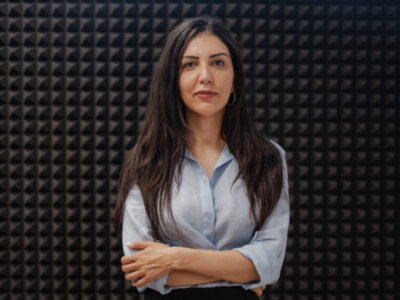
Maksym Onopriienko is the Member of the National Council of Ukraine on Television and Radio Broadcasting He is responsible for exercising the regulator’s supervisory and analytical powers, including media monitoring and analytical projects. Among them, partnership initiatives such as the Gender Profile of Ukrainian Media study conducted jointly with Women in Media. He also oversees the Council’s regional offices and focuses on broadcasting in frontline and border territories.
In an interview with Women in Media, Maksym Onopriienko talks about trends in media registration during the full-scale war, the ethical standards of modern journalism, and the growing interest in Ukrainian content in the occupied territories.

Have the National Council’s priorities in media regulation changed during the war? What are the most pressing challenges now?
The biggest challenge is security. Many media outlets from frontline and border regions have relocated. Quite a few were forced to suspend their operations altogether. Some have lost their broadcasting licenses and equipment because the Russians seized Ukraine’s radio frequency resources in the temporarily occupied territories.
Speaking of regulation, I would not say that the National Council’s priorities have changed — rather, they have become more responsive to wartime conditions. We now take into account the realities of frontline and border regions. To that end, we have simplified registration procedures and allowed broadcasters to operate not under licenses but through temporary permits, which are free of charge. We also try to connect them with partners so they can continue their work.
Of course, the most important development during the full-scale war has been the adoption of the Law on Media, which came into force on March 31, 2023. At its core, this law is much more lenient and liberal toward the industry. It allows for greater flexibility — for the regulator as well. I would therefore say that regulation itself has also become more flexible and adaptive.
How many media outlets has the National Council registered?
As of September 23, 2025, the Register has just over 3,000 entities operating around 6,500 media outlets. The total number of valid licenses, including those suspended, is 797. Meanwhile, the total number of registered media, services, and foreign linear media stands at 5,562. Among them: 3,895 print media outlets, 1,057 online media outlets, 312 audiovisual service providers, 2 video-sharing platform providers, and 42 registered foreign linear media.
How many of them are Telegram channels registered as media?
Out of the 1,057 registered online media outlets, only 86 are Telegram channels. So, not that many. The law clearly defines what constitutes media, and by their nature, Telegram channels fit this definition. The only issue is that registration of online media under the Law on Media is voluntary, so many are in no rush to register. However, the Law on Advertising has pushed some of them to act.

What trends do you observe in the registration of online resources as media?
If we look at trends in online media registration, the first wave came in 2023, right after the Law on Media came into force. Then there was a brief slowdown, and now, in 2025, we are seeing a new wave. For example, during the first nine months of 2023, we registered 204 online media outlets. In 2024, the number rose to 412, and in 2025, as of now, we have already registered 452.
This increase is due to the new provisions of the Law on Advertising, which regulate the advertising of gambling and betting. The law clearly stipulates that such advertisements may only appear on registered online platforms. As a result, many sports-related resources have actively begun registering with the National Council.
The law also requires a co-regulation body to develop criteria defining which platforms qualify as online media and which do not. Together with this co-regulation body, we are now developing these criteria to prevent the registration of overtly gambling-related websites.
Do channels like Trukha (an anonymous Telegram channel that topped popularity rankings in 2023–2024 — Ed.) register as media? What about popular bloggers such as Ihor Lachenkov, known as Lachen?
Channels like Trukha are not registered. At one event, during a public talk with the head of the National Council, Olha Herasymiuk, Trukha’s self-proclaimed owner, Maksym Lavrynenko, said they would definitely register. However, as of today, that has not yet happened.
Lachen is also not registered. However, we do have registrations for other online media, such as interviewer Ramina Eshakzai’s YouTube channel. Sports bloggers Ihor Tsyhanyk and Viktor Vatsko are registered, as is Yevhen Klopotenko’s channel. But, of course, I would not call this a widespread trend.

Does the National Council have any influence over media YouTube channels? And does it plan to expand its tools for monitoring content on platforms that are not traditional media?
Yes, we do monitor platforms that are not considered classical media, within the framework of our media law. For us, the primary indicator is whether a broadcaster has a license or registration. If a radio station is licensed or registered for FM broadcasting, we monitor its FM output. If that same radio station has a YouTube channel but is not registered as online media, we still have mechanisms to respond. So, if our monitoring records complaints or violations of the law, we take action.
When it comes to platforms like YouTube more broadly, the Law on Media allows the National Council to sign memorandums with video-sharing platforms. However, this is only an option, not an obligation, and that is the problem. The platforms are generally unwilling to sign cooperation agreements, especially with state institutions. We met with representatives of all major platforms, including Meta and YouTube. Their response is always the same: “We have community guidelines.” If content violates those guidelines, a complaint must be filed. There is a standard complaint form for users and a separate process for government agencies. We have had cases where we submitted such complaints and the platforms did respond, restricting access to the content, but not promptly. By the time they react, the content may already have gathered thousands of views.
We will not make real progress in this area until we implement European legislation. The European Union already has standards known as the Digital Services Act (DSA) and other related civil acts that regulate video-sharing platforms and cooperation with them. Ukraine is expected to implement the DSA as part of its path toward EU membership, but this is an ongoing process.

Could you elaborate on this? What role does the National Council see for itself in implementing European standards such as the Digital Services Act?
Ukraine does not yet have equivalent legislation, but we are already analyzing the DSA and adapting relevant mechanisms. These include ensuring transparency of political advertising to prevent manipulation during electoral processes, particularly given Russia’s information influence, and countering fake accounts and bots used to spread disinformation. We also focus on strengthening Ukrainians’ resilience to disinformation through media literacy projects and educational initiatives, as well as protecting users by providing clear mechanisms for reporting illegal content.
Separately, we are exploring the possibility of integrating Ukraine’s List of Persons Posing a Threat to National Security as a tool to counter disinformation. There is a proposal to our European counterparts to consider adapting this mechanism for use within the EU’s online platform regulation framework, or to legitimize its application in Ukraine under the DSA. This list has proven to be effective and fully aligns with Articles 16 and 34 of the DSA, which deal with the removal of illegal content and combating disinformation that threatens security.

For a long time, Ukraine has debated whether access to Telegram should be restricted. What is your opinion on this?
From a technical standpoint, it is possible, just as Russian resources such as VKontakte and Odnoklassniki were once blocked. From a practical perspective, however, Telegram has become a widespread communication tool in Ukraine. The National Council does not have the authority to close or ban an existing platform. Moreover, in my opinion, this should be a joint approach by state institutions — both to offer an alternative and to conduct educational outreach among audiences, forming a shared stance toward the platform.
In my conviction, there must at least be mechanisms and opportunities to regulate Telegram. At the National Council, we are certain: the rules should be the same for everyone, both for what is now called traditional media, such as television and radio, and for online resources like Telegram channels. In my conviction, there must at least be mechanisms and opportunities to regulate Telegram. At the National Council, we are certain: the rules should be the same for everyone, both for what is now called traditional media, such as television and radio, and for online resources like Telegram channels. In my conviction, there must at least be mechanisms and opportunities to regulate Telegram. At the National Council, we are certain: the rules should be the same for everyone, both for what is now called traditional media, such as television and radio, and for online resources like Telegram channels. If media groups, TV channels, and radio stations are required to disclose their ownership structure, Telegram channels should do the same. All relevant regulatory criteria should apply equally to all.
Women in Media documents cases of online violence against Ukrainian female journalists on its website. One example is the ongoing discrediting campaign against journalist Olena Mudra, which has lasted several months. While investigating those behind such attacks, we found that the National Council has limited leverage in these cases. When sources spreading disinformation are not registered as media, it is nearly impossible to regulate them. What do you think about this?
This is a complex issue. First, the law does not grant the National Council any authority in such cases. Our legislation does not currently define concepts such as hate speech or disinformation — and that is part of the problem.
Speaking specifically about the case of journalist Olena Mudra: after she filed complaints with the police, a criminal investigation was opened. We cooperated with law enforcement — they requested our monitoring data, which we provided and which were added to the case materials. However, we are not authorized to conduct investigations or respond directly to such incidents. Under current legislation, matters related to the protection of honor and reputation must be resolved through the courts.
How could the National Council expand its powers regarding pressure and influence from anonymous online resources? What would be required for that?
Under the Law on Media, the National Council may issue decisions in such cases, but technical blocking is carried out not by us, but by the National Commission for the State Regulation of Electronic Communications (NCEC).
Amendments to the Law on Media are now awaiting a second reading in Parliament. They include improvements to the blocking mechanism, particularly expanding the NCEC’s capabilities. Once these amendments are adopted, they will help us, in particular, Article 116 of the Law on Media, which provides for blocking anonymous online resources, will align with the NCEC’s powers. This will allow for faster practical implementation of these provisions.
At the same time, this is also a practical issue: once we have applied these mechanisms several times in practice, we will better see the gaps.
Are there plans to create specific rules for media that work with AI-generated content?
As of now, there are no legal restrictions or regulations on this matter. The only relevant document is a set of Guidelines for Media, Advertising, and Copyright Protection, jointly developed by the National Council, the Ministry of Digital Transformation, and the NGO Digital Security Lab. These recommendations are publicly available.
The National Council’s position is that media organizations should adopt internal editorial policies governing the use of AI. Many outlets are already doing so — for example, Ukrainska Pravda has introduced such a policy.
We monitor media content to ensure it complies with Ukrainian law, and in this regard, it makes no difference whether the content was created by a human or by artificial intelligence. Our response measures target the media outlet that violated the law, not the individual journalist.
We also encourage media organizations to label AI-generated content and to consider the potential risks to audience trust.

In an interview with Ukrainian Radio, you said that many people in the temporarily occupied territories consume Ukrainian content. How do they manage to do that?
In fact, the main ways are well known — internet access through VPNs and, in some cases, satellite connections. However, Russia actively interferes with satellite use. We know of cases where they have conducted raids on households, dismantled satellite dishes, or forced people to turn their receivers in another direction to block the signal. So, the internet remains the main channel.
We know there is a demand for Ukrainian content. We also know that some Ukrainian radio stations broadcasting along the front line can be heard in the temporarily occupied territories. I won’t name them, but we do receive feedback from listeners there. Some of our radio stations can even be heard in occupied Donetsk.
From our side, we are trying to saturate frontline areas with Ukrainian broadcasting in the hope that these signals will be received. From a security standpoint, this is difficult — some localities are constantly under shelling. As I’ve mentioned, we developed a mechanism for granting temporary permits for broadcasting specifically in frontline territories. This is not a licensing competition but a free one-year permit for broadcasters, renewable afterward.
Another issue is launching the actual broadcast. It’s not enough to grant a permit. We also need to procure and deliver transmitters to ensure the signal reaches the area. Sometimes technical specialists cannot access such locations for weeks due to regular Russian attacks. So, it’s a complicated process.
Are Russian-language versions justified for Ukrainian online media, particularly when targeting audiences living under occupation?
Legally, there are no restrictions. Media outlets can have Russian-language versions, as long as the Ukrainian version is the default and main page. All other language versions are optional. Another question is ethical: some people view it differently in the eleventh year of the war and the fourth year of the full-scale invasion, wondering whether Russian should still appear in Ukrainian media.
In my view, Russian-language versions are often maintained by outlets that used to operate in temporarily occupied areas and later relocated. They do this so that their former audiences — those still living under occupation — can continue consuming content in a language that feels more accessible and familiar. I don’t see any controversy about that.

What are some of the best international practices of media regulators that Ukraine has not yet adopted? Are there plans to introduce similar changes here?
The National Council is a member of EPRA (the European Platform of Regulatory Authorities). We are in regular contact with our foreign colleagues, we take part in EPRA events, and exchange experience. They borrow some ideas from us, and we study theirs.
One of the most relevant topics now is the regulation of gambling and betting advertising. In many European countries, it is strictly regulated. In Italy, for example, it is completely banned, while in other countries there are clearly defined time slots for such ads, usually at night and with numerous additional restrictions.
In Ukraine, the criteria for placing gambling ads are to be developed by a co-regulation body, as provided by law. We are now discussing these rules. The industry is pushing for maximum flexibility, while we emphasize the need to consider audience risks, especially for children. We look to Western practices and learn more toward the European model.
In Australia, for example, social media registration is completely prohibited for children under 16. Despite public resistance, the government took a firm stance, adopted the law, and it works. I believe this is an example Ukraine could follow. There are many such practices we can learn from.
At the moment, our main focus remains the implementation of the DSA mentioned earlier. But there’s another aspect: Ukraine is now developing some regulatory approaches that European counterparts don’t have, such as co-regulation. In Europe, regulation is largely based on self-regulation. In our case, the law provides for co-regulation bodies for different types of media, giving them the authority to establish the “rules of the game.” In other words: you are the industry, so agree on the rules that work for everyone — and follow them. We strongly support this approach and hope that in the future it will be implemented more actively. For now, only one such code has been adopted in Ukraine — the Broadcasting Rules on Days of Remembrance for linear audiovisual media. Everything else is still in progress.
Are you ready to be an ambassador for gender equality?
Yes, I am. I support equal opportunities for women and men. During the full-scale war, women have often entered fields that were traditionally seen as “male.” They have gained more opportunities and access, even if partly by necessity. It’s important to me that this continues, that women in post-war Ukraine have the same opportunities. Male leaders have not yet fully realized how comfortable and effective it can be to work with women partners and leaders.
And yes, I am ready to be an ambassador for gender equality. Why do I support gender equality? In part because I have a daughter. She is building her career, and I want her to have the same opportunities as men. That her experience, knowledge, and skills are recognized, rather than being dismissed with comments like: “You’re just a 20-year-old girl — come back after ten years of knocking on doors, and then we’ll talk.”
In your opinion, how do ethics, gender equality, and inclusion affect content quality and audience trust?
They certainly have an impact, because they’re about values, about the democratic world. Equality and non-discrimination are enshrined in our Constitution and laws. Moreover, media and mass culture in general are powerful tools of influence. As a media regulator, we cannot ignore that. We try to participate in all kinds of initiatives, including educational projects, to encourage media to actively support these topics.
Personally, I would not consume content from an outlet with a poor reputation, especially when it comes to equality or inclusion. You can promote diversity standards all you want, but it’s crucial to follow them yourself. Ultimately, it’s about trust and about the media’s responsibility. In my view, trust is the key indicator — especially now, during the war.
How have journalism’s ethical standards changed since the full-scale invasion, as more content now touches on violence and death?
That’s a difficult question. On the one hand, our media must document what is happening in Ukraine; on the other, they must handle sensitive content responsibly. When distributing such material, journalists need to think carefully about their audience — there should be appropriate warnings, including age restrictions.
And of course, this kind of content should not be used merely for clickbait or audience growth. The ethical threshold has shifted somewhat. There is now a need to cover things that previously went unreported. But we mustn’t forget that the audience for such content are people of all kinds.

In your view, is the National Council’s communication with the media community transparent enough? How could it be improved?
From my, perhaps subjective, perspective, we are quite transparent and open to communication. Our meetings are streamed live online and never suspended. The draft decisions voted on at Council meetings are published on our website the following day, in full detail with all attachments and reports. Every case can be reviewed, especially those involving enforcement measures, with explanations of why and on what legal basis.
Contact information for both the Council’s staff and its members is available on our official website. Anyone can come in for a meeting or call us directly. We hold numerous public events and take part in others organized by our colleagues, where industry representatives can talk with us — not only within the formal program, but also informally afterward.
Our representatives frequently visit the regions: we conduct trainings, conferences, and meetings with media professionals. There’s always room for improvement, of course, but in my opinion, the National Council is a government body that operates with a high degree of transparency.
By Oleksandra Horchynska, Women in Media
Photo credit: Gennadiy Kravchenko, Women in Media
This material was made possible by International Media Support (IMS) as part of the project “United for Equality in the Media: Promoting Gender Equality Through Cooperation Between Public Organizations, Media, and Authorities” implemented by the NGO “Women in Media.” Any views expressed here belong to the authors and do not necessarily reflect those of the IMS.