
Women journalists are increasingly coming forward with concerns related to professional burnout, dealing with traumatic topics, and finding a balance between their professional and personal lives. In response to these challenges, Women in Media NGO’s peer-support groups, held since 2019, are evolving too.
Why it’s getting harder for women journalists to hold on
A double workload, chronic overload, working with traumatic topics, online attacks, blurred boundaries between professional and personal life — these are only some of the challenges Ukrainian women in media face every day amid the full-scale war.
This takes a toll on journalists’ psychological state as well. More and more often, they come forward with concerns related to professional burnout, secondary traumatization, emotional exhaustion, and finding a balance between work and personal life.
As the study The State of Female Journalists and Other Female Media Workers in Ukraine, conducted by Women in Media NGO in early 2026, shows, 78% of respondents said their workload had grown. Only 6% reported that it had decreased. This rising workload comes against a backdrop of staff shortages and instability in the media sector, creating a permanent regime of intensive work.
Another study, Her Voice, Their Target, conducted by Women in Media NGO together with UNESCO, found that 81% of Ukrainian women journalists experienced online attacks in 2025, including misogynistic insults, sexist language, and defamation campaigns. Such attacks not only affect one’s psychological state but also create a dangerous “chilling effect,” in which women journalists are forced to change their professional behavior out of fear of further harassment.
“Today’s realities are creating new challenges for the media sector in Ukraine, including for the women who work in this field. Professional issues can be compounded by challenges of a personal nature — for example, ones connected with an increase in caregiving work because a partner is serving in the military, or with forced relocation, and the like. Sometimes it’s hard for women to cope with all of this on their own,” says Oleksandra Horchynska, project manager at Women in Media.
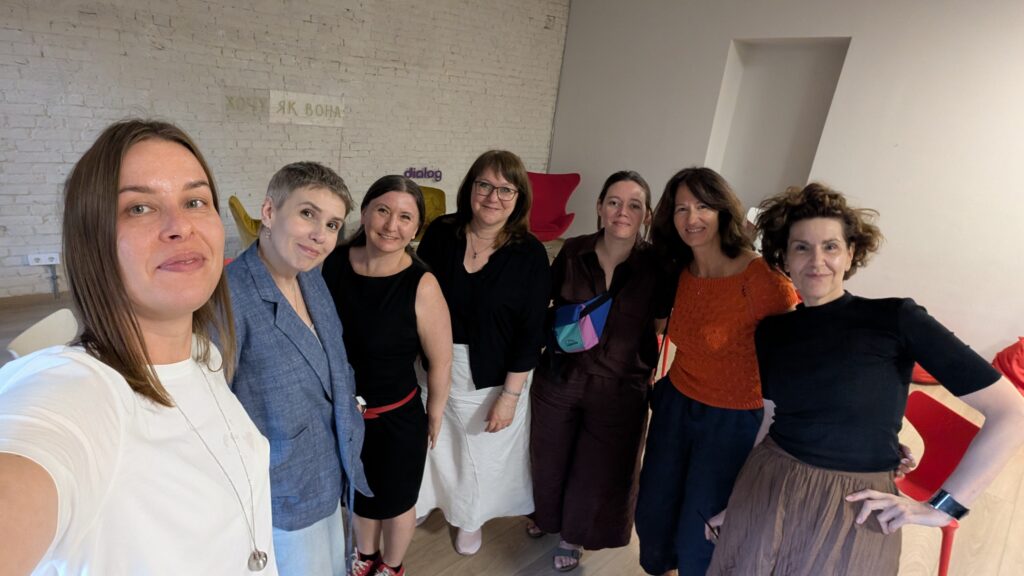
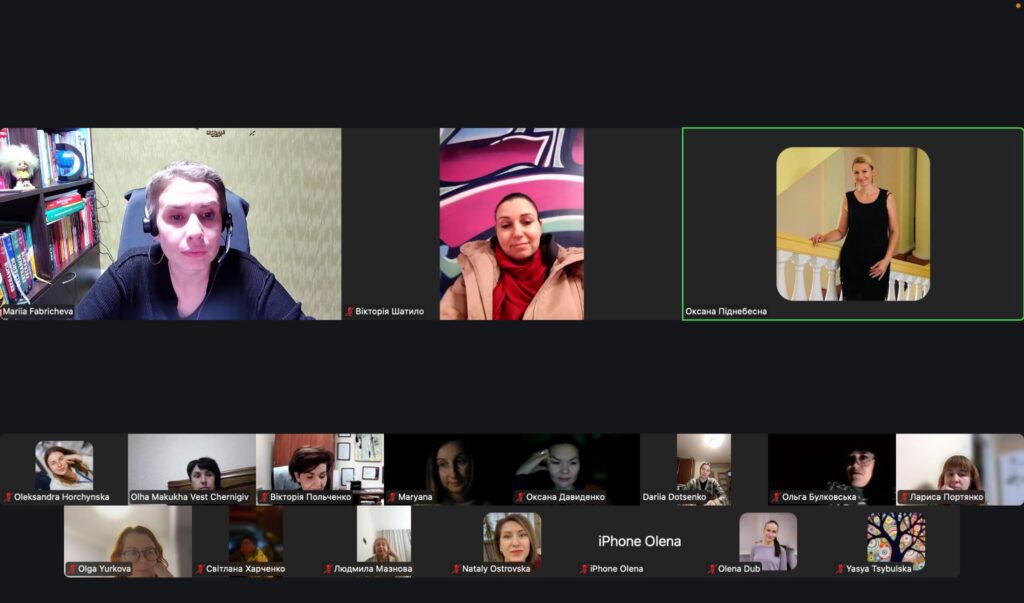
That’s exactly why Women in Media’s peer-support groups are especially relevant today. They’ve been held regularly for more than five years running, in both online and offline formats. The meetings are free for participants and take place with a professional psychotherapist. In addition, women in media receive handouts to work through on their own — tests, articles, and other practical resources. You can read more about the history of the groups in a separate piece.
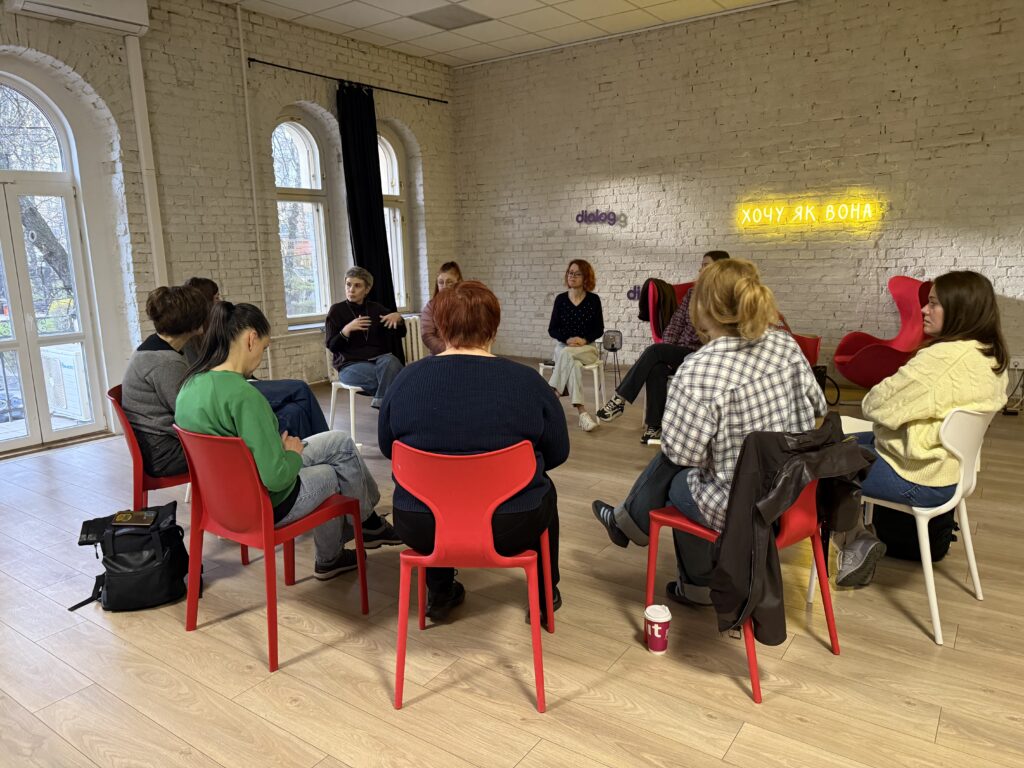
Each group is devoted to a topic chosen by the participants themselves. They can suggest one during registration or reach out to the organizers separately. All the topics relate to the professional lives of women in media. Some of them return in a new context. For example, one of the recent meetings was devoted to reproductive challenges and combining motherhood with work — a topic that echoes the very first support group, “How to Combine Motherhood and Work.”
What women in media bring to the table
Meeting facilitator and psychotherapist Maria Fabricheva describes how the participants’ concerns have changed.
“Living amid a prolonged war and chronic stress inevitably affects the concerns that participants bring to the peer-support groups. What comes to the fore are the topics of burnout prevention, reducing the risk of secondary traumatization, working with emotional overload, restoring one’s reserves, and being able to stay professionally effective under prolonged stress,” Maria Fabricheva notes.
At the same time, she adds, topics of everyday life remain present in the groups too. But today they’re inseparably tied to the wartime reality: where a journalist is located, whether she works in Ukraine or abroad, what level of danger, responsibility, and workload she carries, and how her personal life is changing.
Women journalists’ work also has its own professional particularities. Many of them work daily with the subjects of war, loss, violence, human rights violations, and human tragedy. The content they create and process is often saturated with pain and traumatic experience, which significantly raises the risk of secondary traumatization, emotional burnout, and professional exhaustion.
“Amid a prolonged war, the balance between workload, decompression, and recovery shifts radically toward workload,” the psychotherapist says.
A separate challenge, she says, is the need to stay in a professional role even when one’s own emotional reaction is prompting you to rescue, to help, or to immerse yourself in a story far more deeply than professional standards allow. The psyche can react in the opposite way — with emotional numbness or a drop in empathy. In the context of constant work with traumatic material, this can be the body’s protective response.
“Women in media have to quickly process complex information, verify facts, work with fakes and disinformation, including from Russia, and present sensitive topics in a way that makes the material resonate publicly while at the same time not re-traumatizing the subjects, the people affected, and the audience. This requires a high level of professional ethics, attentiveness, precision, and the ability to withstand emotionally difficult material. Layered on top of this is the general backdrop of chronic stress, danger, and everyday challenges that journalists face in Ukraine or in emigration.”
Under such conditions, the psychotherapist explains, it becomes harder for a person to analyze a situation, thinking can become more tunnel-like, and inner self-criticism can intensify. That’s exactly why it’s important to notice these changes in time and reach out for support.
Why the groups matter to participants
It’s often hard for women in media to explain the specific nature of their stress to people who don’t work in journalism, says one of the peer-support group participants, Nataliia Zvoryhina, editor-in-chief of the newspaper Zaporizka Pravda. At the Women in Media meetings there’s no need to do that — the participants understand one another instantly, because they know well what it means to work with human grief, with war, or under shelling.
“For me, taking part in the groups isn’t just professional communication — it’s the creation of a unique safe space that has deep personal and practical meaning. My experiences give me a feeling of isolation. In the group, I learn that my colleagues are going through the same thing. So I understand that my fears, fatigue, or anxiety are a normal reaction to abnormal conditions, not a weakness. Journalism and civic work during the war demand colossal effort. The group becomes that safe ‘rear guard’ where you can take off your armor, receive support, and restore your inner resilience so you can continue your mission,” comments Nataliia Zvoryhina, editor-in-chief of the newspaper Zaporizka Pravda.
In the future, she would like to see more meetings devoted to burnout prevention, working safely with traumatic stories, the right to rest and joy, finding inner sources of support, and how to plan life amid constant uncertainty.
“The main value of the groups is the atmosphere of absolute trust. Here you can be sincere, vulnerable, cry or grieve, knowing that everything said stays within the circle. There are no bosses or subordinates here. All the participants are equal, and each one’s experience — whether she’s a well-known editor or a young reporter — is equally valuable,” she adds.
Other participants have similar impressions. Hromadske Radio journalist Anastasiia Bahalika has attended the support groups from the very beginning, back in pre-COVID times.
“Back then, it gave me a great deal of energy for my own inner work, for long overdue changes. Now I go to the support groups not in search of strength, but for the feeling that I’m among my own people, for the understanding that we all face a similar set of challenges during the war. It’s a very valuable thing — to know how one kind of dynamic or another plays out in different teams, how other people manage to cope,” says Anastasiia Bahalika, a journalist at Hromadske Radio.
Olha Holovina, a freelance news producer at Deutsche Welle, notes after an offline meeting about healthy communication in newsrooms that she took away not only practical advice but also a new perspective on the role of a manager.
“The meeting about toxic relationships in newsrooms and teams turned out to be interesting, relaxed, and comfortable to talk in. I jotted down the books Maria recommended, and I’ll definitely read them. I was reminded once again that a manager’s style and role aren’t something fixed, but something worth thinking about constantly and something you can improve.”
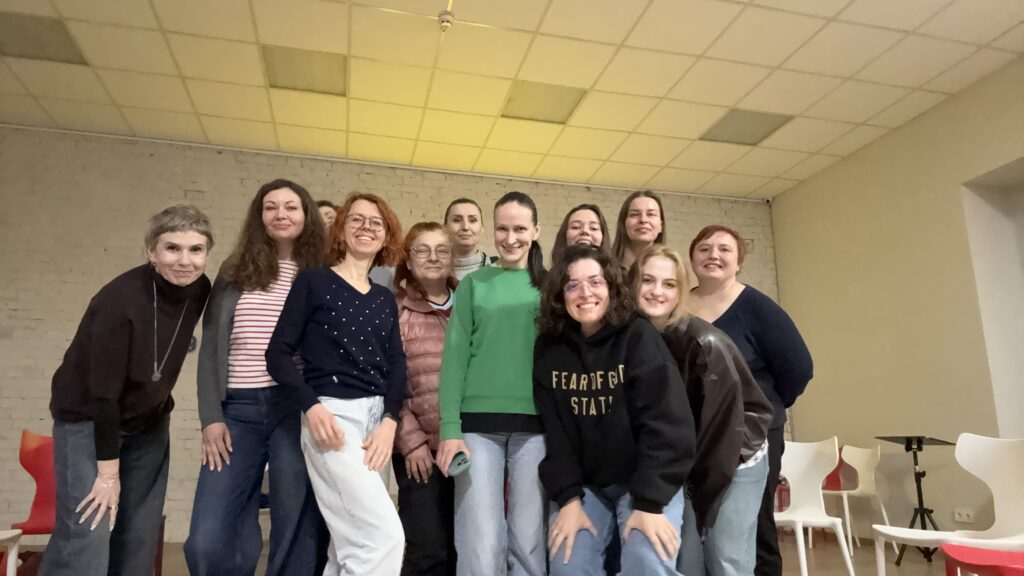
Oksana Davydenko, Deputy Director for Legal Affairs at StarLight Media, who attended three peer-support groups over the past year, says her biggest realization was that, regardless of position or place of work, women in media often face similar challenges.
“It’s important to have a space to talk, to share without outside judgment — ‘right’ or not, ‘good’ or bad, but simply as things are. A space where everything said stays within the circle, which gives a feeling of trust and safety. A big bonus is also getting to know talented women in media who do a titanic amount of work every day. That’s why, in my view, the peer-support groups are a very important initiative. My advice to those who haven’t joined yet is to try it. Especially the offline meetings, which give a lot of resource and support,” she shares.
Psychotherapist Maria Fabricheva explains that, regardless of a meeting’s topic, participants ultimately arrive at shared questions: how to withstand high emotional tension, how not to be left alone with professional challenges, how to stay capable of working while not losing touch with themselves.
In a space of trust, women in media can exchange experiences, receive support, reflect, ease tension, and find new ways to take care of themselves.
“Peer-support groups can be not only a space for decompression, but also a place where professional vision expands, new ways of caring for oneself emerge, a sense of belonging to a community is nurtured, and sources of support for further work are found,” Maria Fabricheva concludes.
The peer-support groups are run by Women in Media NGO as part of the Voices of Ukraine project, which is part of the SAFE program coordinated by the European Centre for Press and Media Freedom and implemented under the Hannah Arendt Initiative with the support of the Federal Foreign Office of Germany.