How difficult it is to adhere to ethical standards during the war, how the gender of invited experts affects views and monetization, and why it is important to maintain broadcasting in frontline areas.
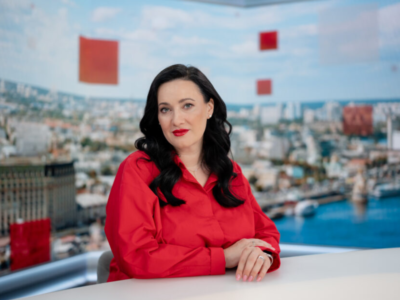
Viktoriia Yermolaieva is the editor-in-chief of Hromadske Radio. She joined the team in 2014 after having to move from Kerch to Kyiv due to the annexation of Crimea.
Ruslana Brianska is the executive director of Hromadske Radio, who was recently elected to this position. She has been part of the editorial team since 2020 — previously working as a presenter, editor, and deputy editor-in-chief.
In their conversation with Women in Media, the managers of Hromadske Radio share new projects, their experience with combating gender-based discrimination and sexism, and explain why it is important for women journalists to unite into a professional community.

Today, Hromadske Radio reaches areas near the frontline and the border and may even get to the temporarily occupied regions. Could you tell us about the current reach of Hromadske Radio and why it is important for you to remain present in these areas even though it does not bring in revenue from advertising?
Viktoriia Yermolaieva:
Now, Hromadske Radio broadcasts in frontline areas, in several large cities, and in Kyiv. We dream of being available across Ukraine, and obviously, we want to be heard in all big cities.
The issue of frequencies is complex and painful for us, and that’s where we put in a lot of effort and resources. To obtain frequencies, we have to go through a competitive selection by the National Council for Television and Radio Broadcasting. The financial side is important, as well as the ability to maintain transmitters. This is expensive for us as an independent broadcaster. So finding opportunities to expand broadcasting is a challenge for us. Yet, we keep doing it.

Since the beginning of the full-scale war, the Russians have captured or destroyed nine of our transmitters, which were located in frontline areas. There are not many of our transmitters left in the Donetsk oblast. But those that still work cover a significant part of the occupied territory — people tell us that Hromadske Radio is available there. In addition, during the full-scale war, we have also started broadcasting in Sumy, in Chernihiv.
Those who are in the occupied territories can read and listen to Hromadske Radio through the Ceno browser, which can bypass the blocks set up by the Russian Roskomnadzor, which unfortunately also apply to the Ukrainian territories temporarily under the Russian control.
Ruslana Brianska:
Our tower in Pokrovsk worked for two weeks — we connected it on September 2, and on September 17, it was bombed. But it was important for us to get on that frequency because the Russians were just a few kilometers away. People had to hear Ukrainian news.
Indeed, for many companies, it is important to broadcast where they can find advertising opportunities. For example, there was a huge competition for frequencies for Lviv and Odesa. In the cities located near the front line, with risks that the towers will be destroyed by the Russians in a matter of weeks, the competition is not that big. So Hromadske Radio often wins such frequencies. For us, this is a mission.

What challenges do you face when it comes to ensuring broadcasting in areas near the frontline or the border?
R.B.:
First, as we’ve already mentioned, there’s the risk of the towers being destroyed by the Russians. For example, the other day we learned that they are currently trying to jam the signal in the town of Druzhba in Sumy oblast.
The second point is funding. We spend about UAH 200,000 a month on the rent of transmitters. This is a major part of our budget, over 20%.
We actually wanted to stop broadcasting in Druzhba, as well as in two villages in Odesa oblast, near the temporarily occupied Transnistria, because we were unsure whether it was relevant to maintain those transmitters there. But, at the same time, we want to remain in places where the Russian propaganda reaches because we hope to serve as a counterweight to this propaganda. So the situation is complicated.
V. Ye.
Our sources indicate that the Russians deliberately launched a radio station on our frequency in Druzhba to silence Hromadske Radio. That is, they deliberately spend their resources to make sure that even small localities near the border are cut off from Ukrainian information sources.

Do you receive feedback from listeners in these areas about the importance of your work? What kind of feedback is it?
R.B.:
I know many stories when Hromadske Radio helped people during the occupation. For example, in Bucha, where I live, people were preparing ahead of the invasion for possible consequences and purchased battery-powered radio units to stay in touch with the world somehow.
I still have the messages that I received from a friend back in 2022, who was under siege in Borodianka, Kyiv oblast. When I talk about it, I always tear up. Everything was gone back then, there was no gas, power, water. “There was only radio, and in that radio were you,” she texted. It’s a very warm message, and it’s about the importance of Hromadske Radio.
We also have a picture when volunteers brought a Starlink to Ivankiv in Kyiv oblast after if was deoccupied, which helped people have at least some kind of connection with the outside world. They gathered in the square next to this Starlink and listened to Hromadske Radio. We also know of a book written by a man from Izium in Kharkiv oblast about how this city lived under occupation. There is an entire chapter in that book dedicated to Hromadske Radio.
V. Ye.:
I’ve heard stories about how in 2022 people gathered in basements to listen to a single transmitter they had in their part of the building. And it was thanks to Hromadske Radio that they learned about whether they could leave a certain locality.
Thanks to such feedback, we understand that we have to preserve our mission in every way possible.

For many media outlets in Ukraine, the financial crisis associated with reduced funding from the United States has become an impetus to search for new approaches, engage foreign partners and investments. How did it affect you? What new approaches to financing did you look for?
R.B.:
Indeed, this situation affected us since, for a long time, the American organization Internews was one of our main donors. Fortunately, in January 2025, when Trump announced the changes, we were working with other grants — some of them were provided to us by European organizations. Thanks to this, they were able to survive somewhat better than the media completely reliant on American support.
Searching for alternative funding sources, we are also creating co-prouctions with various commercial projects. Unfortunately, it does not bring in a lot of funds. Neither does YouTube monetization. But it still supports us to a point.
In January 2025, we launched a fundraiser urging people to support independent media, including Hromadske Radio. Our listeners and readers really do support us: we read words of support in messengers, they call us. But in general, speaking more globally, Ukraine has almost no such culture as supporting independent media. Since January 16, we have been able to raise only UAH 207,000. This is not a very large amount for a newsroom, but we understand that everyone is having a hard time.
We are now thinking about changing our approaches to the fundraising campaign and to the operation of our commercial department. I am convinced that we should not skimp on people who can bring us money.

V. Ye.:
A special feature of Hromadske Radio is that we are doing giveaways alongside fundraising — for example, we have partnered with Ukrainian publishing houses. They provide us with books for free, which we raffle off among those who support us financially.
We also recently had a raffle for the Witch of Konotop play — Ruslana somehow managed to buy one, and instead of going there herself, she decided to use it to raise funds for Hromadske Radio. Another lot was a consult with our colleague, presenter Andrii Kulykov, on working with your voice because he is a true expert at it.
We have a chat with our patrons. We are constantly in touch there: they can message us, ask questions, suggest topics, share their thoughts. We report on what their funds are used for. In communication, it is critical that people understand what exactly they are donating to. Such funds enabled us to keep the morning show on Hromadske Radio, which is a great result. People feel involved, and we really value that.

Could you share how the content of Hromadske Radio has changed over the past year? What new programs or projects have been added? What did you have to give up, and why?
V. Ye.:
Our year was quite eventful. We have managed to increase our audience on all platforms, and even though in winter 2025, we encountered serious problems with funding, overall, we stay on track — despite having to give up some departments. This is all thanks to the heroic work of our colleagues, who work overtime and weekends, understanding our joint mission. For this, I want to express enormous gratitude to our team.
Last year, our signature project on YouTube was Somebody Loves Somebody by Ana More about equality. We are launching the second season soon — we managed to get funding for its continuation.
Also, we are about to launch a new project called I Hear Others, which will be presented by Maksym Butkevych and Daria Bura — about the rights of prisoners of war and their families, of the mobilized, military servants, and civilians. This project is very important in every way, particularly in terms of values, because Maksym Butkevych is a co-founder of Hromadske Radio. He is a cult figure for us. When Maksym was in captivity [in Russia], we were all rooting for him, we launched campaign after campaign to support him just to keep his name in the information field. So, Maksym’s release was an enormous event for us: when I found out, I cried from happiness, the only time in the entire last year.


We did have to shut down some projects. That includes Severe Reprimand, hosted by Alina Sarnatska. It happens that formats need to be changed, new approaches need to be sought, or presenters simply get tired. On the other hand, we launched another project about the military – In the Line of Fire with Iryna Sampan. These are interviews with combat commanders that Iryna records in our studio, or directly on the frontlines. In addition, together with Andrii Kulykov, we launched a weekly digest Beyond Headlines. We decided that we would do this pro bono, without any extra pay, because it’s important.
Together with Women in Media, Hromadske Radio also released a new season of the project The Truth about Women’s Health with Anastasiia Bahalika. Its concept was developed for the situation of war and the lives of women who live in areas near the frontline and near the occupied ones. These women often have limited access to information and to medical services. We do not provide medical services over the radio, but we teach one simple, crucial concept: you have to take care of yourself because you are important. And if you listen to your health, to your body, and you feel that something is wrong, you should pay attention. This project became quite popular on social media, and the Kharkiv independent broadcaster, Radio Nakypilo, approached us with a request to broadcast the problem as well. Such content, they say, is very much needed, particularly in the Kharkiv oblast, close to the frontline.
There’s also a plan to launch a project dedicated to another socially important topic — caring for children with disabilities. It will be hosted by our colleague Tetiana Kurmanova. She will talk about what benefits and assistance from the state parents raising children with disabilities can receive, what difficulties they face, pressure and discrimination from society, and more.
Management positions at Hromadske Radio today are held by women media professionals who have many years of experience working in the company as editors, presenters, and journalists, and know all the processes well from the inside. How does this knowledge and understanding help in management processes?


V. Ye.:
What is special about Hromadske Radio is that the position of editor-in-chief or the director is elective — that is, the members of the CSO elect people for these positions by voting. They can also propose their candidacies, which can be submitted to the competition. But it is always a competition, and in general, democracy works for our benefit. A team that faces various challenges at work sees how everyone is doing their jobs and can thus decide whom they want to see in management. A year ago, I was elected editor-in-chief by voting. Ruslana was elected the same way. So these are all team decisions.
I have come a long way at Hromadske Radio: I started by transcribing broadcasts as a volunteer in 2014, without getting paid, I worked on the air or with texts on the website. Thanks to this experience, I can do almost any job today — perhaps, except for sound engineering. Thus, when I interact with different departments, this knowledge makes my task easier: I know how they work because back in the day, I was in their shoes.
R.B.:
I think that it is useful having people in management positions who previously worked within the structure in other roles. We understand our strengths, we know where we can save money, what we can let go a little, and which aspects require more funding.
I started this position at an extremely difficult moment, and in my very first week on the job I already faced an enormous number of challenges. The most important task for me right now is to preserve Hromadske Radio in a format in which it will definitely not be destroyed.

Viktoriia, you are a co-founder of Women in Media, and many journalists at Hromadske Radio are active members of the community. Why is it important to join that community?
V. Ye.:
Women in Media is a unique community that I am very proud of and inspired by. This community is second to none among journalistic organizations. It provides a safe environment where any woman journalist who is part of the community can share something, receive support — and not just words, either.
This is a community that provides unique opportunities for women: that includes health support, both mental and physical, mini grants for preventive medical checkups, medical insurance. Now, the community also helps with funds to pay for care work, such as a babysitter for the child while the mom is at work. In my long journalistic experience, I had never seen such opportunities before.
Women in Media and Hromadske Radio are great friends. These are two organizations that are related to each other in terms of values, and it makes me happy to be involved in both of them.
R.B.:
I, too, really love Women in Media. I often notice that, when I talk to friends from other professions, I get the feeling that every sector should have similar organizations — say, Women in IT or something. Because women face discrimination and need protection while working in completely different professions.

Many women work in various positions at Hromadske Radio. Have you or your colleagues ever encountered sexism or gender discrimination? Tell us about it, please.
V. Ye.:
Speaking about Hromadske Radio from within, overall, it is a discrimination-free environment with a tolerant attitude that people have to one another. However, of course, beyond our “bubble,” we can still encounter such situations.
For example, I noticed that people find it easier to accept a female editor-in-chief rather than a female director. I guess there is a stereotype that a woman can be an editor or a journalist, but for some reason cannot be a director.
R.B.:
Indeed, I noticed this myself when I became the Executive Director. For example, people ask me how my husband feels about my promotion. Recently, I was getting together a set of work documents, and when I had an appointment, people referred to me by my full official name on the phone. But when I went down there in person and introduced myself, I heard, oh wow, how come, she’s so young. In fact, age is not the main criterion for choosing an executive director. Neither is sex.

One of the latest projects by Women in Media NGO is a map to record online attacks against Ukrainian women media workers. Have you or your female colleagues encountered online violence?
V. Ye.:
I encountered a similar situation back in 2014, when I was living in Crimea and working at a local media outlet as a correspondent. At the beginning of the events that would later unfold into occupation, I covered all of this, including pro-Russian rallies, I wrote about disinformation spread by Russia, debunked myths about “Banderovites.” Back then, I received threats, faced bullying and blackmail — I got a lot of comments on social media, on the website. I am certain they actually knew a lot about me because Kerch is not a big city. I didn’t last long, and immediately after the so-called referendum, I moved to Kyiv in March 2014.
R.B.:
Actually, on YouTube, including the channel of Hromadske Radio, you can still see quite a lot of comments that are discriminatory towards women. These can be remarks like, “The man is doing a good job presenting, and the woman would be better off staying at home.” Our presenters often get remarks about their appearance; people can say things like, “why aren’t you in the kitchen.”
In the autumn of 2024, Hromadske Radio received certification of the Journalism Trust Initiative (JTI) based o the standard initiated by Reporters Without Borders (RSF). Why is this award important?
V. Ye.:
Last year, Hromadske Radio was included in the White List of Recommended Media by the Institute of Mass Information for the first time. We also received an award from Reporters Without Borders.
The certification process took quite a long time, and I was the one responsible for it. It probably took me four months to do everything: I had to collect a lot of information and fill out a large questionnaire. But before that, we had to draw up many editorial policies that were new to us, such as security policies, in accordance with the requirements of Reporters Without Borders.
Over time, we saw that all these documents were indeed very helpful in our work, and the presence of internal instructions greatly facilitated our day-to-day operations. For example, we are currently hiring new people, and in order to explain the rules by which the office of Hromadske Radio operates, we simply need to share our policies.
It is not difficult for Hromadske Radio to adhere to ethical professional standards because this is how we worked before receiving the certificate anyway. For example, the auditor who visited our newsroom during the certification process had no questions at all about our content. We produce high-quality, balanced content because we never violate standards.

What difficulties do you face when selecting heroes and heroines, experts for broadcasts or materials?
V. Ye.:
There are indeed certain difficulties with that. The conditions under which the media market operates require us to have a large number of views. It is the views that make YouTube content monetized, which means that it can survive. But the number of views is directly affected by which guests you invite to the studio.
Unfortunately, we noticed that there are certain top experts who are men and who always get a lot of views. I know for sure: if we invite this specific person, a man, the broadcast will gain 100,000 views on YouTube. And if we invite this woman, it will get 2,000 views at most. And this is a difficult situation because you have to choose between popularity, views, and gender balance. We try to maintain this balance.
This activity was made possible by International Media Support (IMS) as part of the project “United for Equality in the Media: Promoting Gender Equality Through Cooperation Between Public Organizations, Media, and Authorities” implemented by the NGO “Women in Media.” Any views expressed here belong to the authors and do not necessarily reflect those of the IMS.