
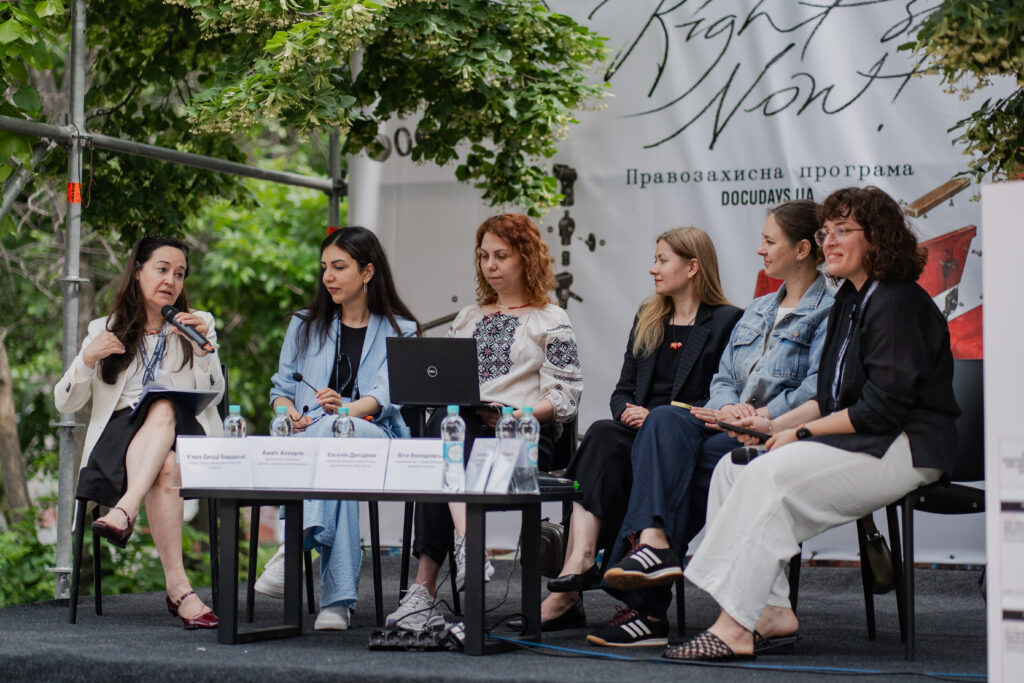
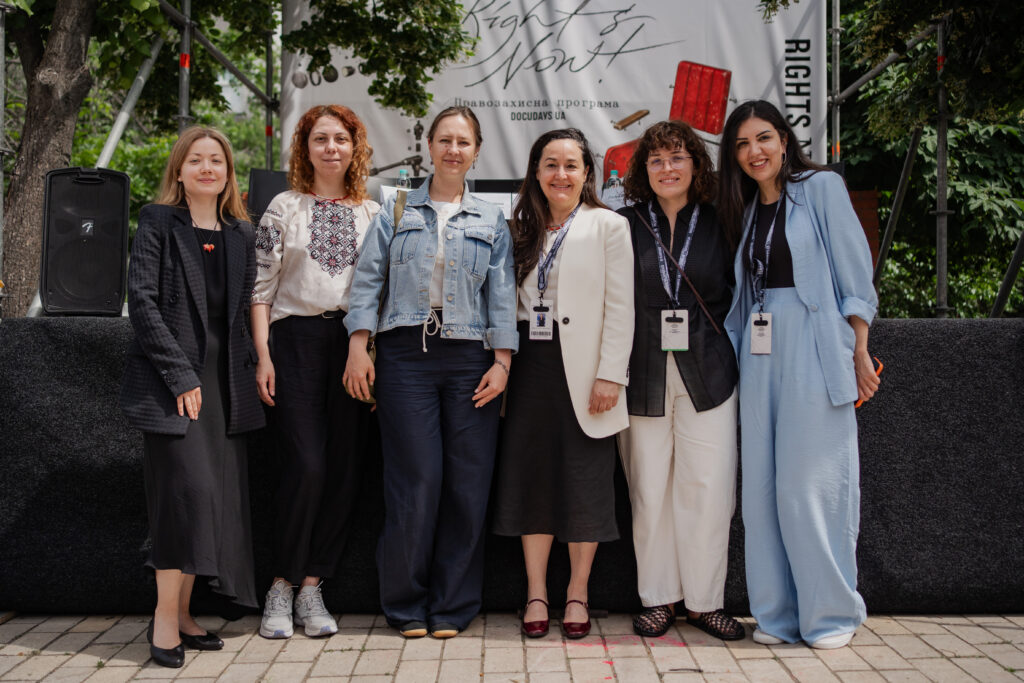
The 23rd Docudays UA International Human Rights Documentary Film Festival is underway in Kyiv. As part of the “Coffee with Human Rights Defenders” section, Women in Media, in partnership with UNESCO and with the support of Japan, held the event “Not an Artificial Threat: How AI Amplifies Violence Against Women Media Professionals and Why It Threatens Society in Wartime.” The conversation was moderated by the organization’s head, Liza Kuzmenko.
A real threat
Artificial intelligence has already become an integral part of everyday life. Beyond helping with routine tasks, AI also carries risks. A study by Women in Media, supported by UNESCO — When Artificial Intelligence Turns Hostile: Gender-Based Threats Against Ukrainian Women Journalists — found that among 119 women journalists surveyed, one in fifteen (7%) had already encountered online attacks created using AI, while another 16% had observed such attacks against their colleagues.
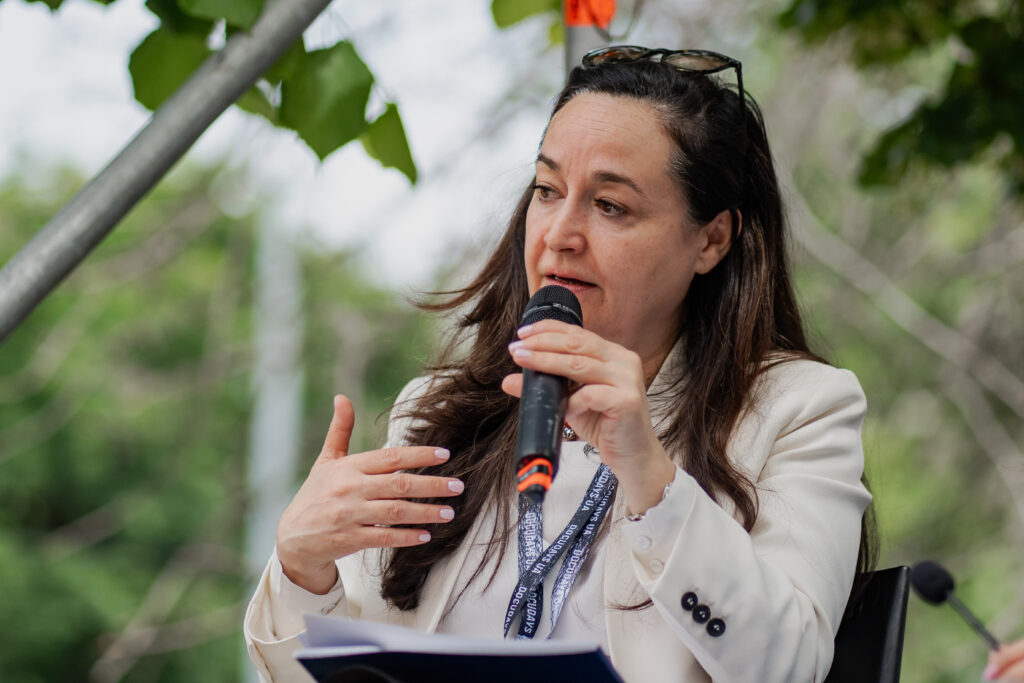
Chiara Dezzi Bardeschi, Head of the UNESCO Office in Ukraine, noted that since women make up nearly 80% of the journalistic community, attacks on women journalists are not only a gender issue — which is, of course, very important — but also a threat to people’s overall access to information, both within Ukraine and beyond.
“These are real threats and real violence against women and journalists in general. This is not just a question of equality. It’s a question of the safety and the future of independent journalism. It’s a question of access to the information that allows people to make informed decisions,” Chiara Dezzi Bardeschi said.
As technology advances, almost anyone can create a photo or video using artificial intelligence.
“To put you in a video, no special technical skills are needed. All it takes is one photo of you” agrees Yevheniia Drozdova, head of data journalism at Texty.org.ua.
Texty.org.ua, in cooperation with Women in Media, conducted a study, Artificial Intelligence and TikTok: How Famous Female Journalists are Being Systematically Used for Undisclosed AI-Generated Content, showing how the images of women journalists and TV presenters are used to promote hostile narratives or fraudulent schemes. The study was shortlisted for the Sigma Data Awards, an international competition to celebrate the best data journalism.
Yevheniia Drozdova stresses that the goal of AI-generated material is to capture attention. People with well-developed critical thinking might say it’s obvious the content was made by AI. But the perpetrators are targeting those who will believe it — even if that’s only, say, 20 people.
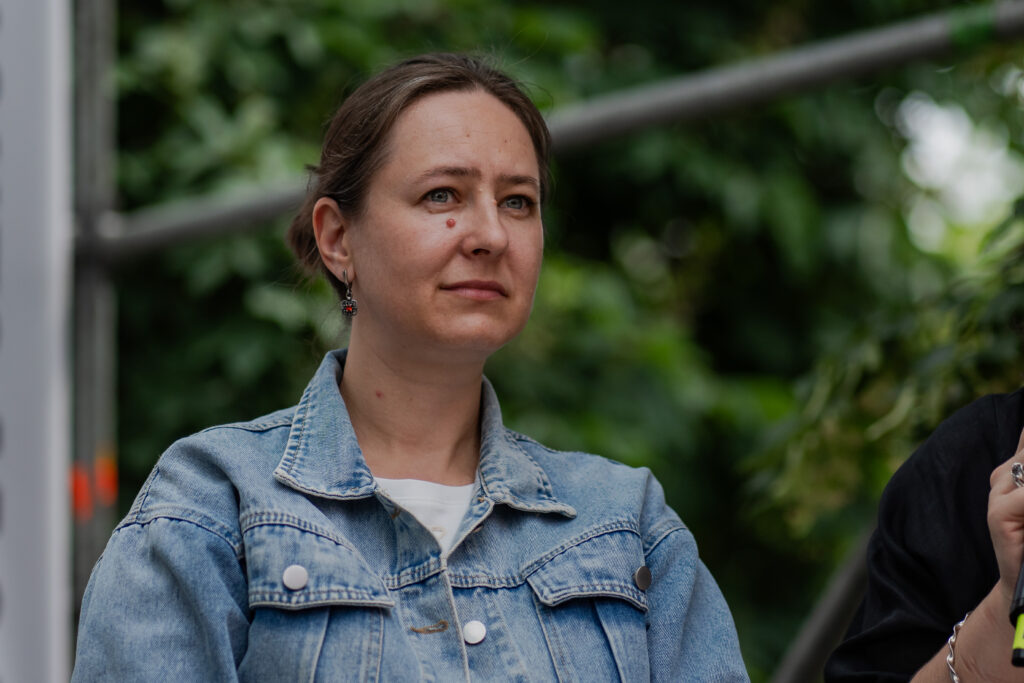
“Some people say: ‘I know it’s AI, but it’s telling the truth,’” adds investigative journalist Olena Mudra, who faced an online attack for defending the Carpathians from wind-turbine construction.
An AI-generated character even took the journalist to court. And it was only recently that the case was finally closed.
Artificial intelligence is actively used by the Russian Federation to push the narratives it wants, spread disinformation, and discredit the Ukrainian military. Anayit Khoperiya, Deputy Head of the Center for Countering Disinformation, says the Russians use images the audience will trust. For example, to amplify the claim of a migrant influx, they used AI-generated priests. These characters address audiences who believe in magicians, fortune-tellers, astrology, and the like, using the personal address “Sister,” which stirs emotion and makes the character feel closer.
Yevheniia Drozdova added that the internet increasingly resembles a conversation among bots. AI makes it possible to produce huge quantities of video, and even if one is taken down, new ones are created. This distorts reality.
“When you go on social media, you’d think we’re living among wolves. But step into the real world, and it turns out that’s not the case,” Yevheniia says.
Open-data expert Nadia Babynska, who attended the event, added that the danger of AI also lies in the fact that it is trained on gender biases and produces results full of stereotypes. “People don’t google anymore — they AI it,” Nadia says. According to her, artificial intelligence also helps hack accounts, and even two-factor authentication may not help.
Critical thinking and reputation can protect you
For now, there are not enough real tools to counter the threat posed by artificial intelligence. Media lawyer Vita Volodovska, Head of the Digital Security Lab, says legislation is quite fragmented and slow. There’s a need to train police, to learn how to preserve evidence, and so on.
“When investigations drag on for months and punishment never comes, it creates an effect of impunity,” she says.
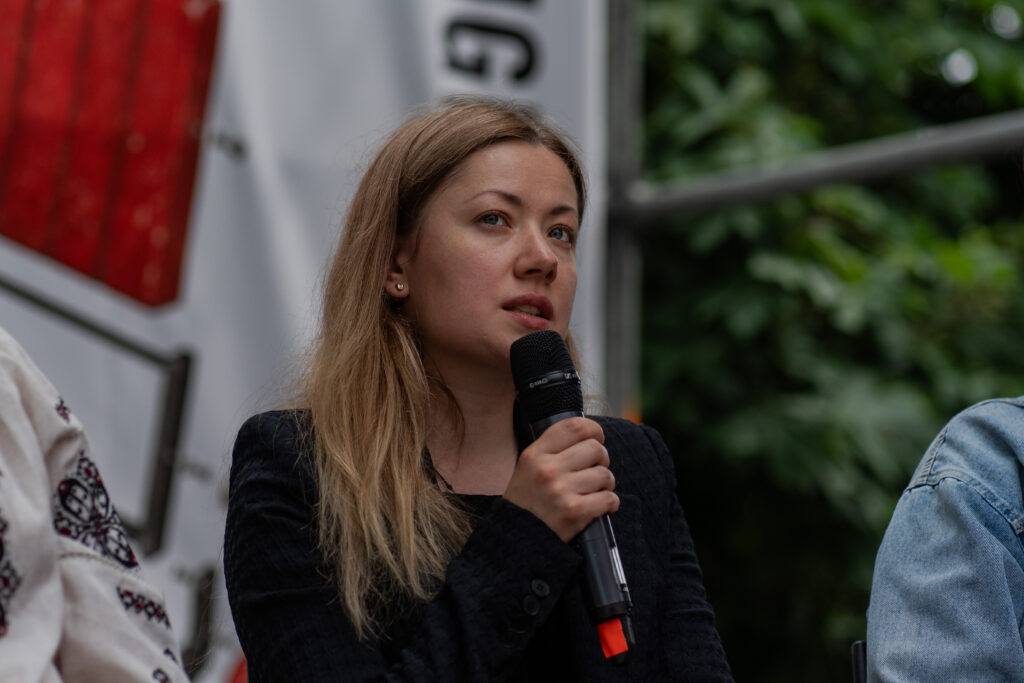
In her opinion, the platforms hosting these videos should have built-in protection in their design and should automatically remove videos that pose a threat. Apps that help “undress” people should also be banned.
Anayit Khoperiya reported that they cooperate with Meta and TikTok, and that it took a long time to prove to them that AI-generated videos pose a threat and discredit the country rather than entertain the audience. The platforms are meeting them halfway and removing content after complaints. One of the videos was taken down a record seven minutes after it was posted.
Liza Kuzmenko noted that publicity also matters. She thanked Olena Mudra for sharing her story. “Visibility makes the problem less frightening. When others see that support exists, they too will find the courage to speak up,” Liza emphasized.
Women in Media continues to log cases of online violence on a map.
All the speakers agreed that what can protect against the malicious influence of AI is critical thinking, responsible use, and one’s own reputation. Media outlets should adopt a policy on the use of artificial intelligence. Women in Media has developed a template that any newsroom can use and adapt to its own needs.
Women in Media is currently working on translating the UNESCO document Red Teaming Artificial Intelligence for Social Good — The PLAYBOOK. This is a practical guide demonstrating that what’s needed is not only advocacy and raising awareness of the problem, but also concrete tools and recommendations on how to counter and respond to such challenges.
“UNESCO will continue to support Ukrainian women journalists so that they can work without fear,” emphasized Chiara Dezzi Bardeschi, Head of the UNESCO Office in Ukraine.
Text: Olena Kushchenko, Women in Media. Photo: Danylo Pavlov, Women in Media.