
Women in Media NGO has prepared two practical documents for Ukrainian newsrooms — a Model Policy on AI Use in Newsrooms and a Template Guide on AI Use in Newsrooms.
The documents will help media outlets adopt artificial intelligence tools responsibly, safely, and in line with journalistic standards.
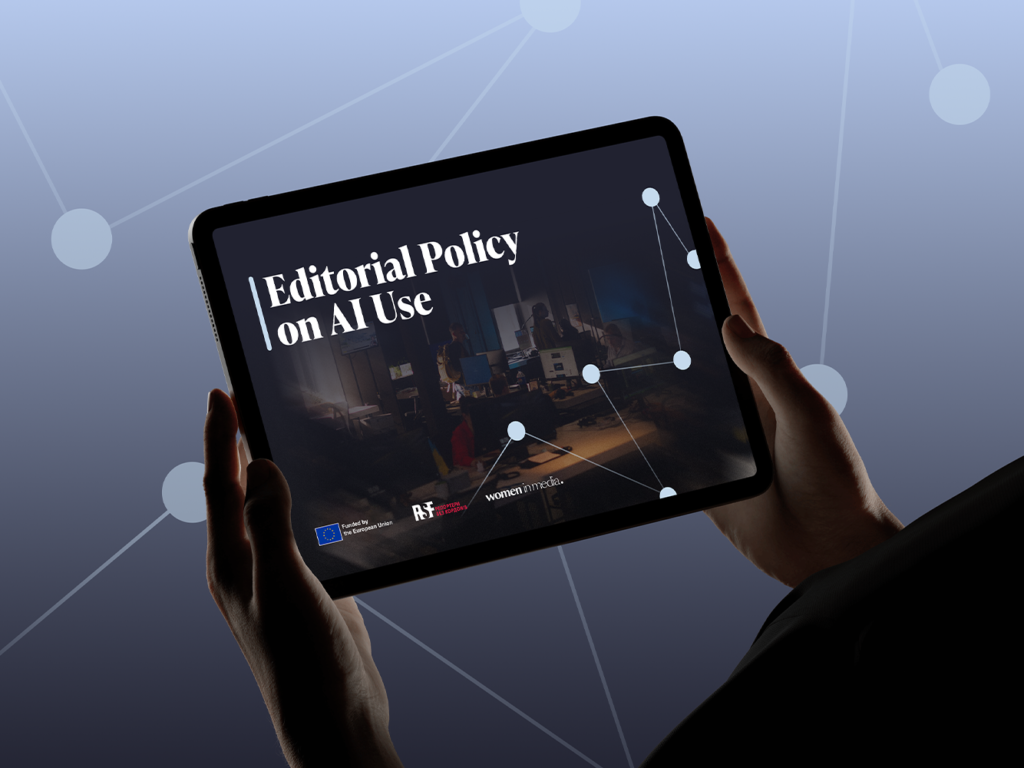
The Model Policy offers newsrooms a framework approach to AI use and sets out its core principles — legality, transparency, editorial autonomy, human oversight, personal data protection, non-discrimination, and accountability. The document gives particular attention to the risks of technology-facilitated gender-based violence (TFGBV) and the need to factor in gender sensitivity when introducing AI tools.
The Template Guide, in turn, contains practical recommendations for editorial teams on choosing AI services, setting up digital security, handling personal data, and safe prompting (the process of formulating queries, instructions, or tasks for AI systems to obtain the desired result).
A distinctive feature of these documents is their gender-transformative approach. Unlike most of the existing recommendations on the use of artificial intelligence in media, they not only take the risks of discrimination and gender bias into account but also offer concrete mechanisms for preventing them.
The documents contain recommendations on countering technology-facilitated gender-based violence (TFGBV), the use of gender-sensitive language, avoiding the reproduction of stereotypes when creating content, and the responsible coverage of sensitive topics. They also take into account the specific challenges that women journalists face in the digital environment, including the risks of deepfakes, online harassment, doxing, and other forms of digital violence.
“Most of the AI use policies that media outlets are developing today focus primarily on issues of accuracy, copyright, or transparency. We have deliberately gone further and integrated a gender-transformative approach. This means not just responding to risks but also changing practices that can reproduce discrimination and inequality. We wanted to create documents that will help newsrooms use AI safely, ethically, and with an awareness of the challenges that women journalists encounter especially often in the digital space,” said Liza Kuzmenko, Head of Women in Media.
The documents also include recommendations on labeling content created or edited using AI, designating responsible officials within newsrooms, and assessing risks.
Women in Media calls on Ukrainian newsrooms to use the proposed templates as a foundation for developing their own internal AI use policies and guidelines, tailored to the specific needs of each outlet.
Early, 10 Ukrainian media outlets began developing and adapting their own AI policies with the support of Women in Media NGO and Reporters Without Borders. The program’s participants are: Ukrainska Pravda, Frontliner, StarLight Media, Radio Nakypilo, Gwara Media, Rubryka, RIA Pivden, the newspaper Vist, Suspilne Broadcasting, and The Ukrainian Week.
The documents were developed in collaboration with the Women in Media NGO team by Tetiana Avdieieva — Senior Legal Counsel at Digital Security Lab and a member of the Expert Committee on AI at Ukraine’s Ministry of Digital Transformation.
The materials were prepared as part of the project ‘Not Artificial Threats: Tackling AI-Facilitated Violence Against Women Journalists in Ukraine’, implemented by the NGO Women in Media with the financial support of the European Union, within the framework of Reporters Without Borders’ action in Ukraine.