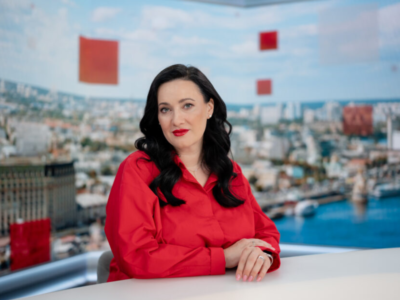
Zurab Alasania is a Ukrainian journalist and media manager, one of the key initiators of the transformation of the National Television Company of Ukraine into Suspilne, the public broadcasting company. He headed the National Public Broadcasting Company of Ukraine (NPBCU) as Chair of the Board during a period of active reform.

Zurab Alasania served in the Armed Forces of Ukraine for almost three years and was demobilized at the end of 2024 after reaching the retirement age. In the spring of 2025, he joined the team of the Danish international media organization International Media Support (IMS), taking on the position of media advisor.
In his interview for Women in Media, he talks about sharing experience with European colleagues and about gender balance in journalism; he also considers the impact of technological progress in the media industry.
You have recently joined the IMS team. Would you mind sharing what you do in your new position?
At work, I encounter very different cases — there are both success stories and quite strange situations. It seems to me that in Ukraine, we have partly forgotten that some of these media are only starting their journey. Many things were implemented here 15–20 years ago, and they are only now approaching this. Ukraine has already taken several steps forward during this time.

Europeans are different, with different experiences. There are cities and towns that I had never heard of before, that I had never seen on the map. But they are populated by people just like us who, too, overcome the challenges of the information void, blindly trying to find something, to seek new ways for development.
What interests foreign colleagues most about the Ukrainian experience?
They are actually interested in Ukraine itself. They are equally confused by what happened to international aid. All of Europe is now thinking what can be done with this. The media are already suffering: not only because of what Donald Trump is doing, but also because their very nature is changing dramatically.

I feel that the media are steadily crawling towards death, to the cemetery; they are looking for the closest graveyard. Maybe this is an evolutionary selection, and this is only natural that only the strongest ones will survive. I think there will be a super concentration of large media outlets, but few of them.
We have not yet fully realized the scale of the technological breakthrough that has occurred — and even less do we understand what to do with it. We do not have enough time to adapt; our newsrooms are not ready for such a rapid information exchange. We often simply get lost in this stream.
What areas of work and issues does IMS define as priorities in Ukraine today? Why?
One of these areas is supporting local media. As a donor, IMS is looking for ways to invest into media development most effectively. This includes, in particular, the so-called news deserts — places with gaps in information dissemination occur due to the absence or lack of the local press. The IMS donor support helps to cover these areas.

It is also about working with minorities, with different populations. It’s not just about Roma or LGBT+ communities. For example, I feel like there are hardly any media outlets aimed at the audience of teenagers of ages 13 to 17. And they have their own entire worlds that are sort of left neglected. IMS tracks such things through research, finding out who is lacking what and how it can be covered.
How much attention is being paid today by the international community, in particular by foreign donors, to the topic of Russian propaganda and countering disinformation in the Ukrainian information space?
This is a permanently losing battle. When you constantly come up with something and others refute it behind you, you end up one step ahead at all times. And others are constantly forced to spend resources chasing you, and then you release the next batch of disinformation.

That’s what Russians do; they have enough money for this and structured organizations that do that. Half the world is spending resources to refute these narratives. I’m not saying we shouldn’t do that, but this is a losing game for sure. I don’t know what to do about it yet. But the army is working with this proactively.
Was it easy for you to decide to return to work in the media after serving in the Armed Forces of Ukraine?
In fact, I can’t even say the media asked me if I wanted to. I was not laid off; according to the law, a drafted military servant remains in the same workplace where he was before joining the army. So I just went with the flow.
After the army, it’s not easy to make your brain work in the old ways. Suspilne did not really walk on eggshells around me, they were like, okay, you’re going back to work tomorrow. Yeah, that’s how I went with the flow. I love Suspilne; it is my life’s work.

As for IMS, we worked together with them anyway, so they were absolutely supportive of me joining them as a media advisor.
In addition, I am a member of the Supervisory Board of the Healthy Solutions Charitable Foundation — I also really like this initiative ideologically
You were among the signatories of the public appeal to include the issue of support and restoration of local media in Ukraine in the agenda of the Ukraine Recovery Conference 2024. Why is this topic important?
I still believe that without media in the classical sense, the world is in for a disaster. You see what’s happening to the world, right? I mean the exponential increase in the volume of information due to the development of technology. This chaos affects all of our lives. But if you just remove journalism, remove the media, if they just dissolve in the amount of information that exists, the world will suffer major losses.

Journalism must survive, but I have huge doubts about that. I still don’t see what new quality the world can produce with this amount of information, in this chaos. Something will emerge, but I’m not sure humanity will like it.
In theory, you can be replaced as a journalist, AI will do it with no effort. Yes, maybe it will be faster in some way, the quantity will increase, but I’m not sure whether it will be an equivalent to what you are doing. The issue is how we can pinpoint this difference, how we can phrase it, how we can set the objective to move in this direction, to preserve journalism: alive, thoughtful, calm. How we can do it — I have no idea so far.
In my opinion, today, you can’t say that theater is very popular, or classical music, or reading books. These are things that have become more elite. So I’m afraid that journalism can also switch to this élite niche for a select few. I am not judging whether it’s good or bad — I am just speaking about the fact itself.

Previously, people talked this way about the Internet — they said that newspapers and television will disappear because of it.
Haven’t newspapers disappeared in Ukraine? Do you think television won’t go next? At least in the form in which we knew him. It is turning into YouTube as non-linear television, which is a more or less economically attractive model, as well as TikTok — short formats. These are opposite things.
I don’t know how it will ultimately affect humanity — it’s too difficult to speak about it now since too little time has passed. Changes happening to humanity cannot be identified so quickly. But technological progress is much faster than people have time to reflect on it: write a philosophical work, or simply record their thoughts in writing. In contrast, there are many works written about television, there are studies, including very serious ones, there’s theory and sociology.

Do you notice the impact of the mobilization of men on the gender composition in Ukrainian editorial offices, and on the work of the media in general?
The shortage of people is noticeable everywhere. On the other hand, if we speak about women’s rights and emancipation, this is also something we wanted. We wanted equal rights and opportunities. We can also view this situation as a chance for women to occupy those niches, to enter professions where they previously faced barriers.
For me as a manager, the most important thing was always what the person is like, since you can be a jerk regardless of whether you are a man or a woman. The second priority is expertise, that is, how well the person knows their job. And gender only comes after that. And that, too, is not about the professional sector, but about everyday life.
When it comes to military draft, women and men are obviously not equal: men are subject to mandatory draft, women are not. I believe many women were not ready for such a large-scale, long absence of men.

But perhaps this is also about changing the ideas that men have: telling them that the world is not just their space, it’s not just their roles, and even if they were in a certain position previously, they can be replaced. This is a difficult, painful process. And, of course, it would be better if these changes did not happen because of war. But if they hadn’t happened before voluntarily, men will have to be forced to accept them.
Speaking about the general shortage of personnel, what affects the situation apart from the war? For instance, many of my colleagues from the media point out another issue — the low level of education among today’s graduates of journalism schools.
It seems to me that young people perceive life differently than my generation did, for example. But when I was a child, a teenager, a young man, my parents said the exact same thing: that we have a wrong idea of life.
They — young people — are more frivolous, but that’s wonderful. Let them. Will we be able to handle the war for them? I don’t know if we have to. They will then definitely build their own world later. And that world will be different from the one we are used to today. I don’t know whether it will be worse or better. Perhaps, it will be worse for us, but better for them, since it’s for them.

Do they work better or worse? It’s difficult to say. Maybe they are just not fit for the tasks that we give them now. But they are fit for something else: a different life, a different job, a different way of thinking.
The media are actively implementing gender policies these days, and Suspilne, too, has this document. In addition, there is also a separate department for diversity, inclusion, and equal opportunities at Suspilne. Could you share how long the company was preparing for it and why this focus area is important?
Suspilne works with Western media very closely, and everything is completely fine in their case — such policies were implemented there better faster than we started doing it. We are going to join the EU, so we have to study their rules, and adjust ours to theirs. This is a completely normal and healthy practice.
Inclusivity is not such a scary word. It means that different people should have the same access to services as everyone else. For example, if I am hard of hearing, I want to not only be told things, but also shown them or translated into sign language. Suspilne does it as much as it can. Especially considering that we use old buildings that were not adapted for everyone and are inaccessible. This means that if you want to create proper access, you have to rebuild something that existed before, when nobody thought of people this way.
Ukrainian legislation is fine in terms of gender issues or access and inclusiveness — it develops fast. Almost everything is ready. Another thing is our human culture, and the world that is still patriarchal.

Suspilne does what it can; it is not the pioneer of this process. This is the government’s job, and the government is moving in the right direction. However the government cannot change us, people; we have to change ourselves, explain and share things.
Women were under pressure for too long, and this spring is finally starting to straighten out. There may be exaggerations in this process, but that’s only natural for major shifts in society. Eventually, everything will balance out — it won’t go back to the way it was before, but will reach a new level of equality. So far, there are excessive actions on both sides, mutual hostility, sometimes aggression. But I believe this is temporary.
What about gender-sensitive approaches in the content produced by modern media?
In books, I can tell if they were written by a man or a woman without even looking at the author’s name. Sometimes also in music. As for journalism, that is more difficult to say. I remember one case when I was hosting a debate at Suspilne — but back then, it wasn’t Suspilne yet, it was the First National Channel. I had two co-hosts: Myroslava Gongadze and Inna Moskvyna. In both cases, they were better, softer, but they were roles — that’s what we agreed on, these were television roles. But when Myroslava Gongadze arrived, she already had experience working in American media. And even with a list of questions, she asked the speakers such simple questions — but the right ones — that they got completely knocked out. And these questions really had to be asked. I wondered if she worked in this approach as a woman or someone with American work experience. Because I wouldn’t be able to do the same.

Why do you think it is important to involve men as allies when it comes to gender equality, particularly in the media? Are there many men in the media sector who are ready to publicly identify as feminists, support gender equality?
I remember how, during the formation, the typical address would be “Gentlemen.” It took a long time for the commander to start speaking differently. I say, “Ladies and gentlemen.” They were the same officers standing before me, just with female faces. At first, the commander would chuckle, then he was angry, then he said this was not what the rules said. I was like, well, you can start, and then maybe the rules will change. For a while, there were attempts to change it. However, later I served in different units, and it never accomplished anything. I don’t know why — maybe it’s just a habit for us men. Perhaps, it’s the same cultural thing. What is it about our thinking that makes this shift so difficult?
What do you think about the media community in Ukraine? To what extent is it fragmented, or, conversely, consolidated and cohesive?
I have been part of this community for about 30 years — and, to be honest, I feel that it is just not there. It’s falling apart, everyone has fought with everyone else. But from time to time, new conflicts emerge that only exacerbate the fatigue.

There is also the group cancelling thing, which is really exhausting. I truly hate the feeling of hatred. And when I see the hate, I feel hurt. I hurt both on the behalf of those who are bullied and those who do the bullying. Formally, there is the sector, something like a community that the oldest representatives of the profession are trying to maintain. Community is a nice word, but I think it’s too pretentious and hardly works anymore.
I’m sitting in front of you in a biker vest. I traveled all over the world. Wherever I was, if another biker was riding past me, we would always greet each other. I am not aware of a community like that among journalists who don’t know one another. What is stopping us? Professional jealousy, dislike for each other, the understanding that we are losing ground because we are dissolving in this amount of media.

How effectively does self-regulation work in Ukraine?
Globally, self-regulation does exist, and it’s great, and even in times like this, it remains effective. Here, though, self-regulation is essentially reduced to the Ethics Code of the Ukrainian Journalist, and there’s nothing else. In contrast, there is the more conservative National Association of Journalists of Ukraine.
If we cannot organize things within our community, the state does it for us. It has always been like this, in any profession. But wherever the state gets involved, things get worse, because the state is not good at business, not good at regulating; it’s good at bureaucracy.
For example, we never managed to implement unified press cards, though there were a lot of discussions about it. I’m surprised the state hasn’t done this for us yet, but it will. The state has missed all these years when it came to classical journalism, and now, it will have to do it, particularly because the resources are increasingly moving online. In addition, this is demanded by the European community, which does have self-regulation. But they are also lagging behind in this process: their platforms have existed for a long time, but they have only just begun to regulate them.

Self-regulatory practices are actively implemented by countries such as Sweden and Denmark, and it is something that is based on agreements within the community. That is, media workers reach an agreement on what should or shouldn’t be done, and they follow these agreements. I feel like this scheme won’t work in Ukraine because of a difference in mentality. What do you think about this?
Yes, and they also still have quite a lot of newspapers. And this is just an entirely different culture. I wouldn’t say it’s better or worse; that’s not a fair comparison in the first place.
Yes, we don’t have that, and we envy them a little in that sense. But we have a lot of other things. We cannot say that our journalism is less groundbreaking than theirs. Absolutely not. I would say, perhaps it’s the opposite. We are more straightforward, more penetrating. But everyone experiences everything in their own way, and therefore their experience will not take root here, and ours there.
Try to remember at least one case when Russia promised us something and kept its word? Not once. We live in a reality where we know we will be let down and deceived. Do you think this doesn’t affect us? This is another dimension of war that is not yet discussed or reflected upon. But I think this will later manifest itself in the work of writers or musicians, or in the cinema: Russia affects us by its very existence. How can this experience be conveyed to Swedes, who are far from this, who do not feel this directly? It can’t. But this influence is certainly there.

Do foreign colleagues want to learn from us? Now, we are carriers of a unique experience, particularly when it comes to working at war and during the war.
We will train them, but journalists will be the “follow-up” to our enormous army. That is, it is our army, military experience that the whole world will need. They will not just listen to it; they will buy it, and it will be expensive. And journalists, in turn, will be followed by social issues to which we are already accustomed, but the world will just be learning this.
So far, we see that it is rather foreign journalists who come here and teach us, who have their experience. An outside perspective is also useful because inside, we are deeply traumatized and offended. Yes, I get upset hearing the things they say about peace and tolerance, but I know this should exist, even if I don’t accept it.
As a person of the older generation, I have it easier than you do because I know for sure that Russians don’t exist for me anymore, and they never will. I will never give Russians a platform, and I don’t think there are bad or good Russians. My time is running out, and I know for sure that this will be the case for now. But they will emerge in your field of vision, in your contacts — I mean, you as people who are younger than I.

Western journalism already lives in that world — they maintain contacts with Russians. But I don’t understand how you can have anything in common with them at all. Theoretically speaking, if I were, God forbid, a Russian, it would be more tactful to just shut up for twenty years. Ukrainians are being killed — yes, it’s not me doing that, let’s imagine I’m a “good Russian,” I live elsewhere, not in Russia. But my country is killing people, and I would keep silent at least because of that deep sense of guilt. Time will come to accuse those who did it, and then I would open my mouth and speak. Not until then. Otherwise, I’m just a stupid, unempathetic, unresponsive stump.
But the world is what it is. And people are different. Unfortunately, we cannot build the world the way we want.
This activity was made possible by International Media Support (IMS) as part of the project “United for Equality in the Media: Promoting Gender Equality Through Cooperation Between Public Organizations, Media, and Authorities” implemented by the NGO “Women in Media.” Any views expressed here belong to the authors and do not necessarily reflect those of the IMS.