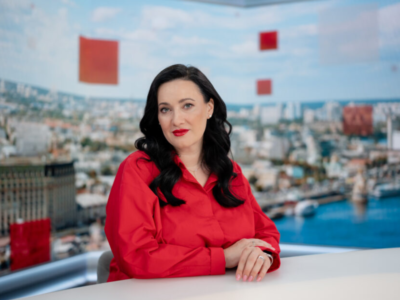
Yaroslav Yurchyshyn, Chairman of the Verkhovna Rada Committee on Freedom of Speech, explains how Ukrainian public structures continue to employ post-Soviet communication approaches with society and the media, and why Ukraine needs to shift its focus from recovery to survival.
Yaroslav Yurchyshyn is the Member of Parliament from Holos (Voice) fraction and the Chairman of the Verkhovna Rada Committee on Freedom of Speech. He was appointed to this position in December 2023. He identifies one of the Committee’s top priorities as countering the obstruction of journalistic activities, combating fakes, and securing the return of Ukrainian media professionals from Russian captivity.
In his interview with NV, Yurchyshyn discusses why journalists are dissatisfied with the communication of state structures, explores the feasibility of regulating anonymous Telegram channels, and delves into the prospects for the Yedyni Novyny marathon in 2024.
Are war and freedom of speech compatible at all? In other words, is it possible to have complete freedom of speech in wartime conditions?
In fact, freedom of speech is always a derivative of responsibility. If we adhere to the logic of the absence of any self-aware or ethical framework, it becomes quite easy to turn into a mechanism for disinformation or propaganda. Now, this is evident in the case of Telegram channels, where in the pursuit of hype or sensationalism, launching disinformation campaigns becomes very easy. They undermine the credibility of the media as a mechanism to safeguard the right to express one’s own position and to ensure the competitiveness of balanced access to information. Ukraine shows a rather interesting correlation between the need to protect its information field and, accordingly, the guarantee of freedom of speech. We are gradually returning to the relationship that we had before the full-scale invasion began. An increasing number of information registers are being opened, and the President is hosting a press conference attended by the vast majority of media outlets, allowing them to ask the questions they want. Another consideration is how prepared we are, both as a society and as media outlets, to pose tough questions to the authorities. Are all media outlets ready to do this?

It’s challenging to determine whether there will be an equal balance between protecting the internal information field and ensuring freedom of speech. This is easier to evaluate from the outside by observing the process.
In 2022, Reporters Without Borders highlighted Ukraine’s progress in safeguarding freedom of speech compared to the pre-war 2021. This is a huge achievement. However, based on the outcomes of 2023, our indicators are expected to be less favorable. Why? These pertain to the recent trends of pressure on journalists, combined with a lack of concrete results in the investigation of these cases. Additionally, the failure to change the format of the Yedyni Novyny telethon, which was crucial at the beginning of the full-scale invasion as a source of 24/7 reliable news, now raises more questions than it provides answers.
Therefore, freedom of speech, like democracy, is a process that needs constant improvement. A sense of responsibility for how events are covered, speakers given a platform, and the verification and independence of information sources are absolute components of true freedom of speech.
Earlier, you mentioned that Ukraine needs a law on disinformation that would enable making official claims against the owners of social media. How precisely should such a document address and resolve this issue?
We are discussing networks that operate in civilized jurisdictions, and currently, we are working on cooperation with them at the level of the European Parliament – an act that we will also need to ratify. Of course, we are not yet members of the European community – this act is set to enter into force in 2025. This is more of a challenge than an opportunity. This approach would enable us to communicate directly with administrations and owners of social media, allowing us to influence the policies implemented in communities such as Facebook, YouTube, and others. That’s why we are currently in talks with the European Union and the Council of Europe, aiming to become [part of this network] of European regulation. Telegram falls beyond all these limits because no one in Europe uses it. This is the specifics of the post-Soviet space, a huge level of anonymization. The nominal owners say that they are independent and do not report to the Russian authorities. But simultaneously, when protests erupt in Bashkortostan [A republic within the Russian Federation that wants to secede from Russia] for some reason, opposition groups are promptly shut down, facing issues with information dissemination.
Therefore, we will probably have two ways. The first is to improve the Law On Countering Disinformation. The Anti-Disinformation Center of the National Security and Defense Council has long raised the question that we need to improve this area of regulation.

We had a working meeting with representatives of media expertise. The majority of them agreed: if a mechanism to address the synthetic distribution of messages is found, [it can be influenced]. I mean, not the natural birth and gradual popularity of a message, but rather the snowball method where it becomes popular immediately. Russian propaganda, like Chinese propaganda, often uses synthetics. The message is disseminated through bots and anonymous accounts, often created and cultivated specifically for this purpose. It instantly gets maximum distribution, and then ends up in the mouths of propagandists a la [Russian propagandist who works on television Margarita] Simonyan.
If this is a natural distribution, influenced by the networks’ dynamics, it becomes impossible to control and poses a danger. It shifts from combating disinformation to specific censorship. Telegram is most widely used for synthetics. In fact, through specific regulations, we can compel Telegram channels to either register or provide mechanisms for our special services to exert influence. After all, we have experience in banning social media platforms directly associated with the Russian Federation, such as Odnoklassniki and Vkontakte. If we become a space covered by European regulation, then Telegram, in principle, cannot exist without verification. Well, here’s a question for Durov [Russian businessman Pavel Durov, who is called the owner and founder of Telegram and VKontakte] or whoever is behind Telegram: are they willing to undergo at least a certain verification mechanism?
There are three ways we can act in this direction, but the third one is very complex. The first is to enhance accountability for disinformation, artificially amplified propaganda campaigns, and indirectly influence those participating in Telegram. The second, a more systematic and strategic decision, albeit progressing slowly, involves joining the unified regulatory European space. The question is when and how it will start. The third, most effective yet challenging to implement, often running counter to human nature, is to enhance skills in fact-checking and critical thinking. More improbably, we need to go all three ways.
The 65 + age category, which primarily watches Telethon, does not have this skill. They are used to the fact that when something comes from a TV or other verified source of information, it is true. That is why it is quite easy for Russians to manipulate this age category. The second most popular platform after Telegram is not Facebook, YouTube, WhatsApp, or Signal, but TikTok. And we understand that this is no less a challenge, especially with the use of artificial intelligence. Tik-Tok can be even more toxic than even Telegram.
But Tik-Tok is designed for a slightly different audience.
This poses a significant problem because even now in TikTok, there are videos where they purportedly imitate [Valerii] Zaluzhnyi or [Volodymyr] Zelenskyi, and children perceive this as a fan activity. If we contemplate banning Telegram, where does the older demographic shift? Of course, they are joining the most popular platform. And they watch all these fake mockumentary [A type of movie or TV show in which fictional events are presented in a documentary style to create a parody] that is, a combination of real and artificial. Someone with fact-checking skills would verify this and say that’s obviously just banter. And the older generations will not check. Imagine the scenario where a video is circulated, purportedly showing the Supreme Commander-in-Chief of the Armed Forces of Ukraine declaring that we have surrendered our weapons and dispersed – the panic it would cause. So there is no simple solution here. But the further we delay making a decision, the more expensive this decision will cost us.

Have you already mentioned Yedyni Novyny. What changes would need to occur for it to satisfy both the audience and the media aspect of the telethon itself?
There are many scenarios. The question is primarily directed at those responsible for information policy. Officially, this is the Ministry of Culture and Information Policy. Unofficially, this should be in coordination with the Presidential Office. Not because we have established such a historical tradition, but rather, during the presidential elections, the society bestowed upon him a level of trust that affords opportunities to influence even those areas not initially in the priority zone.
Expanding the number of available channels in the telethon can alter the perception of those who are most critical, leading to increased trust. Maybe not for long. There will be a significant difference in telethon slots – it still exists now, but there will be a tremendous upsurge. But that scenario is not very likely.
The second option is to expand the broadcasting standards, which are currently available in the public slot and, in principle, are satisfactory to the majority of media experts and society, to other slots. But the question is: what is the mechanism? These are commercial channels, and theoretically, the state should not interfere in editorial policy. Unless they do something illegal and they don’t. But this option would give a gradual return of trust. Hardly to the level at the beginning of a full-scale invasion, when almost everyone watched and trusted Yedyni Novyny. However, more than 50% trust in this scenario can be achieved at a certain stage. More information from the military, more competitive formats. I’m not suggesting a return to Svoboda Slova with Savik Shuster, but rather discussion studios where representatives from various political and public spheres can express different positions and views on political, economic, and other issues.
If these two scenarios are not involved, there will most likely be a third one. The anticipated or unanticipated path of Yedyni Novyny’s disintegration. Channels will raise questions about loosing popularity [among viewers]. At one point, trust in ICTV and 1+1 channels was measured in tens of percent, but unfortunately, the audience has now decreased to less than 10%. At this point, the countries should have a strategy for withdrawing [channels from the telethon].
There must be a guarantee that the practices observed between 2014 and 2021, where individuals associated with political, public, or social movements effectively disseminated Russian propaganda on certain TV channels, will not return. But here we return to the issue of combating disinformation. We need a mechanism for how to clearly distinguish and prevent that. Or understand that, unfortunately, Russian disinformation will be easier to influence us.
The process of exiting the telethon can be either strategically calculated, with the state guaranteeing certain stages of the exit, or it will occur naturally due to the voluntary nature of the association. Commercial channels will say, “we’re not interested anymore. Thank you, we are moving forward.”
At present, we are more inclined to pursue the second scenario, aiming for Yedyni Novyny to respond to the demand for more verified, balanced information and fewer elements like “two or three weeks” and forecasts for Crimea. At the beginning of a full-scale invasion, they were necessary. Now, taking a rather negative turn: people confront a reality that is not so optimistic, leading them to become more critical, and ultimately, they simply migrate to Telegram, abandoning the telethon. It’s challenging to determine the effectiveness of the second path. However, if not the second, the third option will happen.
2024 will become critical for Yedyni Novyny.
Either the format will change, providing the telethon with the opportunity to continue, or it will remain unchanged, prompting commercial channels to gradually consider withdrawing.

The dismissal of Valerii Zaluzhnyi and the media attention leading up to it highlighted that Ukrainian journalists are discontented with the communication of state structures at the official level. In particular, we are talking about a post from the Ministry of Defense saying “Dear journalists, no, this is not true.” How would you rate such communication?
The only synonym that suggests itself to me is such a very childish communication. Children, when faced with a problem, often try to dissociate themselves from it, saying “this is not me, and this is not my home.” No one wanted to say what it really was. Because it’s about taking on the negativity of this situation. Of course, we require unity between the political and military command, and if there are any misunderstandings, a change of command becomes a logical and natural process. But society would like to understand the reasons and goals. In the end, it had to be explained.
The mature leadership of the state addresses the adult society, saying, “Guys, the decision has been made, and it’s not a tragedy. We will continue to fight, continue to compete.” However, neither side has demonstrated maturity.
If we recall the communication of Zaluzhnyi, the General Staff, and the Presidential Office, it was about the same. They either remained silent or dropped some hints. This created opportunities for maximum disorientation of people. Therefore, bloggers who received information that the conversation had occurred and the process was initiated, even without a set date, perceived it as the resignation having taken place and began sharing it. Given the importance of the issue, some media outlets, of course, couldn’t resist the temptation to seize the moment before the information could be verified. So, they posted it in “our sources” format. The only result we obtained was a decline in confidence, not only in the authorities, already critically low for a country at war, but also in the media.
Telegram channels don’t care about trust at all, they worry about coverage. The problem is how communication should be built as responsibly as possible. If there is no solution, they should go out and say, “as soon as there is one, we will definitely inform you.” This is adult communication that calls for responsibility. And this, in particular, is the possibility of losing your position. Our officials are hostages of this post-Soviet communication. If you manage to pass the ball to someone else, they will be the ones fired, not you. With such communication, we will never build a society of trust. State bodies need to invest not only in positive communication, discussing successes, but also in crisis communication, being able to inform society when something isn’t successful and how they are addressing mistakes.
We have other examples. When, for instance, journalist Yura Nikolov uncovered corruption in the procurement of the Ministry of Defense, this department, during the tenure of [then head of the Ministry of Defense Oleksii] Reznikov, initially opted to follow the classic scheme and assert that there was no problem. “It was all invented by agents, we will contact the SSU,” and so on. After the stage of denial, the stage of acceptance gradually emerged: acknowledging the existence of a problem, attributing it to our predecessors, and emphasizing our commitment to addressing it. But there was such a long period between these two stages that it led to the resignation of the minister and to a change in procurement procedures. As a result, we again have a drop in confidence in the key guarantor of our national security, that is, in the Ministry of Defense.
Now Ukraine is in the process of adopting the law on mobilization. This is an extremely complex process: the country has been in a state of war for ten years, including two years of the full-scale invasion, led essentially by volunteers, those who felt the call of duty. But, of course, they are exhausted. Unfortunately, some of them have already died, some are wounded, and what we need primarily is interchangeability, so that they understand they can be replaced. However, we are dealing with the politicization of the process, the absence of mature communication, and the need for incentives, not just punitive, but also motivational.
My colleague Roman Kostenko [Secretary of the Parliamentary Committee on National Security, Defense, and Intelligence, MP of the 9th Convocation] recently registered a draft law, co-authored by more than 70 MPs. Along with another colleague, Volodymyr Tsabal [MP, Secretary of the Budget Committee in the Verkhovna Rada], they calculated the bonuses that can be provided to those who are ready to mobilize and actively destroy enemy equipment. The cost of the issue was not so high that even some motivational measures could work – for instance, strengthening the mechanisms of compulsory involvement in fulfilling a citizen’s duty to the state.
Sometimes Russian propaganda doesn’t even need to generate anything. They just sit and wait for us to criticise each other. So I’m very unhappy with the process. As someone who has been working with the authorities for a long time, I understand the reasons behind this. When communication managers propose making a critical statement about something, they are often told that it’s better to remain silent for as long as possible or simply not make a decision. If there’s a consensus that this is a prolonged war, and we’ll face challenges both externally and internally through various methods, we must adapt our communication strategies accordingly.

The recent high-profile scandal about the surveillance of the Bihus.info journalists’ team. How do you assess the events and the SSU’s reaction after the investigation was released?
In Ukraine, the special service is still not under parliamentary or civilian control. In other words, it pertains to self-regulation and the understanding that in a democratic country, prosecution or interference in private life without specific grounds, which require criminal proceedings and the permission of an investigating judge in the investigation of a particular case, is essentially impossible.
What do we have in the situation with [Denys] Bihus officially? Communication of the Security Service in the beginning was simply a failure. Firstly, when a crisis of this magnitude is reported by the press service, it is already a sign that the problems are more than serious. When there is a contradiction within the message itself – claiming surveillance of an alleged drug cartel, but acknowledging that this surveillance was illegal – how can we discuss anything? The subsequent communication from the head of the SSU, Vasyl Maliuk, showed more balance in response to the public outcry and the journalists’ investigation, although, once again, it involved a narrative related to drugs. But it was clearly demonstrated that these are unacceptable actions. Those who were involved in those actions are now under internal investigation, some of them have been suspended and dismissed. We can assume that, unfortunately, law enforcement agencies quite often abuse the possibility of wiretapping in certain criminal proceedings. In this case, it is either Article 307 [The illegal production, manufacturing, acquisition, storage, transportation, transfer, or sale of narcotic drugs, psychotropic substances, or their analogs is punishable by imprisonment for a term of four to eight years], or Article 309 [Illegal production, manufacture, acquisition, storage, transportation, or transfer of narcotic drugs, psychotropic substances, or their analogs without the purpose of marketing is a criminal offense under the Criminal Code of Ukraine] of the Criminal Code of Ukraine.
We very much hope that the National Police and State Bureau of Investigation (SIB), those who are currently investigating these components will provide answers. Although your colleagues have reasonable doubts: again, as an example – the case of an attack on Mykhailo Tkach. There are suspicions, but so far the case is not in court, although the camera recorded. Again, the Bihus case. Some specific people carried out the investigation, the SSU says that this investigation is illegal. Where is the suspicion, and where is the evidence that these individuals are the actual performers, leading us to the ordering entity?
The National Police and the Attorney General’s Office, in the case of Yurii Nikolov, say that they are already investigating the individuals who ordered the act. This brings a cautious sense of optimism; however, the specific name has not been disclosed yet, and the case has not reached the court. In the case of Kateryna Hanziuk, the ordering individual was mentioned several times, and years later, the court found Vladyslav Manher guilty. In the Gongadze case [Ukrainian journalist Georgy Gongadze was killed on September 17, 2000. On January 29, 2013, Oleksii Pukach, the former head of the main criminal investigation department of the Ministry of Internal Affairs, was sentenced to life imprisonment with the confiscation of property and a ban on holding public positions for the murder of Georgy Gongadze. During interrogations, Pukach implicated former Interior Minister Yurii Kravchenko, former Speaker of the Verkhovna Rada Volodymyr Lytvyn, and the second President Leonid Kuchma as individuals who ordered Gongadze’s murder. None of the customers were brought to justice], the maximum that we have reached is the performer – while everyone knows who ordered him.
In cases like Bihus, Nikolov, Tkach, or instances of regional pressure on journalists, effective operational work is crucial. This is unacceptable when, on the third day after Yurii Nikolov submits a report, an investigator from the District Police Department tells him, “You’ve submitted a report; we have 30 days to consider it. Why are you coming here every day and ask about that?” That’s not what we need right now. And it is rather naive to believe, being employees of the secret services, that investigative journalists who exposed ingenious schemes will not find who ordered them.
Do I have one hundred percent confidence that the surveillance of Bihus’ team was authorized in the highest offices? Unlike my fellow journalists, no. Considering how many plots Bihus.info has uncovered, there is a lengthy list of those who might have had an indirect influence on the SSU. We, as a state, are most interested in proving that this was the case. While official authorities remain silent, an increasing number of people are convinced that this could not have happened without approval from the President’s Office. Again, we return to the question: we are a country at war, and if there is no trust in those who lead the fight, the army becomes less effective. If there is no trust in top officials or their entourage, then we are in a huge crisis, in particular, a crisis of opportunities.

In early January 2024 you reported that 25 Ukrainian journalists are being held captive. Are their locations known?
At the most recent count, these are 26 journalists. A substantial number of them are public journalists in Crimea, including employees of national media and human rights defenders who have collaborated with Crimean Tatar media. They are held either on the peninsula or on the territory of the aggressor country. The vast majority are treated as citizens of the aggressor country, although this does not align with international standards. This is the biggest problem in protecting this category of civilian prisoners – Russia does not recognize them as such.
You also need to mention Victoriia Roshchyna [Freelance journalist Viktoriia Roshchyna, who also worked with Ukrainska Pravda, went missing in late summer 2023 in the occupied territories. The last contact with relatives occurred on August 3, and they filed a missing persons report on August 27, 2023] from Ukrainska Pravda who was captured on the contact line and now, probably, she is being held somewhere in Melitopol, or Berdyansk – we don’t know for sure, we have only indirect data. Since the Russian Federation has withdrawn from all international treaties, essentially acknowledging that its national legislation takes precedence over the international agreements it signed, the pressure on Russia is very limited. But, for example, the Russian Federation still remains a member of such organizations as the UN and the OSCE. These organizations are guarantors of international treaties, the Geneva Convention, according to which civilian prisoners must be released immediately when their detention is recorded. Unfortunately, our international partners are not as active as we would like.
Melitopol journalists who were captured during the occupation, Crimean civilian journalists, employees of several Ukrainian media outlets, including Roshchyn and others, should be the constant focus of attention for specialized structures working on the protection of freedom of speech. We will propose a resolution to Parliament, urging international structures to intensify efforts in pressuring Russia for the release of this category of civilians.
We have partnered with Reporters Without Borders to initiate a global advocacy campaign, somewhat resembling the campaign for the release of Oleh Sentsov that existed at one time. The strength of organizations like them, or the International Federation of Journalists, lies in their representative offices not only in Western countries but also in the Arab world, Latin America, and Africa, whose positions Russia is more sensitive to. The vast majority of recent prisoner exchanges took place, with the assistance, among other things, of certain Arab countries and Turkey.
Therefore, in collaboration with Reporters Without Borders, we will explore mechanisms of international advocacy to bring attention to this issue. It is optimal for us that, in any conversations with world leaders, questions are consistently raised about how we can maintain any form of communication when the Russian Federation arrests civilians, particularly journalists who have additional guarantees of inviolability in international law.
Do you think editorial offices should book employees in case of mobilization?
There is an example of an aggressor country, where all employees of federal media are booked and are not subject to conscription in principle. Russia perceives the media as one component of the propaganda machine, essentially calling all journalists to the information front. In Ukraine, the situation is slightly different. Despite having a level of interchangeability similar to that in the Russian Federation, we do not have the same quantity of human assets physically. Therefore, discussing booking in the current conditions – I would say, it will sound more naive than realistic.
A lot of mobilized media professionals now hold combat positions. Dozens of media professionals have been lost within the ranks of the Armed Forces of Ukraine. This is a complex issue that requires communication and discussion.
In one of the studies conducted by the NGO Women in the Media, it is noted that the mobilization of men significantly impacts the gender composition of editorial offices during wartime and the distribution of responsibilities within the team. What do you think about that?
It is possible that certain unique positions in the media can indeed be booked until interchangeability is established. Because if this war continues for a prolonged period – not just years, but decades – Ukrainian women will unfortunately have to learn and assume roles that were previously occupied predominantly or entirely by men. If, at this stage, we possess unique competencies and lack employees, predominantly men, the media outlets will be closed. So we will lose competition in the media, which clearly poses huge threats.
Let’s consider a period – be it a year, two, or three – where certain categories can be mobilized in a predetermined proportion. The media can choose to adhere to this proportion or not, similar to state-owned enterprises, public services, and business structures. If it is feasible to make these professions interchangeable, by investing like the state or with the involvement of international donors to retrain women for these roles, and we need time for this – this is also an option that will facilitate communication with a potential partial booking. But I am pessimistic in this regard. Now the need to train the reserve is measured in hundreds of thousands of personnel of the Armed Forces of Ukraine. Rather, we will have to talk about removing booking from certain law enforcement agencies or civil servants. In one format or another, everyone will be involved in the war. The longer this war lasts, the more likely it is that we will have to create certain incentives for even greater involvement of women in the army – not only on a voluntary basis, but also must mobilize them in certain categories.
We return once again to the question of motivation to attract all these people. After all, those who were motivated have already joined the army long ago…
As a state, we are interested in not only using the stick principle. This is the duty of a citizen – those who have fulfilled this duty are already in the Armed Forces. I really hope that they are alive and well, but, unfortunately, there are other cases. Here it is very important to use a carrot. I genuinely appreciate the new campaigns launched by individual teams, appealing to the idea that joining is an honor. They promise training, readiness, and a supportive circle of colleagues. But the state should also give answers: where will a veteran return to? And what is the guarantee that he will return?

After the war, an economic boom should not be expected. This will be a difficult recovery period. Will they have to compete with their colleagues for a job? Despite being a matter of justice, both male and female veterans invested their time in the defense of the state and should have had a workplace to return to after their service. But what if their company had massive layoffs? What’s in return? Can we allocate resources to support the initiation of personal businesses, ensure a certain period of financial assistance until at least three or four competitive positions are available for the individual to secure employment?
Recently, the National Council of Television and Radio Broadcasting together with the NGO “Women in the Media” presented research Gender profile of Ukrainian media. It underlines the significance of endorsing self-regulatory initiatives focused on achieving gender equality, such as the development of codes of ethics and standards for the media. What is your opinion on this?
The question here is simple: are we part of the Western civilized world? If the answer is yes – and we’ve even articulated in the Constitution that we aspire to be there – then it should be implemented. The modern civilized world operates based on the logic of equal opportunities, respect for diversity, and the promotion of the idea that everyone, irrespective of gender, ethnic origin, or social status, has equal opportunities. It’s the personal responsibility of individuals to determine how they will use them.
I believe that in matters of gender balance, media outlets that have assigned their employees to the journalistic ethics commission or collaborate with an independent media movement are more likely to implement such practices. In larger cities, this is more common, given that there is more access to information on how to do it.
My view is purely as a media user: we are sometimes even ahead of other industries in this regard. For example, the number of women among editors-in-chief is likely higher than among members of the supervisory boards of public or private enterprises. And the quantity of materials published on this topic exceeds the number of thematic discussions on this subject in corporate seminars. There is no limit to perfection, so I think we still have to work hard.
Both the President and the First Lady have been actively discussing the topic of post-war reconstruction in Ukraine, emphasizing the need to contemplate it even as the war continues. Sometimes, such messages are perceived critically by people, as if recovery is irrelevant for the time being, and we need to win first. How do you think this topic should be presented in the media today to appear organic?
The very information trend of talking about recovery during the big war is a little dangerous. It propels us into a non-existent reality – a reality where we can exhale and address internal problems in the absence of external pressure and a threat to the existence of the state. I like the term “survival” more. “In fact, we are currently a nation in survival.
I would also be happy to build a new country here and now, but in reality we cannot fulfill this task without protecting ourselves. Our entire discussion around mobilization is complex because we approach it from the standpoint of a peaceful Kyiv, under fire, with residential buildings hit by missiles. Yet, at the same time, we lack the visceral sense of war experienced by cities like Kharkiv and Mykolaiiv. In Kherson, Mykolaiiv, or Kharkiv, discussions with the mayor are not centered around recovery but rather on how to ensure people have access to drinking water – focused on survival in challenging conditions. I understand this logic at the time of promoting our counteroffensive. Now, the discussion needs to shift to survival, emphasizing the necessity for critical reforms: the overhaul of the judicial and law enforcement systems, the establishment of mechanisms to safeguard the rights of journalists and freedom of speech, and the restoration of emergency infrastructure. It’s not about creating a new country; it’s not about recovery, it’s about the here and now as an essential element of our survival. This shift changes the focus of our international partners. If we present the narrative of restoration, why hasn’t Ukraine received a single penny for restoration from the proposed funds? Because there is nothing to restore.

In a country contemplating whom to mobilize – be it a media operator where the media is losing its effectiveness, a representative of law enforcement wondering who will patrol tomorrow, or a teacher deciding who will educate children – discussing recovery seems a bit naive at times, in my opinion. To survive a war with a much more powerful enemy, we need critical help from our partners. It is illusory to contemplate what will happen tomorrow.
This material was made possible by the New Democracy Fund (NDF) and International Media Support (IMS) as part of the project “Breaking Down Barriers: Bringing together public organizations, media, and state bodies to achieve gender equality in the media space of Ukraine,” implemented by the NGO “Women in Media.” Any views expressed here belong to the authors and do not necessarily reflect those of NDF or IMS.