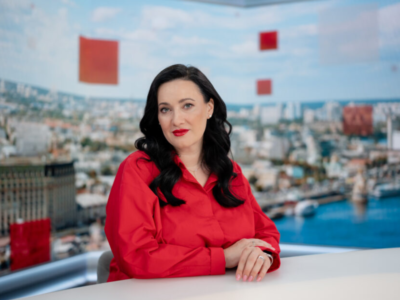
Women in Media spoke with three editors-in-chief of media outlets whose editorial offices were forcibly displaced due to the occupation. They discussed the search for new meanings in their work, the specifics of content selection, and the impact of the war on the gender dynamics within their teams.

Anna Murlykina, 0629.com.ua
“A few days before the full-scale invasion began, we had an editorial meeting. At that time, no one knew what scale [of war] to expect. We all made decisions based on our experiences from 2014. Not a single person out of the six who attended the meeting said they were planning to leave the city,” recalls Anna Murlykina, the long-term editor-in-chief of the local online media 0629.com.ua in Mariupol and a member of the Commission on Journalistic Ethics, reflecting on the start of the war in Ukraine.
At that time, she did not yet know that her mother, who was in the hospital, had cancer. However, a day after the invasion began, on February 25, she was forced to leave Mariupol for Zaporizhzhia to take her mother for surgery. She was never able to return to her hometown, although, even then, she had no plans to leave for good:
“I, like most people, did not believe there would be a need to leave Mariupol. I was sure my mother would have surgery in Zaporizhzhia and return to Mariupol in a couple of weeks. I packed only what was needed for a hospital stay: sportswear, and slippers. All valuables and everything else stayed in the house in Mariupol. Most of my colleagues left in the same way.”

The website’s editorial team was evacuated from the city over three days, from February 25 to 27, 2022, when it became clear that the offensive was serious. The editorial equipment could not be taken — it was destroyed. Later, it was revealed that the office had been robbed, and some of the computers began to reappear in different locations. For instance, one of Anna Murlykina’s colleagues discovered that someone was trying to log into her computer from Georgia.
On the first day of the full-scale war, the website’s only male journalist at the time, Oleksandr Hudilin, joined the army. On April 12, 2022, he was captured, and he remains in captivity to this day. According to Anna Murlykina, recent reports suggest that during this time, he was held in occupied Horlivka, Donetsk region, Olenivka, Taganrog, Russia, and then back in Horlivka, before being moved again to the Russian Federation. Last summer, Hudilin managed to send a letter to his mother through a man who was later exchanged and released from captivity.
“Although the entire letter was addressed to his mother, some fragments were also for me,” says Anna Murlykina. “Sasha’s wife, Natasha, photographed them and sent them to me. I cried when I read it. Sasha wrote that he remembers our conversations, and they help him cope. He also apologized, saying that, most likely, after returning, he won’t be able to return to the profession because he wants to focus on rehabilitating people like him — those who have experienced captivity.”
Another colleague of Murlykina, Maryna Moloshna, joined the Armed Forces of Ukraine, signing a contract immediately after leaving Mariupol. Three others went abroad — only one of them returned to work.
“In 2022, there were times when I worked on the website alone. I thought then that it was the hardest part. But it wasn’t, because the most difficult part is now. In 2022, I knew exactly what I was doing and why. Unfortunately, I don’t have that clarity right now. I’m not sure if I’m definitely doing something important for a clear purpose,” says Anna Murlykina.
This is also due to the fact that as more time passes since the occupation of Mariupol, it becomes increasingly difficult to find topics and angles, and to keep the audience engaged on the website about the city. In 2022, Murlykina recalls, it was clear that it was crucial to talk about Mariupol to a wide audience, including foreign and Western ones, because all the journalists had left, and there was no one else to do this work. Those who remained in the city after the occupation were also unable to transmit information to the controlled territories due to communication and electricity issues.
“All that we received at that time was mainly thanks to the press service of Azov, because they had Starlinks. I also had two people in Mariupol who had access to the Kyivstar tower, which was powered by a generator. These two people could make calls from there, but the calls lasted only 30-40 seconds — I didn’t even have time to ask a question. It was very fragmentary, but valuable evidence,” recalls Anna Murlykina.
She says that until the end of 2022, she worked “on this wave, like a powered gadget”: writing about people who experienced the blockade, left Mariupol, and underwent the so-called filtration procedure. She barely ate and hardly slept, releasing one interview every day. And then, she says, everything broke:
“It especially began to grind inside me when I started to look more closely at the people who remained in the occupation or who were leaving it. This shifted my idealized picture of the world, where there were only Mariupol heroes — all the same, and Russian scoundrels — all the same.”
At the end of 2023, the team at 0629.com.ua, for the first time since the invasion, conducted a strategy session and set goals for the year. This was when the idea of becoming a platform that unites Mariupol residents scattered around the world emerged. The challenge, says Anna Murlykina, is that these are actually three different audiences with three different information needs: those who left Mariupol and settled abroad, internally displaced persons, and those who remain under occupation. During this time, the journalist notes, the interests of the audience have changed dramatically. In particular, back in 2023, the theme of the liberation of Mariupol was unifying — people had hope for the future. However, it soon became clear that the city’s de-occupation would not happen in the near future:
“Now, talking about the future of Mariupol after de-occupation is becoming taboo. The theme has shifted from inspiring, to unifying, to now being seen as annoying. The three groups of our audience have started to diverge. It is very difficult for us to cover their interests, but we are trying. We write stories about successful employment abroad, adaptation, learning new languages, government programs, mortgages, compensation, payments for IDPs, and the work of evacuated medical and educational institutions. The most difficult part is finding topics for those who are still under occupation.”
In June 2024, Anna Murlykina became a member of the Commission on Journalistic Ethics. With experience working in a city where 90% of the media was owned by a single person — the oligarch Rinat Akhmetov, which influenced the dynamics within the media community — she is keenly aware of the importance of a healthy professional environment and support among colleagues.
“We worked hard to build the reputation of our media outlet and defended it, which later, in 2022, helped us secure our first grant,” emphasizes Anna Murlykina. “Now, I stress the importance of maintaining a strong reputation, because it helps us survive in difficult times. Working according to standards is what keeps us from making mistakes.”
Yana Chumachenko, Severodonetsk Online
Yana Chumachenko, editor-in-chief of Severodonetsk Online, moved to Severodonetsk after Luhansk was occupied, a city where she had worked for many years as a journalist in various media outlets. The regional correspondent for Depo.Donbas worked until 2016, when she went on parental leave. Afterward, she nearly dropped out of the profession, and by the time the full-scale invasion began, she was contemplating a return to journalism.

“When the full-scale war started, we left immediately — I understood that I couldn’t stay in Severodonetsk because of my professional activities. We went to stay with relatives in the Lviv region, because this time we didn’t want to move somewhere nearby, as we had in 2014. I was somewhat out of touch with the media context, and a small child needed constant attention,” recalls Yana Chumachenko about the beginning of the invasion. Now she lives in Ivano-Frankivsk.
Severodonetsk Online, founded in the late 1990s, was headed by Yana Chumachenko at the end of 2023. She recalls that when she saw the media was planning to restart and looking for employees, including women, she applied for a vacancy but didn’t expect much success. However, they hired her. Yana Chumachenko worked as a journalist for about six months, and when the publication began to expand, she became a publishing editor. About a year later, she was appointed chief editor.
Currently, Severodonetsk Online employs displaced people, all from the Luhansk region. Along with the expansion, regional staff were also added, including people from Zaporizhzhia, Kyiv, and Ivano-Frankivsk. Regarding the gender component, women predominate due to mobilization.
“The three of us started: me, founder Andrii Nidchenko, and journalist Evhen Tetianychko. A little later, our communicator Kateryna Hariachko joined us. Subsequently, Andrii joined the Armed Forces of Ukraine, then Yevhen. Even later, a social media manager left to serve. Now, we have two men and about eight women,” says Yana Chumachenko. “I used to work in gender-balanced editorial offices, which was great because there are different approaches. Now, women are trying to take on everything themselves. It may be easier in some ways because a woman understands another woman better, but overall, I would, of course, strive for gender balance.”
Today, Severodonetsk Online primarily focuses on the audience from the occupied “triangle” of towns: Lysychansk, Rubizhne, and Severodonetsk. In these towns, there is no communication with local residents who remain under occupation, making it very difficult to gather information about daily life. Unlike Luhansk in 2014, where it was still possible to contact residents despite the occupation, says Yana Chumachenko:
“We understand that reaching the occupied territory is almost impossible. Therefore, in addition to the website, we are also developing TikTok and other social media platforms so that people who have moved to Starobilsk or Luhansk can watch the news. However, we mostly still focus on our audience of displaced persons scattered across Ukraine.”
The content produced by Severodonetsk Online features positive stories about IDPs who have managed to revive or start their own businesses from scratch, as well as addressing the broader challenges faced by IDPs, such as housing, payments, and more. Another key aspect of their coverage is memory preservation.
“We understand how people left. Those who left by car could take at least something, while those who evacuated by train or bus could only take one bag. As a result, no one was able to bring family albums or photos. A lot of things were lost,” explains Yana Chumachenko. Her parents’ apartment was hit by a shell, destroying children’s albums and school photos in the fire.
“We call ourselves the encyclopedia of the city — even before we updated the concept and approach of the publication, we had a lot of historical materials. Now we continue this topic — about historical memory, about the origins of this war. We conducted a survey among the audience, which showed that people are very interested in this. Last year I spoke at the Donbas Media Forum — people thanked us for our work in this direction. They hugged me, we cried,” says Yana Chumachenko.
We also talked about burnout in the profession and fatigue: the editor admits that this summer she took a few weeks off, during which she did not open her computer at all, because she could not communicate with anyone. Then it began to seem that everything that was being done did not make sense and was not needed by anyone, all the interviews were “the same”, and people stopped being interested in the war. In addition to her vacation, Yana Chumachenko was also helped by working with a psychologist, and some of her colleagues also received psychological consultations. She emphasizes that she made sure that this year everyone took a full vacation and rested. If one of the colleagues gets tired, the editor-in-chief tries to reduce the load.
“Burnout and the constant search for meaning – why you do it – is exhausting. Many people in our editorial office face this problem. Therefore, I want to think about it in advance, send it to a psychologist, give it a break for a day or two,” the interlocutor explains.
Working with topics related to the war is not easy morally, adds Yana Chumachenko. Some stories have to be passed through — so that then it takes a day or two to “recover” from a difficult conversation. However, these are the realities of our times, from which there is no escape:
“We make materials with the military, the wounded, and the wives of the fallen soldiers — it’s hard psychologically. We didn’t learn this at the university — how to work in such conditions, with such sensitive topics. This is constantly a new experience — you are afraid that you will step in the wrong place, you will hurt someone.”
K. is a local media outlet from the occupied part of the Kherson region
K. is a journalist and editor with many years of experience, originally from a small village in the Kherson region that is now under occupation. Prior to the outbreak of the full-scale war, she worked as an editor for a local publication that had both a print version and a website on The City platform, which was launched in 2018 with the support of the ABO Local Media Development Agency.

K. was unable to leave the village immediately after Russian troops entered at the beginning of the invasion. The journalist remained under occupation for several months, attempting to transmit information to the territories controlled by Ukraine. For security reasons, K. requests that her first and last name, as well as the names of the publications with which she has collaborated or is currently cooperating, not be disclosed.
“We woke up under occupation. Chongar was about 100 km away from us, so columns of tanks passed along the highway on the morning of February 24, 2022. Our editorial office was located in the center of the village, and it was robbed. We had nothing left, but we continued to inform the public through the website. We never stopped our activities for a single day — I think we just hadn’t realized yet the risks and serious challenges this posed to our security. There were issues with internet communication, but news continued to appear on the website every day,” K. recalls the beginning of the full-scale war in their region.
A few months later, she decided to leave the occupation. She spent five days in a filtration camp in Vasylivka, Zaporizhzhia region, waiting for official exit corridors. After that, she ended up in Kyiv. Colleagues from neighboring communities, who also wanted to report on life in the occupied region, began to join in creating content.
“I divide our website’s audience into three categories. These are people who remained in the occupation, IDPs within Ukraine, and those who went abroad,” says K. “I monitor the occupation information resources every day, as there is a lot of news there. This information can be useful for the small group of people who remained under occupation—those who did not go to serve the Russians but for some reason cannot leave. It’s important for them to know that they have not been forgotten. It’s important for them to read local publications and stay connected with Ukraine.”
In addition, the website is also filled with materials about local self-government, including information from the relocated village council — for some time, its website was blocked. News is published about the provision of material assistance to the families of military personnel, police officers, rescuers, and the families of those who were captured, injured, or died. It also provides data on the restrictions or rules set by the self-proclaimed occupation authorities in the locality, such as curfews, the appearance of new roadblocks, a ban on the sale of alcohol, etc. The website also offers specific tips, such as what to do if a relative dies in the temporarily occupied territory, how to restore lost documents, and much more.
As for the part of the audience that reads the resource from abroad, materials about finding housing, using public transport, employment, and receiving medical services in different countries are particularly useful.
“From the very beginning, we tried to collect and provide as much information as possible, so that it would be concentrated in one place—on our website. In social media, pageviews have fallen because readers do not leave an information trail behind them. They are afraid to leave comments and likes. And this applies not only to those who are directly under occupation but also to those who left the occupation, as almost everyone still has some relatives there,” says K.
Before the start of the full-scale war, her team consisted of four people. Today, the work of the online publication is essentially carried out by two people: K. herself and the technical specialist who maintains the website. Occasionally, other authors are involved in content creation. Such activities do not bring profit in themselves, unless there are grant projects. However, according to K., such projects can currently only be found for short periods—ranging from several months to a maximum of six months. Therefore, they mainly work “on a volunteer basis,” the journalist notes.
In order to provide for herself and her family, K. works as a biology teacher at a school, as she has a teaching degree. Currently, she teaches children remotely, but in addition to teaching, she also attends advanced training courses.
“I have lessons until 3 PM, then from around 3 PM to 6 PM — advanced training courses and passing exams. I am currently in a media residency in Bucharest, and as part of this, I must also fulfill my obligations under the project: attend events and write materials. Plus, I need to upload at least three news pieces to the website. This is my daily work,” K. lists everything she does during the day.
Finding long-term funding for her media is a real dream for K., but it also requires resources that are not yet available. After all, everything would once again fall on her own shoulders: finding a suitable project, filling out a grant application, describing all the responsibilities, and coming up with an idea. In addition, according to K.’s observations, grant-givers are generally reluctant to support small media outlets.
When asked if such work drains her and if she feels professional burnout, K. answers as follows:
“The maximum workload mode, so that stupid thoughts do not get into my head, is a normal state. If I had six lessons before lunch, I had enough communication. And I still need to communicate either by phone or Zoom, collect information, or just look through websites, write news. Therefore, I am more likely to act as a psychologist — especially if I communicate with the occupied territory,” K. explains.
About her motivation to continue writing for the website, even though it almost does not bring profit, the media worker says:
“People should not feel left to fend for themselves — even if they are under occupation, even if they have left for other regions of Ukraine or abroad. But how can I abandon people? I know that no one else will do this job. People are waiting for news every day.”