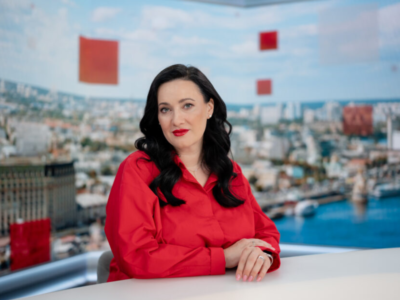
Olga Herasymyuk, discusses the differences between blogging and journalism, how modern Russian propaganda works, and the origins of sexism in the Ukrainian media sphere.
On March 31, 2023, the Media Law came into effect, one of the requirements for Ukraine’s accession to the EU. This law is part of a major media reform and introduces several changes in regulating the media sphere in Ukraine. It specifically introduces co-regulation in the media market as a new type of relationship between media and state bodies.
The new law also proposes to move away from the traditional concept of “mass media” and instead use the term “media.” Print and online media outlets can now voluntarily undergo registration procedures with the National Council. In addition to “classic media” such as editorial offices, bloggers who operate on YouTube, Instagram, Facebook, and authors of Telegram channels can also register and obtain media status.
In practice, the implemented innovations of the law work by allowing Ukraine to combat Russian propaganda and disinformation. As for whether Ukraine should restrict access to Telegram, Olga Herasymyuk discusses these issues in this interview.

It’s been almost a year since Ukraine has implemented the new Media Law. Can you tell me what has changed in the Ukrainian media space during this time as part of the media reform?
I’ll start with the best: this reform has been recognized by the European Commission as one of the most successful. We have seven main requirements that must be met for Ukraine’s accession to the EU. We’ve been working on our media reform for over 10 years. The main requirement laid down for all countries preparing for accession is the implementation of the Audiovisual Directive, which Ukraine fully incorporated into the draft law from the outset.
In one year, we’ve accomplished a lot: we’ve adapted internal procedures, documents, restructured the composition of the National Council, making it more suitable for new tasks. Although the Council is still called by its old name, it has actually become a convergent regulator. We regulate things that were not previously within our competence. After all, the modern media sphere is no longer just radio and television. It’s a completely different technological era. And we’re currently mastering this new challenge.
The new media law has provided measures to counteract the propaganda of the aggressor country, which were absent in regulation for several “peaceful” decades. The law enables more effective regulation measures against violations. At the same time, it provides more protection for the media itself. Violations are now classified, and there are verified methods of influence in the event of minor, significant, and gross violations. Gross violations include, for example, actions that lead to violent change, overthrow of the constitutional order, incitement to aggressive military conflicts, violation of territorial integrity, and other actions that threaten national security. Significant violations include content promoting violence, hatred, discrimination, and similar phenomena.
Previously, we didn’t have the opportunity to react to this. Now, significant violations entail substantial fines, while gross violations may result in license revocation, cancellation of registration as a media entity, prohibition of publication and distribution of printed media, as well as temporary or complete prohibition of online media dissemination.
Regulation isn’t just about reacting to violations. It’s also about collaborating with the media industry to build a high-quality, manipulation-resistant, fake-free, and disinformation-free information space. It’s about consulting together, discussing any observed mistakes, and being ready to meet, debate, and correct them jointly.

The power of stereotypes must be toppled.
We often invite editors, producers, journalists, and media lawyers to joint discussions. Overall, this year we’ve held seven thematic roundtable discussions — this is one of our priority projects, titled “Competent Media – Democratic and Tolerant Society.” We’ve had meetings with Jewish human rights organizations, Crimean Tatar, Muslim, Roma, veteran groups, as well as with church councils, associations of people with disabilities, and LGBT+ communities. Together, we discuss how to ensure that all layers of our society are visible in the media just as they are in life, so that everyone has access to information, to the media, and is part of this process — just as they are an integral part of society. Accordingly, we monitor and observe the trends developing in this direction.
The power of stereotypes must be toppled. There are historical, cultural, and everyday stereotypes. They pass from generation to generation and, consequently, are reinforced through the media. Similarly, they can be overcome through the media. This is very important work, and it yields serious results. Because we see how positively things are changing.
You mentioned that the Law on Media provided new opportunities to combat hostile propaganda and disinformation. What exactly is being referred to?
Hostile propaganda continues its work constantly and has been able to manipulate people’s minds in preparation for the current conventional war. Let’s remember Crimea, Donetsk. It evolves, so to speak, and the “crucified boys,” “combat mosquitoes,” “snowdrops” — all these and similar absurd, terrible fakes have now acquired and continue to acquire more sophisticated, more toxic forms. The development of new media technologies has also expanded these possibilities. Right now, it is crucial for us to convey to the entire partner world the necessity of seeing the paths of development, as well as the impact of disinformation on all societies. This is currently aimed at weakening support for Ukraine and “calming down” countries regarding the actual risk, namely the risk of further Russian aggression beyond Ukraine’s borders.

We have been and continue to fight for the adoption of sanctions at the European level regarding Russia Today, Sputnik, and similar resources. Because as soon as these “sewers” are closed, hundreds of small sites and pages with different names appear, where the same content is disseminated. Russians disguise themselves as European media. According to the new law, we must register them if their origin is European. They also masquerade as Ukrainian media: spreading their narratives through Ukrainian online resources. These, in turn, uncritically and without source verification, in an unreasonable pursuit of clickbait, reprint manipulations and disinformation.
Online is now the main battlefield, there is a lot of work to be done here. We cannot ban social networks, as Russia did. However, regulating digital platforms is an issue that has already been approved in the European Union as crucial, especially considering disinformation. Recently, laws on digital services and digital markets, as well as the law on media freedom, have come into force in Europe. When Ukraine joins the EU, we must also implement them.
Thus, the regulation of major platforms is today’s reality. This list includes, in particular, Facebook, Meta, Amazon, and others. Extremely serious sanctions are defined in case of law violations by them. However, Telegram has not yet been included in this list. The platforms included in the list have a user base of at least 45 million. They provided this information themselves, and Telegram reported a figure slightly higher than 39 million. But if we calculate how many times and in which countries users access Telegram, and how dispersed the Russian-speaking audience across Europe is – Telegram’s main audience – they will be included in this list. According to our colleagues from the Estonian regulator, for example, in Spain alone, 25% of users consume Telegram, and 11% in Austria. According to some information, European partners are currently working on this issue.
The world is effectively governed by a dozen large privately-owned digital platforms. They must be accountable to societies. For us, communication and cooperation with colleagues from European regulators are important in this matter. Ukraine is a member of EPRA (European Platform of Regulatory Authorities), where all “national councils” of Council of Europe countries are represented. There, we actively collaborate with partners to address these issues. Recently, the National Council was invited to join the European Regulators Group for Audiovisual Media Services (ERGA) as an observer. We have bilateral memoranda of cooperation with a number of regulators.
Currently, we are working on a memorandum with the French regulators, with whom we are in constant contact. A particular focus of cooperation is satellite distribution, through which Russian channels are broadcast, which falls under the jurisdiction of France. And this is a private business, making conversations very challenging as commercial interests prevail there.
In September 2023, in Warsaw, we signed the Declaration of Five Countries: Ukraine, Poland, Romania, Latvia, and Lithuania. This is a joint platform where we agreed to specifically combat Russian disinformation and propaganda.

In an interview with Tucker Carlson, Poland was identified by Putin as the instigator of Hitler’s attack in 1939. We proposed to our Polish counterparts to issue a statement to the European regulators of major countries, as well as to the platforms that spread this interview. The issue is not about Tucker, but about the fact that large digital platforms have become a place from which this spread to millions of user audiences – essentially, platforms have become a means of spreading hateful ideologies, fascism, justifying genocides, and the Kremlin’s imperial interpretation of history, which is intended to be fixed in the minds of people worldwide.
In our work, it is also very important to know the boundaries so as not to cross the thin line under the guise of fighting violators. We, as regulators, understand this very well, so we always stand on the side of those who talk about preventive measures.
The fight against disinformation is our constant, daily, routine, but relentless battle. The Russians have a lot of money, a lot of institutions specifically working on this constantly, and they have been doing so long before the war started. They have a backup plan for every case. Now they are attacking through the West: firstly, where elections are taking place, narratives are spreading about the need to stop assistance to Ukraine, and this is very noticeable. Within our country, this is also very noticeable because these narratives are picked up by Ukrainian media to create clickable headlines. I think often media professionals lack the professional knowledge to understand where it works and where it is dangerous. We need to grow professionally faster – war does not give a vacation for this school.
You’ve already mentioned Telegram channels. Why are they so popular in Ukraine today?
Telegram channels have become very popular because of their convenience. It’s very quick: you enter, see what other resources haven’t provided yet… Many of our state officials, organizations, and communities have set up their own Telegram pages. We also read about air raid alerts there.
This convenience is also used by those who promote disinformation and manipulative messages through Telegram. Because the main feature is the anonymity of the platform. Consequently, there is impunity and speed in delivering disinformation. Very often, for example, pages are created under the guise of a regular page, such as a page for a particular city. At first, they really talk about this city, its parks, walks, important household messages, and people go there because it’s interesting, important, and it’s about you and for you. And then they are fed with fake news. Once, a whole series of Telegram channels appeared with the logo of our National Council, claiming that these were channels of local communities under the auspices of the National Regulator. We had nothing to do with it. Obviously, a network of influence channels was planned.

In an interview given to Ukrinform in July 2023, it was discussed, among other things, that according to the new law “bloggers in Ukraine can voluntarily register and officially become online media,” but no one forces them to do so. At that time, among the online media registered by the National Council, there was one YouTube channel. Has this figure changed as of now?
Currently, we have registered 231 online media, including: 183 websites, 11 Facebook pages, 10 Telegram channels [with three more applications being processed], 16 YouTube channels, 7 Instagram pages, and 3 on TikTok. Also, one Viber, one WhatsApp, and one X. They have registered as media – essentially, they are officially journalists. Those who have received registration may be accredited, for example, if they want to attend a press conference. They will not be told, “Who are you, get out.”
Was the Telegram channel “Trukha” not registered?
Not yet. But, by the way, I spoke with them once. When I first mentioned last summer that there were problems with Telegram due to the spread of discriminatory messages, there was an outcry. They started to insult me in the best traditions of black PR. Trukha then reached out for a comment and promised not to distort my words. Incidentally, I asked them, “Why don’t you register?” The journalist promised to talk to their owner. But so far, we haven’t received any applications. Perhaps they will come [to register].
But doesn’t this undermine the role of journalists? Does it mean that previously one needed to obtain specialized education, work experience in editorial offices, and have a portfolio to be considered a journalist, but now it’s enough to just register as media?
Today, the boundaries between many things and concepts have blurred in the world. Everyone who has a Facebook account is also a journalist today. Even large traditional news agencies often provide news with a reference like “as written on their page by such-and-such.” And this such-and-such turns out to be a source—not just a source of information, but also an authoritative source, which could, in fact, be a competent expert, rather than a Facebook or X journalist. Today, bloggers who lack proper professional education largely determine the agenda. And to a large extent—not in the best way.
What, in your opinion, is the significant difference between blogging and journalism?
If you look for theoretical definitions of this, you’ll read about dozens of different, serious distinctions. But in reality, they no longer exist. The question in front of everyone is one: the quality of work and the absolute responsibility of the author. To become a professional, you still need quality education, a strong cultural level, literacy, and experience. This hasn’t changed. Today, you can get a good education without being limited to the journalism faculty of a domestic university. I even envy the modern young people with this new range of possibilities, which we didn’t have in my journalistic generation.

The concept of freedom of speech is often manipulated, especially considering that it’s about responsibility.
However, today we also face significant challenges in this field: whether someone has a portfolio or not… Media literacy is a pressing challenge of our time. The concept of freedom of speech is often manipulated, especially considering that it’s about responsibility, professionalism, and quality. But when it comes to regulation, whether you are registered or not, if you violate the laws of Ukraine, particularly the Media Law, you will be held accountable. By registering online media, we are simply leveling the playing field, because television and radio journalists have always been required to comply with the law, while anything goes online.
What are the threats posed by artificial intelligence and deepfakes today?
Artificial intelligence is not a threat; it is the Fourth Industrial Revolution, or Industry 4.0, which has brought many fears that machines will replace humans. This fear is quite old. Yes, AI performs many tasks that are characteristic of human intelligence. However, whether it will live its own life is too early to say. We do not know all its possibilities, though we should not dismiss them. In any case, behind AI stands a human. So, if we take a narrow framework—media, we can talk about significant benefits for simplifying many technical processes, as well as, logically, the downside—using AI to harm. All human inventions have this side. Therefore, there is an ethical code that, especially in our era, has shifted from something secondary to the number one question.
Just recently, the European Parliament adopted an Act on AI. Also, recently, the Ministry of Digital Transformation, together with the National Council, the Ministry of Culture and Information Policy, and relevant experts, developed recommendations for responsible AI use in the media. The goal is to familiarize Ukrainian journalists with current international practices in this field.
As for deepfakes, it is a threat capable of ruining people’s lives, relationships, and influencing societal processes. Ironically, the first means of combating this is AI itself: for example, Microsoft, Google have already launched their technologies that AI uses to detect forgeries. The second means is human critical thinking.

The phenomenon of deepfake is truly destructive. Recently, I found out about my “death” from a video on YouTube, or more precisely, from numerous calls and messages to me, which surprised me. I asked what had happened, why I suddenly received such specific attention— at that time, I was at the UN. It wasn’t a very classical deepfake. However, it caused many friends, relatives, and colleagues to have a difficult time before the truth was revealed. It’s known that the video was created by an anonymous channel, perhaps to increase its clickability, or maybe it had other tasks. Currently, access to it is closed, but we have reached out to the platform and are awaiting a response.
I also know that hearing about oneself—of a similar nature—caused a very painful reaction in a well-known, public figure of old age, coupled with personal tragedy. American colleagues who learned about such a case said it was a crime and should be severely punished. Such actions are aimed at amplifying “noise” and causing disturbance. Sometimes, it’s hostile actions.
Immediately after that, there was the spread of misinformation about the “death” of King Charles III, and our media outlets spread it. There will be many such cases. Therefore, I emphasize the need for serious critical thinking.
In December 2023, the National Council, together with the NGO Women in Media, presented the Gender Profile of Ukrainian Media. Why is this topic important for discussion now?
This research is unique. Just about five years ago, when we were just beginning to address the issue of gender balance in the media and didn’t have any laws on the matter at that time, we gathered representatives from various media outlets, mostly television. We asked them if they could share information about the gender composition within their media groups—how many men and women worked there, in which positions, etc. You can’t imagine the alarmed reactions this elicited. “Why do you need this?” “It’s our business.” “You shouldn’t be asking about this at all.” I couldn’t understand why. Moreover, at that time, everyone was saying, “What’s the problem anyway? Don’t we have equal rights for women?” It was only later, when we started working on this and showing how things really were, that our colleagues began to recognize the stereotypes, see what they had previously overlooked, and contemplate redistributing roles and addressing the invisibility of certain issues.

In media of the “colonial type,” it was implicitly believed that a female presenter should be young and attractive.
After years of resistance, in the Gender Profile of Ukrainian Media study, media professionals for the first time, and there were over 200 of them, revealed themselves as they are. Not long ago, I was on a mission to the UNESCO headquarters, where I presented our work. Colleagues were enthusiastic and named it one of the best European practices. Especially notable was the aspect that we are working on this amidst war. We received similar praise recently at the UN, where I shared this experience during the Commission on the Status of Women. Copies of these studies have been sent to various continents.
GENDER PROFILE OF UKRAINIAN MEDIA
Due to mobilization, many men are forced to leave their positions in civilian life, including in the media, and join the army. Meanwhile, more work is being transferred into the hands of women, often involving new tasks or greater volumes and responsibilities. How does this change the gender landscape in newsrooms?
Many men and boys have gone and continue to go to the frontlines, but women also answer the call of duty to fight for our freedom. Many women working in the media, especially in regional areas, risk their lives by reporting from hotspots, delivering vital information to their viewers, readers, and listeners under fire, ensuring communication access, conducting filming, and rebuilding the destroyed infrastructure of their channels and studios. I know many such examples in Chernihiv, Sumy, Poltava, and Kherson regions…
Honestly, I never particularly felt a “gender” difference in newsrooms, although it was there, of course. Today, the war has changed it even more.
The Gender Profile of Ukrainian Media is the first stage of its research. It was important to understand and document what exactly is happening in this sphere. For example, there used to be a stereotype that media executives are predominantly men. However, the aforementioned study showed otherwise. It turns out that women hold the majority of managerial positions in the media. Interesting data is also available regarding the gender distribution among presenters and “field” correspondents.

Another interesting aspect: the older the employees in the media, the fewer women there are among them. Older men are considered okay when they work on screen or in the media in general. Perhaps, this is also a stereotype – in the “colonial type” media, it was implicitly believed that a female presenter should only be young and attractive. Older women, regardless of talent or professionalism, were not selected for work. By the way, unlike Western practices. You’ve probably seen attempts by some channels to have news anchors present the news in evening attire – as they say on social media, “to attract attention”.
Previously, young women often presented the weather, for example, in quite revealing outfits.
Well, they chose forms. And this was the female media version of the profession, which is actually called “the use of the female body for commercial purposes.” Although we also had an older weather presenter, very popular – Mykola Lutsenko, who worked on ICTV. I regret that he decided to step away from the screen. But still, as women aged, they mostly faded into the background. It’s happening now too.
For example, do you remember older women hosting shows on Ukrainian television? I remember, once Tamara Shcherbatiuk hosted the program “Nadvichirya” for a very long time. But precisely because this program was intended for older people, for “pensioners,” as we call the older generation here. By the way, they never call the older generation “pensioners” or “grandmothers” in the West. There is no such “category” there.
Recently, there was a scandal at the Kyiv Institute of Journalism, where female students accused one of the professors of sexist remarks. They also created an anonymous Google form where they collected anonymous stories from other students who had encountered inappropriate behavior from this professor. Among the responses in this spreadsheet, there were mentions that the professor expressed sentiments such as “only the beautiful work on television” or that one should get married at the right time. This goes to show that such attitudes unfortunately sometimes start not from newsrooms, but even from universities. Although, of course, not all professors are like that.
Not all are like that, indeed. By the way, I myself have encountered such cases in my life. I lived at a time when women were not potentially considered important individuals. Back then, you couldn’t become someone central in journalism if you weren’t: a man, a party member, or didn’t have a Kyiv registration. All of this applied to me at that time.
Even if you write a letter, and sign it in blood that you will never get married, never have children, it wasn’t considered an indulgence – you were always seen as a defective employee. Because you’re a woman who has her function. If you somehow managed to break through, you sometimes had to hide your pregnancy, risk your health, do significant and sometimes harmful work for less pay and zero appreciation. I have a lot to tell from my own life in this regard too.
Today, despite everything, I see many changes. Already many people think and act differently. Women and girls act differently, and boys and men think differently too. In general, today we are a nation worth admiration.
The things you mentioned about this professor need to be changed immediately. Such people cannot be teaching. Now there is a new director at the Institute of Journalism, and I am confident that he will put an end to such phenomena. Journalistic education also requires a fundamental overhaul.

In August 2023, in one of my interviews, I mentioned that in Ukraine there are plans for a dictionary of “undesirable lexicon” for the media, meaning intolerant language that is not recommended for use due to the inappropriateness of certain terms. Why is such a dictionary needed?
Actually, it’s somewhat the opposite. We are working on recommendations for how to speak on air correctly. As mentioned in our conversation, we are working together with various communities to make our media stronger in language tolerance.
When we spoke with all the groups I mentioned – national communities, gender, religious, and other communities – they all identified a common problem: they are invisible in the media. For example, Roma people say they are never invited to comment on anything that doesn’t involve a crime. And they don’t want to be called “Gypsies.” There’s a stereotype that Roma people are criminals. Or, for example, the Jewish community says that a Jewish expert is usually called upon to comment on issues in Uman, if something happens there, or, at best, on the Jewish New Year. The same is said by religious figures who could comment not only on Easter or Christmas but also on unpleasant incidents in the church.
Veterans, people with disabilities, and others cite examples where their status in the media is confused with illnesses or terminal sentences, which can evoke pity and undermine dignity. Sometimes in the media, situations like “a veteran without arms or legs entered university” or “someone in a wheelchair [The terms “wheelchair,” “disabled wheelchair,” or “disabled cart” are considered incorrect. Recommended terminology: wheelchair] got married” are presented as something extraordinary.
Ukraine is a multicultural, multireligious country with a rich history. It is a country rich in educated, intelligent people from different communities. That’s why we recommend building media manifestations in this way. Also, together with these human rights NGOs, we are creating a dictionary of recommendations on how to speak to each other, represent each other without discrimination, in a tolerant and dignified manner. We consult with the public, and they advise us on what is considered offensive, what is correct, and what is neutral.
These dictionaries of recommendations will be constantly supplemented and changed because over time, everything changes in societal relationships and concepts. What was previously considered normal for someone may sound offensive or have different definitions today. Why is this important? Because it concerns human life, which is the highest value.
Note: This material has been translated using artificial intelligence. If you have found an mistake, please inform us by email: ngo.womeninmedia@gmail.com
This material was made possible by the New Democracy Fund (NDF) and International Media Support (IMS) as part of the project “Breaking Down Barriers: Bringing together public organizations, media, and state bodies to achieve gender equality in the media space of Ukraine,” implemented by the NGO “Women in Media.” Any views expressed here belong to the authors and do not necessarily reflect those of NDF or IMS.