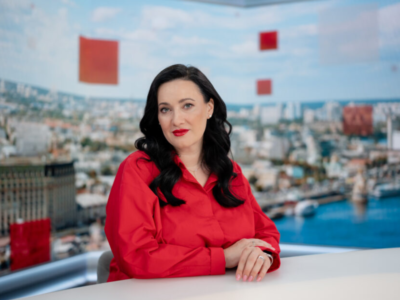
Tetiana Berezhna is the Vice Prime Minister for Humanitarian Policy and Minister of Culture of Ukraine. She was appointed in October 2025, and a few months later, in December, she publicly introduced her new team.
On December 25, on Christmas Day, Tetiana Berezhna became a mother, giving birth to her first child, a daughter she named Osaka. On December 31, at the last session of the Cabinet in 2025, she showed up with her baby.
In her interview for Women in Media, Tetiana Berezhna shares how combining motherhood and government work affects her productivity and talks about support programs for creative industries, particularly ones aimed at women in this sector.
You have recently given birth but you have been working since the very first weeks afterward. How does this affect your personal productivity as a mom and as a minister?

Yes, I have a new role, one of a mom. There are still many stereotypes in society that a woman cannot combine work and motherhood. I really wanted to show by my own example that they are indeed stereotypes.
I gave birth on Christmas, and a week after delivery, I went to a government session with my child. It happened by chance: my baby started crying, and I realized that the only way to calm her down was to hold her. My daughter calmed down, and the meeting went smoothly. I want to thank my colleagues and loved ones for their support. This is really very important.
I sincerely believe that every woman has the right to choose. Someone wishes to spend more time with the baby, and someone is ready to combine motherhood and work right away. Every woman has her own interests and preferences. There are different people, different situations. The only common things here should be society’s support, understanding, and empathy regarding moms and their choice.
Speaking of me, during this time, I have realized that motherhood has made me even more productive. I have acquired new skills: crisis management, strong time management, and prioritization. I clearly understand that my working hours should be as productive as possible since I also need to dedicate my spare time to my child. I think women who combine motherhood and work often become even more productive because of this.

We have previously seen examples of women politicians from other countries across the world combining these two roles in public. For instance, in 2025, German MP Hanna Steinmüller spoke from the Bundestag podium wearing a sling with a baby for the first time in history. Social media is already calling you the first such example in Ukraine. What do you think such public manifestations can change for Ukrainian women in politics on a global scale?
Ukrainian women are actually overcoming a lot of stereotypes now. We see women on the frontline, among volunteers, medics and paramedics, leading enterprises, defending our country.
There used to be very few cases indeed when women politicians would come to a Government meeting or a Parliament session with a baby. But the world is changing, and so are the challenges. It has now become completely natural that your child becomes part of your life. At the political level, we must show that there is nothing strange about it.
I guess many women never even thought this was an option. If my example helps at least some women understand that the decision is up to them, that they can choose what works best for them, that’s already important.
Now, I feel a double responsibility. To the state, to other women, but also to my baby daughter. What I am doing for the country now I am also doing for my child. I would like to tell her someday that I used this historic moment responsibly.
What systemic barriers still prevent women in cultural industries from fulfilling their potential?
I remember how we were talking in a 2023 interview about the gender pay gap, which was about 18.5% at the time. And the biggest gap was in the cultural sector. The issue is that there are many women in culture, but they rarely hold leadership positions. That is what leads to the pay gap.
At the same time, I am confident that these barriers are often stereotypical rather than systemic. Ukrainian women have proven that they can work in leadership positions, in business, in politics; they can defend the country. They have always done that.

The government must create opportunities through grand programs, support for entrepreneurship, access to resources. For instance, in the recently launched grand program “Your Own Business” for creative industries, over 63% of winners are actually women. This shows they have potential and it can be fulfilled.
Is the Ministry planning separate support programs for women in culture, creative industries, and media?
We are working on support programs for creative industries in general. Women are often the main beneficiaries of these programs.
It is important to me that government tools should be open and accessible. When women gain equal access to resources, they perform very strongly. This also benefits society as a whole. Culture thus becomes more diverse, stronger, and more representative.
We view the development of support programs for women as an investment in the quality of our cultural environment. The issue of gender equality is the fundamental principle of cultural policy, which you can even see when you look at deputy ministers of culture. We integrate a gender-sensitive approach into our support programs, and we plan to strengthen it systematically. This includes grant and competition mechanisms, as well as the educational component.
Together with the National Social Service and the State Committee of Television and Radio Broadcasting, we have developed the “Gender Socialization” memo. Furthermore, we are guided by international practices of cooperation with UNESCO and the EU to create conditions under which women in Ukraine will have equal access to funding, international opportunities, leadership positions, and global visibility.

Could you please tell us about the Ministry’s priorities for 2026? What have you already started working on first?
I have been the Minister for almost six months. I dedicated the first few months of my work to immersing myself in the sector: I had daily meetings with representatives of the theater community, museum workers, cinema professionals, librarians. I had to understand what could be resolved here and now.
As for strategic priorities, the first one is getting more resources allocated to culture. We speak a lot about culture as an element of national security, the nation’s voice. But this is nothing but words unless it is backed by funding.
We launched the Ukrainian Cultural Heritage Fund. It is a tool to engage international resources into restoration of monuments. There’s also the new presidential national culture support program.
Another significant step is the law on patronage that has been approved by the Cabinet and should soon be considered in the Parliament. This is an opportunity to engage business funds for culture. Ukrainian patronage comes from a deeply rooted tradition. Just think of the Kyiv-Mohyla Academy or the Kyiv-Pechersk Lavra, which developed with the help of patrons.
The second major priority is the preservation of Ukrainian cultural heritage. We see that Russia is deliberately attacking it. The shelling of St. Sophia Cathedral and the National Museum of the History of Ukraine during World War II are attempts to erase our identity.
We have adopted a historic resolution to evacuate culturally valuable objects from high-risk areas. Now, an area within 50 km of the front line is the zone of mandatory evacuation of museum items. Such guidelines have been adopted for the first time since 2014. They include those responsible for the evacuation and the procedure, which will help to preserve more valuables.
Cultural institutions must be financially sustainable. This means proper management and visionary leadership. At the Kyiv School of Economics (KSE), we have launched a program for managers of cultural institutions to teach them to work with patrons and develop projects that businesses would be interested in funding. The rules for providing paid services have also been simplified. This makes it easier for museums, theaters, and nature reserves to make money independently.
During my visit to Copenhagen, I visited the National Museum of Denmark. Its funding comes half from government support and half from its own income. This helps the museum to not only rely on the state but also receive funds from its own earnings, spend them on important investments, research, and increased paychecks for employees. In Ukraine, own earnings often constitute just about 10%. We need to change this model.
We are working to ensure more translations of Ukrainian literature into foreign languages in the best publishing houses across the world. This vector is managed by my deputy Bohdana Laiuk. I sincerely hope we will see results as soon as this year. It’s upsetting to watch a foreign film or read a book where the main character just happens to be reading a book by a Russian author. For some reason, even though Russian literature, like Russian culture overall, is a culture of expropriation, appropriation, it still permeates the global context.
Our task is to make Ukrainian culture visible. This is not only about books; this is also about tours of Ukrainian bands and artists. This requires systematic work with Ukrainian embassies abroad, with ministries of culture of other countries. We are working to show the Ukrainian culture abroad not only to the Ukrainian diaspora, to develop foreigners’ taste for Ukrainian culture as well.

A national program to support Ukrainian content has already been announced. How is it going to work, and what is the role of the media industry?
This will be the biggest culture support program throughout our independence, initiated by the President of Ukraine. The mission of the program is to form a generation that feels a sense of belonging to its country, thinks in Ukrainian terms, and is resistant to external informational influences, and to do it through modern Ukrainian cultural products. Another goal is to support Ukrainian artists and discover new talent, particularly in the regions. This includes audiovisual art, music, theater, exhibitions, short films, and YouTube content.
We plan to start selecting applications in the spring. The themes will be outlined but will not limit the artists’ freedom. It is important to create a product showing that Ukrainians are a strong, talented, resilient nation. It also signals to Ukrainians abroad that they need to come back to Ukraine as there is a great demand for talent now.
For the media market, it is a way to obtain a high-quality Ukrainian product that will compete, generate demand, and strengthen the domestic industry.
As for the world, we need to show that our history did not start in the 1990s. Its continuity is illustrated, among other things, by the fact that we are now talking in the Metropolitan Bishop’s House of the Sophia of Kyiv National Reserve, which has been here for hundreds of years. However, Russia keeps trying to appropriate this history: they have now started filming Queen Anna, a feature film where Prince Yaroslav the Wise will be played by Russian actor Sergey Bezrukov. This is yet another attempt to steal historical figures and culture, which is very cynical in itself.
Our task is to talk about Ukrainian culture, tell the historical truth to the world, and often even to ourselves. We do this on various diplomatic platforms. But it is one thing to speak at meetings and another one to do it through a cultural product that can convey the truth and meaning better.

What do you think is the role of culture in countering Russian propaganda?
Russian propaganda weakens where Ukrainian culture, history, memory of the past, and truth are present. It will also grow weaker when we create enough original Ukrainian products and provide more opportunities and support to our talented artists and institutions.
We must emphasize creation, not prohibitions. Prohibitions still have a place, of course. Russian culture has been imposed for centuries by displacing Ukrainian culture. Now, we are investing in our own work. This will help displace hostile narratives from our space.
Would you kindly tell us more about the Ukrainian book support program announced by the Government? How is it going to work?
Book publishing and language policy are among the Ministry’s priorities now, and these sectors now have their own dedicated vector within its structure for the first time.
Today, the YeKnyha program allows everyone who turns 18 to get money to purchase books. We are also working on expanding the program to offer it to parents of newborns and to university students.
The second vector is the procurement of books for libraries. The law provides for regular restocking of libraries, but this provision has unfortunately been disregarded for a long time. We are developing a co-financing program with local budgets so that libraries can get new Ukrainian books.
Supporting bookstores is the third vector. We are working on a resolution on preferential lease of premises for Ukrainian bookstores. This should encourage the opening of new stores across the country.
The Ukrainian Book Institute and the Translate Ukraine program also play a big role, providing grants to foreign publishers to translate Ukrainian books into other languages. As I mentioned above, it is important that we make Ukrainian culture and literature more visible in the entire world.


What place do the media industry and information policy hold in your plans?
Since 2026, strategic communications have been transferred to the jurisdiction of the State Committee for Television and Radio Broadcasting, which is guided and coordinated by the Cabinet of Ministers of Ukraine. The formation of the media policy remains with the Ministry of Culture.
Our key focus areas include the implementation of European legislation in the media sector and the development of media literacy. We understand how active Russia is in the information space. Therefore, media literacy is a matter of national resilience. We still have the national media literacy project Filter, which is aimed at improving critical thinking. We are also working to counter foreign information manipulation and interference (FIMI) and are preparing a new Information Security Strategy.
In addition, we are working on the implementation of European media legislation. This includes the European Media Freedom Act and the Anti-SLAPP Directive. These are standards that guarantee media independence, protection of journalists from frivolous lawsuits, and editorial autonomy.
Additional priorities include the support of media in frontline areas and journalists’ safety. It is also important to increase public and diplomatic pressure to release Ukrainian journalists held in Russian captivity.
Is the Ministry of Culture planning to appoint a dedicated deputy for media issues?
Media policy is within the purview of Natalia Movshovych, Deputy Minister of Culture for European Integration. It is her responsibility to create favorable conditions for the work of the media in Ukraine and to protect the professional activities of journalists.
Should gender equality become a separate strategic priority of state policy in the field of culture and media, particularly in the context of European integration?
Gender equality should be a separate strategic priority in culture and media. This is directly related to European integration. European standards include, among other things, equal access to opportunities and zero tolerance for discrimination.
Culture and media shape social norms. If women are represented, protected, and have influence over decisions in these areas, it changes the entire system: from the issues we raise to whom society considers opinion leaders. Therefore, it is important that there should be more women in leadership positions in culture and media and more equal access to resources and funding.
The Women in Media NGO actively works on documenting online attacks against Ukrainian women journalists. In the course of our work, we reach the conclusion that Ukraine often lacks legal leverage over platforms like TikTok, Meta, and YouTube, where such attacks tend to take place or disinformation about a specific person is disseminated. How does the Ministry plan to build a dialogue with such platforms to protect Ukrainian content and comply with DSA standards while the Digital Services Act itself has not been adopted in Ukraine yet?
As long as the Digital Services Act is not implemented in Ukraine in full, our options are limited, since these platforms are private companies. After the full implementation of the DSA, as required by the European integration process, the state will have more mechanisms for communication and response.
Overall, DSA is based on the principle that if something is illegal offline, it’s also illegal online. That is, if Ukraine recognizes certain content as illegal, for example, content that promotes war, then online platforms must respond. The implementation of DSA will provide real, legally effective tools to influence global services. This way, we will be able to create a European system that will mandate online platforms to restrict illegal or dangerous content of the aggressor country.
How does the Ministry of Culture plan to work on promoting Ukrainian culture abroad? What role can be played by Ukrainians in other countries?
Promoting Ukrainian culture abroad is one of the key goals of our team. This is also about Ukraine’s international agency, about formation of the right narrative, and our long-term presence in the global information space.
Now, we are building systematic work. Every focus area has a designated responsible team: deputies and the team work on cultural diplomacy, international programs, translations, participation in festivals, cooperation with embassies and cultural institutions of other countries.
This includes strategic cooperation with ministries of culture of other countries, international organizations and institutions. There are different tracks and vectors. For example, this spring, we are going to organize a meeting with foreign ministers of culture to discuss the key challenges in Ukraine’s cultural sector and how we can unite to overcome them.

Another big track is the presence of Ukrainian artists at key international platforms, such as festivals, book fairs, film markets, and exhibitions.
One of the most prestigious film forums in the world, the Berlinale, has just ended. A Ukrainian national stand was set up at the event, as part of the European Film Market. It held a number of events which, among other things, were aimed at developing cooperation. Ukrainian works were also presented at the Berlinale, and one of them won an award.
The Ukrainian documentary Traces by directors Alisa Kovalenko and Marysia Nikitiuk received the Panorama Audience Award. This is a very complex, painful film. It shows the stories of six women who suffered sexual violence and torture at the hands of the Russian military. This documentary got an award and thus resonated with the entire festival and the international community. This serious subject was heard, understood, and supported by viewers from different countries. It’s an example of culture speaking the language of the truth. And the world responds to this truth.
The third priority of our work is the development of translation programs and the promotion of Ukrainian literature in leading global publishing houses.
I would also point out systematic interaction with Ukrainian communities abroad. This is a task that the Ukrainian government is working on. There’s work done by my colleagues from the Ministry of Foreign Affairs, the Ministry of Social Policy, Family, and Unity of Ukraine. Since the start of the full-scale invasion, 5.6 million Ukrainians have remained abroad. Some of them left before the full-scale invasion, a long time ago, and some relocated after it started. They need to be safe. The decision to return to Ukraine is their personal choice. At the same time, it’s important to maintain their connection to Ukraine. Culture is one of the things that help us keep this link.
Furthermore, Ukrainians abroad can act as ambassadors. Many have already undertaken this role, amplifying the voice of Ukraine. They create cultural spaces, organize exhibitions and theatrical events, and integrate into the professional environment of other countries. During one of my visits at the end of last year, I had a very productive and heartfelt meeting with the Ukraine House in Denmark. This is a place that holds regular cultural events. A point uniting both the Ukrainian community and foreigners.
Our task is to support these initiatives systemically. Through coordination with embassies, through partnerships with local institutions, through joint cultural events and programs. We are working to ensure that Ukrainian culture abroad not only serves as emotional support for the diaspora but also becomes a full-fledged part of the cultural landscape of other countries.
Ukrainian women journalists are increasingly facing online attacks, disinformation, and AI fakes. What role do you envision for the Ministry of Culture in shaping a safer information environment?
The issue of interaction on the Internet and the information environment is a common challenge across the world. It cannot be solved by one institution or country, only through cooperation. We understand this, my foreign colleagues understand this. For example, at a meeting of European culture ministers in Cyprus, this is one of the first topics to be discussed.
The issue of media literacy and implementation of European standards is part of a broader strategy. AI technologies create new challenges, from fake videos to manipulated audio. Therefore, developing society’s resilience to such threats remains key.
Gender-based online attacks are also a freedom of speech issue. When a journalist is discredited through sexist insults, fake stories, or fake videos, it is done only to silence her. We systematically work together with civil society. By the way, thanks to cooperation with the Women in Media NGO, who participate in the Council of Europe’s campaign Journalists Matter, we share the best practices with our colleagues from the Council of Europe, OSCE, and Coalition for Media Freedom.
In 2025, we presented the study When AI Turns Hostile: Gendered Threats against Ukrainian Women Journalists, conducted by the Women in Media NGO, to our international partners. Technologies change very quickly, so protection mechanisms must evolve just as quickly.
Of course, documenting such attacks are a separate vector. The interactive map of attacks on women journalists by Women in Media helps to record cases of online violence, cyberbullying, misogynistic campaigns, and sexualized fakes.
Have you personally encountered sexism or ageism?
For me, professionalism has no gender. Competencies have no gender. It is important that a person know what their values and outcomes are. This is how I work, this is how the team of the Ministry of Culture works.
There have been some comments. For example, after I gave birth to my child, people wrote I absolutely had to go on maternity leave. But this is more of a manifestation of stereotypes. I try not to focus on that. The focus should remain with the outcome of my work.

At the same time, I understand that such practices still exist. They affect women’s lives. That is why the issue of stereotypes should not be avoided; instead, the approach should be changed systemically, through examples, equal opportunity policies, and a culture of mutual respect.
Support from colleagues, family, partners, and society is essential in this process. When there are more women in leadership positions in the public space, it normalizes the presence of women in power. And then the question “Can she do it?” gradually goes away. Because women can definitely do anything.
What kind of Ukraine would you like to envision for your daughter — in terms of equal opportunities for women in culture, politics, and media?
It’s one thing to pave the way yourself. But it’s entirely different from understanding that your daughter will end up on this path one day, too. It is at this point that you feel a wholly different level of responsibility. Frankly speaking, this gives you a major boost of strength and energy.
I want my daughter to live in Ukraine, a country of freedom, respect, support, and opportunity. Where she won’t have to prove that she, a girl, “can do it, too,” and won’t have to choose between career, motherhood, and dreams. Where professional opportunities are determined not by gender, age, or stereotypes, but by competencies, character, and hard work. We already live in difficult times, and our children will have to work hard. So we have to get at least this part in order.
I want women to be a natural part of leadership in culture, politics, and media, not an exception or a symbol. And for me, it’s not just about women’s rights. This is about the quality of the state and a healthy structure of society. When there is equal access to opportunities in a system, it becomes stronger, fairer, and more competitive.
It is important to me that my daughter grows up in Ukraine where she can dream big. If I can take even a small step in this direction today, I will do it every day.
This material was made possible by International Media Support (IMS) as part of the project “United for Equality in the Media: Promoting Gender Equality Through Cooperation Between Public Organizations, Media, and Authorities” implemented by the NGO “Women in Media.” Any views expressed here belong to the authors and do not necessarily reflect those of the IMS.