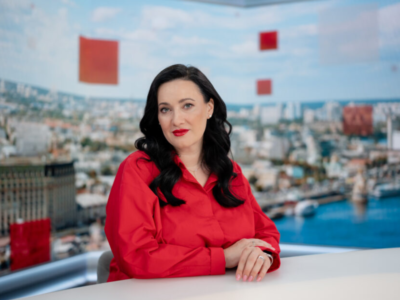
Mariya Frey, a board member of Suspilne, discusses the broadcaster’s work and the implementation of gender policies in media campaigns, highlighting their potential impact in both the short and long term.
Mariya Frey was the general producer of regional broadcasting at Suspilne, and since March 2023, she has been a member of the board. She is working on developing and implementing the strategy for Suspilne’s interregional platform, which includes 24 regional TV channels. She has experience as a journalist, producer and coach.

In an interview with Women in Media, Mariya Frey discusses how the gender policies adopted by Suspilne before the full-scale war reflect on the salary situation in Ukraine’s media market and explains the invisible problems that women in media most often face.
Suspilne exited Yedyni Novyny marathon: what prompted this decision?
First, it is important to discuss the context in which Suspilne operated after the start of the full-scale invasion. Starting on February 25, we began building an information channel system based on regional branches. It took some time to prepare. In 2022, we structured this system to have several teams working in different regions. With the help of international partners, we created a fantastic studio in a backup broadcast center.
From early 2023 to the beginning of 2024, we were able to independently broadcast information 12 to 24 hours a day. The entire information broadcasting system was designed to deliver content to all existing platforms. When the telethon formed a new schedule in May of this year, distributing slots unevenly among media groups within a single production, Suspilne declined to accept the allocated slots.
Alongside other media groups, we worked toward consensus for a considerable period. Now that we have the capacity and all processes are in place, we can resume producing our own information telethon. We continue to exchange content with Yedyni Novyny on a partnership basis.
Recently, there has been much discussion about the telethon focusing more on portraying how well we are doing and that victory is already within reach. Have you encountered a similar situation before, and did it in any way influence Suspilne’s decision to withdraw from the telethon?
The interaction within the telethon was managed by a separate group of people who continued to work, produce informational content, and maintain coordination. When collaborating with multiple media groups on a channel, it’s important to acknowledge that people cannot occupy the same slots, for instance. Regarding censorship or influencing decisions on who speaks or doesn’t speak, no one can sway public perception in that manner.
We had no influence on our editorial policy. We did what we thought was necessary. In fact, all monitoring, political party presence, and adherence to standards consistently demonstrate that Suspilne operates as any public broadcaster should. So I can’t say here about any additional pressure or extraordinary restrictions.

Now our non-stop format continues starting from 2022. It’s just that we finally brought all the teams to one platform. Ahead lie challenging decisions on how to optimize all available TV channels. We plan to make these decisions based on thorough research. For example, determining what content is most consumed and valued, where our presence is most needed, and which platforms offer the most convenient access to Suspilne’s information.
A few years ago, Suspilne adopted gender equality and non-discrimination policies for its staff. What events or considerations led to this decision, and why did you deem it necessary?
The gender equality and non-discrimination policy was adopted at the end of 2021. This process is quite complex, as it involves a high-level document that is approved and reviewed by the Supervisory Board, our company’s governing body. The preparation process began approximately six months before, involving collaboration with external experts. The goal was to shape the policy in a manner that firstly complies with legislation, and secondly, reflects our aspirations and goals.
These policies establish fundamental principles concerning the equality of rights, non-discrimination, freedom of speech, and respect for the dignity of every individual. It also outlines the tools for implementation and subsequent evaluation of its effectiveness.
In 2022, when the full-scale invasion began, this question was temporarily set aside. There are several crucial points in this policy that we would like to implement but were unable to in 2022. For example, there were insufficient resources and capacity to develop educational campaigns for women. We were unable to accurately measure our effectiveness in implementing this policy in 2022 due to the presence of entirely different issues on the agenda at that time.
Before creating policies, we conducted a survey of employees within the company. This was significant because over 80% of the staff expressed the need for such a policy. On the other hand, more than 60% stated that we have no problems with this [gender equality].


As of 2024, we have not received any complaints regarding manifestations of gender inequality or discrimination, as outlined in our policies. This may be due to a lack of understanding of why we have this policy and its intended goals. Most likely, we did not sufficiently communicate this policy and did not achieve a deep understanding of gender equality within the company.
On the one hand, having this policy in place is an essential step. Without this foundational document, there would be no framework to reference. So I am in favor of creating such policies. However, it also requires the company to have the capacity and determination to analyze its performance and measure results.
Are you planning to survey your employees again to assess their understanding of the issues and how these policies can address them?
First, there should be an awareness campaign to refresh everyone’s understanding of our existing policies. And after that, it will be possible to conduct a survey. If we conduct a survey now, I don’t think the situation will change much.
When we discuss gender equality with women within the company, it often doesn’t connect to the practical realities they experience in the workplace.
These practical manifestations are sometimes not seen as “not okay” by the women in our company. For example, women might be given less time and attention than men to make a presentation or express their opinion. Often, men in relevant positions are provided with more opportunities to explain their views and receive more attention. We currently do not have a salary gap for the same positions, but there is flexibility to adjust salaries based on higher qualifications or different working conditions.
If we now place a 45-year-old man and a 45-year-old woman in the same position, considering that a 45-year-old woman often has children and has spent a significant amount of time giving birth, raising, and caring for them, they will likely have different qualifications and experiences.
When considering gender equality, we must first think about women: how their day is structured and how much time they spend on caregiving tasks. How much additional time will she spend due to men’s mobilization?
Considering all these aspects for our female employees, it becomes evident what actions we need to take as a company. As a budget-funded public broadcaster, we acknowledge that we may not currently be a perfect workplace for women, but we strive to be as flexible as possible to accommodate their needs.

We also have to create conditions for women to study. It is crucial for us that female employees have opportunities for development and acquire additional knowledge. What is needed? The most important thing is time. Not all women can study on weekends or after work. They often have additional responsibilities – tasks that were traditionally assigned to women by default. Education requires money, and although the cost is the same for women and men, the financial circumstances are often different. And if you aim to attain an MBA, discounts are rarely available. Studying also requires a dedicated space, which isn’t always possible to have at home. We, as a company, must remember the whole range of invisible problems and tasks that lie before a woman.
Has mobilization already had a significant impact on your company?
Currently, in our company, if you count all levels nationwide, approximately 57% are women. At the directorate level, women also predominate, comprising 50-57%. There are now two women at the board level, which is very good.
Suspilne has the opportunity to reserve 50% of military-eligible men. We cannot reserve everyone, so we always prioritize key personnel without whom the company cannot function.
Every manager faces the task of preparing non-military women to replace mobilized staff. Yes, it is difficult. A year ago, I entered an on-air studio that was predominantly male-dominated. Now, I see that among ten men, there are already two women. This means that everyone understood the task correctly. Within the company, this issue is approached consciously —everyone understands that we will need to replace men with women in traditionally “male” professions.
We had female sound engineers, directors, and videographers. The most challenging area for us has been broadcast technology and information systems. For example, roles such as signal distribution or IT were traditionally dominated by men.
Indeed, all of this stems from the problem we created 30-40 years ago when we directed girls towards certain roles and boys towards others. Now we need to find a person in IT, and we understand that there are very few women in the field of IT technologies. If we continue to perpetuate these stereotypes now, we may face an even bigger crisis in the next 10-20 years.

Do you think that media professionals should be exempt in case of mobilization in order to avoid such a shortage of personnel?
In times of war, journalism serves as a ray of light. If we do not create conditions to exempt media professionals from mobilization, we risk losing this ray. Another question is in what volumes, which media professionals to reserve. For example, we now have the fantastic Media White List initiative from the Institute of Mass Information. I strongly believe that media on the White List should have the option to reserve their colleagues. As for other media, the issue is debatable.
I believe that Mediarukh, or another organization, a media self-regulatory body, could help determine which organizations must necessarily have quotas for reserves, and which, unfortunately, do not fall under these quotas. But it is definitely necessary to reserve journalists, because there will be no point in waging war.
Do other editorial offices often approach Suspilne to adopt their experience in developing gender policies for their own companies?
As mentioned earlier, the first year was quite challenging for this work due to the full-scale war. That is why we first started talking about it in 2023-2024. Of course, people began to ask how we did it. We have been transparent about the fact that developing policies requires additional experts, which incurs additional costs, necessitating the need to find partners.
In 2024, we have witnessed numerous initiatives where non-governmental organizations funded by international support provide expert assistance to various media outlets to develop policies.
Policy development is foundational. However, without integrating this policy into the company’s operational planning, it may just remain a well-crafted document on the shelf. Having it is something to be proud of, but if you don’t disseminate it to people, unfortunately, it becomes a futile effort.
Since 2022, we have been measuring the presence of women and men as experts on our broadcasts. The introduction of this tool was challenging in the first six months, as editors, guests, and teams perceived it as additional work. They questioned why we should count since we already know whom we are inviting, believing it wouldn’t change the situation. However, after a certain period of time, it became noticeable that the participation of female experts remained consistently low — less than 30%. Then they began to think about how to improve this situation.
Our news administration interface includes all the necessary indicators for us as a public broadcaster. We monitor online which topics we produce the most content on, which regions receive the most attention, and the balance between coverage of cities versus regions, etc.
We are currently exploring options to automate this process using artificial intelligence, allowing for rapid data entry and analysis based on available content.

You’ve already mentioned that long-standing stereotypes about which professions boys and girls should pursue have resulted in a lack of women in certain fields. Do you experience a shortage of female professionals when you want to invite a female expert on air, but find that there are few available due to it being considered a “non-female” field?
Today, there are fewer female experts in traditionally “male” professions, which is a consequence of societal norms that once guided girls and boys toward certain roles and stereotypes. Once we remove these signposts and allow children to explore the world without these perceptions, there will be greater opportunities for women and more freedom for men.
Statistics on gender balance in EU countries indicate that, on average, only 37.5% of the supervisory boards of public broadcasters are women. When it comes to top managers, executive, and non-executive directors of public broadcasters, women make up 38.6%. It’s noteworthy that the Directive aimed at improving the gender balance among company top managers was adopted in the EU a few years ago to address this situation. The Law of Ukraine “On Public Media of Ukraine”, particularly Article 8 regarding the composition and formation procedure of the Supervisory Board of Suspilne, does not include any gender quotas or guarantees. What happens to equality issues in practice?
Currently, the president of the European Broadcasting Union is a woman. As far as I know, they are covered by this directive. The CEO is a man, and the directorate consists of three women and six men. They still maintain a provisional Executive Supervisory Board, chaired by Mykola Chernotytskyi, where there is a gender quota requiring 40% representation of women. It’s good.
On the other hand, it should be noted that European public broadcasters are well-established companies with ages ranging from 30 to 100 years. These are companies that have evolved beyond traditional television and radio markets, which are currently undergoing transformation. Very often, top managers of public broadcasters are men. When Ukrainian representatives attend meetings, we are quite progressive in this regard: we have female CEOs, chief editors, and chief producers. But this is also because women in Ukraine have taken on additional tasks and responsibilities, as men focus on the protection and defense of our country.

Parental leave is another good indicator in our gender policy. From 2021 to 2024, a total of 192 leaves were taken, with men taking 3 of them.
I was born and raised in Mariupol, in a very patriarchal society where, as one of three girls, my father often dismissed our importance, believing there was little value in having daughters. I gave birth to my first child at the incredibly young age of 23. But at that time, all my fellow students already had children and were married. I had my second child at 31 and it was a fantastic difference of motherhood. Now that I have two daughters, I tell them that to fully enjoy motherhood, it’s best to wait until after 30. Until then, you should learn, understand yourself, explore the world, accomplish meaningful things, build a financial foundation for yourself, and recognize that having a child after 30 requires carefully weighing all the risks. A child is for life.
Unfortunately, I grew up in a paradigm where you should get married quickly, preferably right after university, and then everything will be fine with you. But I have already been divorced twice. Nothing was good. Everything is a lie. I understand the challenges of moving and constantly renting an apartment. Without my mother’s support, I wouldn’t be able to manage with children, because working requires strength, composure, and confidence. In these moments, I was fortunate to have the support of my family, who helped by taking care of the children during holidays and vacations. But what if there are no such relatives, or if they are under occupation?
Salaries and fees in the Ukrainian media market have always been and remain significantly lower compared to those in European newsrooms. Why does the media sector remain insufficiently high-paid in Ukraine?
We must start with the fact that the Ukrainian media market has always been hypercompetitive. It seems to me that there was no such amount of media outlets anywhere in the world. This is because the media is a tool of influence, and independence was rare. Often, those who emerged did so with the support of international financial aid, such as Suspilne, which develops amid constant struggles for its own budget guaranteed by Ukrainian legislation.
What is happening now, with international media entering our market and offering fees of one and a half, two, or three thousand euros for journalists working in the regions, is actually detrimental to us. On the one hand, we are glad that our colleagues are receiving support in these difficult times. On the other hand, we understand that we will never be able to offer such salaries due to the high costs of our budget organization.
We are currently attempting to raise salaries for some employees in both the branches and the central office, but even for this, we need cash, which is lacking in Ukraine. Therefore, we encourage our international colleagues entering our market to cooperate with us, at the very least by exchanging content to have a greater impact on audiences rather than pursuing isolated solutions.
Another aspect related to salaries is the question of “net” salaries, which we discuss with representatives of the media industry. As a public broadcaster, we work exclusively with “white” salaries and pay all relevant taxes.
During the self-regulation conference in Kyiv in April 2024, you pointed out that ‘our salaries and fees are losing their appeal for male representatives. “And it seems to me that if we maintain the current trends in Ukraine, our company will soon be composed of 80% women,” shared Mariya Frey. I think this is directly related to the question of who traditionally takes maternity leave in the family. After all, it has always been believed that a man should earn more money and provide for the family, so he is the one who stays at work when a child is born.
This also reflects an issue of self-esteem among us women – why do we accept such salaries? And once more, it all comes down to education — broad and crucial. You should not agree to something just because it is offered to you. It’s both simple and profound, requiring years of conversation, reflection, and support for women to learn from each other, advocate for their needs, educate themselves, and ultimately develop financial literacy.
For me, a good indicator of gender equality in the country is also the length of time a woman can afford to purchase an apartment.
What does this indicator show?
In Kyiv, an apartment costs approximately UAH 3.5 million. With a salary of 15 thousand hryvnias, when will a woman be able to afford to buy an apartment for that amount? At the same time, our state officially records that 25% of the minimum subsistence level is enough to raise a child.
Often, problems with gender equality arise where we do not want to look, in those “blind spots” where we believe that nothing exists. For example, there is a female worker who has to work 8 hours a day, and everything else does not bother us.

The experience of Women in Media shows that many female media professionals in the community identify assistance with childcare as one of their greatest needs. Because they lack childcare options, women often decline opportunities to attend retreats, conferences, and other activities aimed at professional self-improvement. Many discuss the necessity of additional funds for hiring a nanny or the idea of establishing children’s rooms at editorial offices, where mothers can leave their children while they work.
I have firsthand experience with this: when my children were young, I frequently had to visit regional offices and travel on business trips. At a certain point, I wondered why my travel expenses were significant for me, while the company only reimbursed my ticket. If I bring children with me, that’s two additional tickets, an extra room or bed in the hotel, and additional meals, which the company cannot cover due to legislation.
If a woman has children under a certain age, we should create conditions that allow her to go on a business trip with her child. It doesn’t really cost too much.

We cannot expect the state to take responsibility for providing for the child after birth. No, we must consider all available institutions. What infrastructure is available for children from an early age? Childcare up to the age of three is important, but what about food for both the mother and the child during these years? Perhaps we need to consider kindergartens that accept children from 6 to 10 months old, as well as additional daily cares, to ensure that women can return to work quickly and have the opportunity to earn money. When we place ordinary women at the center of our attention, we can better understand their needs and provide the necessary support.
Everyone in this country, especially women, has a very individual experience.
This material was made possible by the New Democracy Fund (NDF) and International Media Support (IMS) as part of the project “Breaking Down Barriers: Bringing together public organizations, media, and state bodies to achieve gender equality in the media space of Ukraine,” implemented by the NGO “Women in Media.” Any views expressed here belong to the authors and do not necessarily reflect those of NDF or IMS.