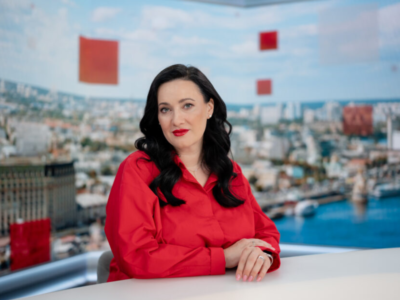
Olia Myrovych, the head of the Lviv Media Forum, shares whether Ukraine needs a “new ethic” adapted to the digital age, why Ukrainian media should unite, and what newsrooms need to know to persevere.

Olia Myrovych has many years of experience in non-profit management, strategic management in the civil society sector, and coordination of grant projects. She has been at the helm of the Lviv Media Forum since 2021.
In her interview for Women in Media, she talks about what Ukrainian media need to be resilient in difficult times, explains why online attacks have become a new challenge for newsrooms, and comments on the power of professional communities.
What do you think was the greatest challenge for the media market in 2024–2025? And specifically for the Lviv Media Forum as an organization?
I think the greatest challenge was actually adapting to long-term strategies, moving from a reactive response to a crisis to transformation within the crisis and to proactive planning for the future, because that’s hard to do during the war.
Many people and organizations in our sector have succeeded in doing this despite major challenges. Frankly, in many aspects, they have now become an example for journalists and newsrooms in other countries across the world. We have learned to plan as if we will live forever but act as if today is our last day. And this is a major advantage, which we can demonstrate not only within our national community but also to the global one. This view of tomorrow, strategizing against the backdrop of a major existential challenge, seems to be something that Ukrainian media organizations have learned to do.

What will be the greatest challenge in 2026?
Due to the difficult circumstances, the deterioration of the economy, mass shelling, and enemy information attacks, people are gradually losing trust in the media and institutions. So, I think next year we will be trying to rescue this trust and find a language that we can use with our audiences. This is so that they hear us and remain on the side of the good, so they would keep supporting democracy and resilience and resist panic and doubts. We are tired, the enemy is ramping up pressure, but I want to believe that we have enough resilience to survive.
Since the beginning of the full-scale invasion, over 300 media outlets have closed in Ukraine. What do Ukrainian media need in the current circumstances to survive?
First, we need to understand what value we bring to the environment, to the audiences, and to society beyond just existing. Ukraine has a significant number of professional, value-oriented, innovative media working in the interests of communities, and losing them would mean losing the voice of those communities. But there is also no shortage of those who haven’t succeeded in modernizing their approaches and formats over the years, failed to understand precisely what their audience needed, what values it had.

Perhaps, not every reader can tell the difference between high-quality and low-quality media outlets, but I would assume everyone can tell the difference between one that’s useful and one that isn’t. For example, a useful media outlet in the fourth year of the full-scale war would feature a list of schools with well-equipped shelters where children can study or professional recommendations for businesses on how to organize their work during blackouts. One that is not as useful would feature an interview with a local official claiming that their town will flourish. I feel that in order to survive, you have to be useful; you have to understand what you bring to the table.
The situation in the media market is probably the least favorable now compared to the entire period since the full-scale invasion. The largest donor stopped its support program, most newsrooms had already spent the funds they used as a safety net, citizens’ and businesses’ incomes are rapidly dropping, and even those newsrooms that were able to develop sustainable funding models are having a hard time.
At the same time, I’m confident that even in the biggest storm, Ukrainian journalism will survive. The bad news is that not all media outlets will survive. In my opinion, those who do not try to get through the crisis alone but rather look for someone to share resources and solutions in a situation when they are lacking have much better chances.

I remember one trip to Kharkiv where I met up with colleagues working in the local newsrooms. I was impressed by their cooperation. In a situation where they need to travel to frontline areas, despite a lack of resources, they agree among themselves as a media community: one newsroom allocates a car, another buys gas, a third sends a photographer, a fourth sends a journalist, and then, through joint efforts, they bring back first-hand material. This is a good illustration of how even in the greatest crisis we can still do what we are called to do—inform our audiences. This story should be replicated in other regions. Our task as a media organization is to do everything possible so that we, as a media sector, emerge from the crisis stronger than we were before it.
Is there a journalistic community in Ukraine?
I can’t say that there is some monolithic media community across the country, formalized into a specific organization, or even an informal one. But I don’t think this is a unique thing that is only typical of the media. We do have numerous micro-communities that unite under certain circumstances to respond to a certain challenge or question together. We often unite against something: against a crisis, against the enemy, against an attack on freedom of speech. But it would be great to unite for something.
I feel that communities have an essential function which, I think, hardly comes up when we think about them. It is policy formation. Even if we are not aware of the policymaking function of the community, it still exists, just beyond the realm of our perception. That is because developing rules that we jointly follow is indeed the main function of the community. Essentially, the community shapes, promotes, and cements the rules that are fundamental for the sector because these people are united by a joint vision, common values, and needs. When they unite, the so-called one voice allows them to be loud enough to promote their interests.
It would be really valuable if, at some point, an honest, transparent, reputable membership-based organization emerged in Ukraine, one capable of replacing structures that we inherited from a system where the media serve the state and its interests rather than democracy, human rights, and rule of law. To build communities, obviously, we will have to overcome the crisis of trust in society, especially when it comes to trust in the institution that emerged from the Soviet experience.

What is the role of civil society organizations and unions for journalists? Such as Women in Media NGO, for one.
It is primarily about building solidarity and a framework of values for shared work of like-minded people—but also about creating a kind of safe space where we can find answers to professional questions about which we ourselves have doubts.
Journalism is often about loneliness, particularly in the face of certain ethical or professional challenges. In such communities, we can find the answers sometimes, and other times—food for thought from those who share the same basic values. I think this is what you feel in Women in Media: the biggest value is the opportunity to find those people you can talk to in a safe space about the challenges that we encounter. This is in response to media professionals’ needs.
What changes do Ukrainian media still need: in terms of values, ethics, practical issues?
Looking at the media as a sector, I guess we don’t have enough understanding of why we work—not just as an organization, but why we exist as a media outlet, what value we bring to society. It is also probably about awareness of us being part of the infrastructure of democracy and co-creators of social culture, not just an independent industry. And I believe we do not have enough professional solidarity. Not speaking about nepotism, but rather about responsibility for one another, understanding that we are all playing on the same side of the field.

Looking at individual newsrooms, I would point out a few things here. I have observed that they are often unprepared or reluctant to outline their mission clearly and to stay true to their own strategy.
Furthermore, in the context of the frenzied consumption of content from social networks, there is probably insufficient attention to refusing to get baited by toxic news stories. For example, when Elon Musk’s 60 tweets get published as news stories within a day, and every message becomes a story, this actually turns into noise, which disorients the audience and complicates the choice for them.
At the purely practical, operational level newsrooms lack strategic management—especially ones dependent on donor funding. They often take a reactive approach, going from grant to grant, while grant work should only be the first step towards implementing the strategy. But this requires institutional capacity, which is often missing, too. It is about building decision-making systems at the organizational level and involving specialists in the team at all levels in these decisions.
What questions would you like journalists to ask each other, and themselves, more often?
I guess—how can I do my job better in existing circumstances? It is not easy being a journalist or an editor in Ukraine these days. But this does not absolve us from responsibility for what we publish to our reader. And this critical reflection and work on continuous professional improvement are parts of our daily challenge.
Perhaps I would also mention the ethical aspect: something we don’t talk about, but we should. Very often, we talk about issues on the surface. We do not keep digging; we do not give our audience a bigger picture.
Do you notice a shortage of talent in the media industry today? Why do you think that is?

There is certainly a shortage, and it is due not only to the war-related factors, such as some media workers leaving the regions or the country of residence, moving to safer places, part of them joining the army. It is also about a shortage of funding in the industry. The media industry is essentially not competitive on the labor market today. Newsrooms do not have funds to pay their employees money that would be sufficient not only for bare necessities, but also to support their family and to develop professionally; they do not have funds to organize journalism on the level on which the best, most ambitious, most professional journalists want to and can work.
Thus, people look for an exit strategy from the industry—this mass exit for various reasons is what creates this personnel shortage. On the other hand, there is a shortage of talent in related sectors with better working conditions, which leads to journalists leaving their industry for these sectors.
The newsroom cannot always allow its journalists to work flexibly under the current circumstances. Journalism is often about working in the field. It is quite possible that the media may have to look at alternative forms of cooperation with journalists, or consider co-production with other newsrooms, since this crisis cannot be resolved quickly. To overcome the personnel shortage, the industry should get additional funding.
Does Ukraine need a “new ethic”—one adapted to the digital environment, social media, and hybrid warfare?
Ethics is the science of morality and, of what is good and what is not. It’s about correct and wrong behavior as we perceive it. In that sense, there’s been hardly any change to journalistic ethics, because the nature of the profession remains the same: serving people and society, enabling them to make informed decisions.
What we therefore call the new ethic is not about a framework of values; it is about the infrastructure and the recommendations for application in specific situations. But these recommendations, too, don’t work without every person asking questions and making a responsible decision in each specific situation.
LMF as an event is not a purely journalistic conference, as it brings together not only media professionals, but also philosophers, artists, researchers, the civil society, international organizations, etc. The theme of LMF 2025 also went deeper than a purely journalistic context: “Speak the Unspoken: Choices, Decisions, Responsibility.” How do you choose your focus themes?
While planning a focus theme, every year, we make our choice based on a crucial principle: it should be equally relevant for a journalist from Ukraine, from, say, the US, and from South Africa. Otherwise, if we focus on ourselves only, a big part of the community—that is, international experts on media and communications—will feel like living props for our dialogue with ourselves and about ourselves. We want to talk to the world about us, to the world about the world; we want to build a joint conceptual field.

The Lviv Media Forum was established as an event, but now it is an entire organization working on various projects related to media support and development of their capacity, resilience, journalists’ networking, mental health support, media research and analysis.
As an event platform, LMF was created in 2013 by the communications team of the Euro 2012 football cup. Lviv was one of the host cities. After the World Cup ended, the team understood how valuable it was for the city and for the whole country to be in the media spotlight, and that was the solution we found. At the time, there was no other international media conference in Ukraine where you could develop a conversation between Ukrainian and international media professionals as a reason to come to Lviv every year.
At one point, LMF was focused on issues that concerned the Ukrainian community. When I joined the team, I tried to uphold the idea that the founders originally had. I had a good understanding of this idea and felt confident about it. Over time, it expanded to include more activities in addition to the event itself.
The LMF found its greatest expression as a platform for interaction between the Ukrainian and international communities after the start of the full-scale invasion. Speaking about our audience now, I would say it’s those who think, act, and speak to the global audiences. Many Ukrainian media professionals, communications specialists, opinion leaders, culture representatives, and public figures make a major contribution. So do experts from abroad, with whom we can have a conversation on an equal footing.
How does the audience that attends LMF change in different years? Who are these people? What sectors do they represent?
LMF 2025 demonstrated that about a quarter of all participants are foreigners, and this percentage is growing year on year. We have quite a few cases where foreign journalists register without invitations—they simply buy tickets to Ukraine, come to the event, cover it for their audiences, and bring back some topics that their audiences will find important and interesting.
For instance, this was the case of Taiwan Radio—their representatives attended the forum, and then following the visit, they made over 20 materials about various Ukrainian experiences and cases. They believe that Ukrainian experience is relevant and valuable for Taiwanese audiences.

This year, Ukrainian interpretation was not provided at the forum, but participants, including regional media, did have to pay an organizational contribution. Do you feel that the absence of interpretation and the need to pay a fee may exclude some media professionals?
The conference focuses on media professionals with international work, on establishing professional ties with communities outside Ukraine. For many regional media, international work is not part of their focus, but there are still editors and journalists who come to the forum, seek contacts and cooperation with international news agencies. I feel like local media have room for interaction here as well. But to feel confident in this space, it is important to speak the same language as the guests.
Do global media actually understand the war in Ukraine? What narratives would you like to change? And consequently, what are Ukrainian media workers finding to be the hardest thing to teach foreign audiences about our experience?
As for how much global media understand Ukraine, I feel nobody understands us yet. For a long time, we were a blind spot even for neighboring countries. We did not communicate with the world, or we communicated very little. We often feel uncomfortable because we feel this lack of understanding. They think they do understand, but to understand us properly you should catch not only the text, but also the context, not only record the events happening here, but also understand the nature of these events. Unfortunately, very few representatives of the international media community are capable of this—this requires coming to Ukraine for a few days at least twice a year, collecting materials, making stories, staying here, having enough of a social circle, understanding the cultural and social context. Even before the full-scale invasion, it was the norm for many Western newsrooms to have a correspondent in Moscow who would cover the region—not only Russia, but also Ukraine and often Belarus. This has consequences.
Trying to dictate something to foreign media, program them, or change their narratives would mean that we don’t understand the principles of their work. Our objective is to give them access and all the necessary information, the opportunity to see the events as they are, to offer them context. Without focusing on foreign media, we should form our own narrative about ourselves. The journalists who come here will catch on, one way or another.
But we must not forget that the national perspective will remain because not all media are equally independent and offer equal quality. Even large newsrooms we hear about often have owners, and these owners either are dependent on the political circumstances or have their own political interests. I mean the largest global media holdings. I don’t think we need to turn to these media for some kind of support: they don’t work for us, they work for themselves. Our job is to make sure they get information from us in due time. Based on that, they can see and hear things, and eventually come up with a story for their audiences.

As an organization, Lviv Media Forum provides various forms of support to newsrooms and media professionals. This includes emergency support, an educational program for professional development, regional media support programs etc. How do you choose priority areas for assistance? Which of these programs usually have the greatest demand?
Like many media organizations in Ukraine, we have limited resources for support, which is why we have to prioritize. This is usually what we consider an investment in tomorrow.
Over the past few years, there has been an increase in the number of programs that are more focused on building resilience and development strategies than on planning for the present. First, I would like to mention support for newsrooms’ strategic development. Our mentors help media outlets find their unique niche, their audience, because this is the starting point for developing a strategy. They also help with building a dialogue with the audience, developing quality work in the area where the newsroom sees its future. To this end, we have also established a research and analysis department. We want the solutions that the media sector offers to newsrooms for development to be based on data.
The Lviv Media Forum has been organizing retreats for media professionals in the Carpathians for a few years now. Why are such programs important?
These are quite intense eight-day retreats. We offer an entire range of activities, from visits to spas and swimming pools to joint hikes in the mountains, visits to museums, movie screenings, discussions, picnics, rafting, rowing, and culinary experiences. Of course, we give people an opportunity to decide how ready they are to engage in such activities. But during those eight days, the participants are involved in the community, they are experiencing new things together. Since the retreat format also enables us to invite journalists’ family members, we essentially form an ecosystem of resilience—not just allowing them to rest, but also making sure this has a long-term effect even after their return.
Last year, we conducted a survey—a long-term impact study, and over 90% of participants noted a long-term positive impact of participation on their mental health. In our experience, this is one of our most effective programs. Over the past three years, we have provided this opportunity to over 320 journalists, plus their family members on top of that figure, and we plan to continue the program this year.
How many burnt out colleagues have you observed, and how often does it affect their decision to leave the profession altogether?
Numerous surveys on this topic show that in the first year of the full-scale invasion, one in three media workers said they felt emotional fatigue and were close to burnout. Our study for UNESCO and the World Bank shows that now, this figure has reached almost 85%.
This certainly affects the ability to remain effective in the profession in the long term. Community efforts are important here because various forms of mutual support, even informal ones, should become a daily practice. Journalism, and the media in general, is critical infrastructure for society and the state. Access to accurate information is just as important as access to drinking water or food because it enables people to make informed, reasonable decisions about their present and future.
Therefore, it is our job as a society to take care of colleagues who work in the media. This profession is very susceptible to stress due to work on the frontline, under shelling, due to documenting war crimes and work with sensitive topics, as well as due to attacks, including online ones. There must be a support infrastructure here if we want Ukrainian media to exist. They exist as long as they have people.

Speaking of online attacks: have you personally encountered something like that in your professional activities?
I have not, but I am not a journalist anyway, I am a management specialist in the civil society sector. I think that online attacks are a new reality of the digital world that we must reckon with. This is up to law enforcement to assess. When it comes to threats or harassment, the sense of insecurity created by this situation hardly contributes to the journalists’ effective work. We must understand that social networks have freedom of speech, and a lot of feedback is not attacks so much as it is a large flow of hostile language.
To fight against it effectively, we should build our emotional resilience. The degree of tension in society is very high, and the level of critical thinking is not as high as we would like in order to have a conversation in a mature, constructive manner. On the internet, the situation is even harder because we don’t have to face the person and sometimes allow ourselves to say more than we would in a direct confrontation.
What research do you think is missing on the media market?
There is a general lack of data on the media sector—it is often disregarded as part of the economy, as a classic market. Therefore, research in this sector gets little funding, if any. Speaking about desired areas of research, it would be great to have regular research on media consumption, on audience profiles. Such studies should not just be conducted once, but periodically, so that we can observe some dynamics.
This year we had an interesting experience: the Lviv Media Forum conducted a study on the losses and needs of the Ukrainian media during Russia’s full-scale invasion, jointly with the World Bank and UNESCO. For the first time in its history, the World Bank viewed the media as part of Ukraine’s economy. Before this, the media has not been featured as a separate sector of the economy, so we have set a precedent. I would like this study to become regular, too.

What are the typical mistakes international donors make when working with the Ukrainian media sector?
Rather than focusing on mistakes, I would like to say what can be done differently so that international donors could accomplish the change they want and declare more effectively.
I would like international donors to rely more on local expertise. Donor organizations often hire foreign specialists to implement programs to transform the Ukrainian media market. But, in my opinion, Ukrainian civil society and Ukrainian media are completely self-sufficient, emancipated, and professional enough to make decisions about their future and prioritize areas that need it.
Perhaps we lack institutional stability and capacity. But this issue can and should be resolved: if the Ukrainian expert community is involved in producing a strategy for the Ukrainian media sector and its implementation, this capacity will be developed quite rapidly.
However, despite years of positive experience, it seems to me that international donors still have doubts about our capacity. The best principle would be “nothing about us without us”—if we applied it, everyone would win: not only the Ukrainian media market, but donors too. Because as a result, they would get a capable, effective, professional media sector. And this is something that we all want.
This activity was made possible by International Media Support (IMS) as part of the project “United for Equality in the Media: Promoting Gender Equality Through Cooperation Between Public Organizations, Media, and Authorities” implemented by the NGO “Women in Media.” Any views expressed here belong to the authors and do not necessarily reflect those of the IMS.