Note: This text is a translation of an interview first published in Ukrainian
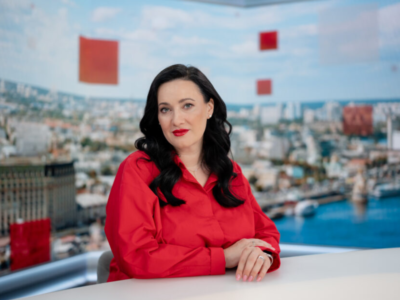
Olga Rudenko is the editor-in-chief of The Kyiv Independent, an English-language Ukrainian online media. The outlet was founded on November 11, 2021, by former Kyiv Post employees, just three days after its owner, businessman Adnan Kivan, dismissed the entire staff and decided to shut down the newspaper. The co-founder was the media consulting company Jnomics Media.

In her interview with Women in Media, Olga Rudenko discusses the principles of editorial independence, explains why her outlet continues to support regional media after the end of U.S. funding, and shares an unexpected story about dismissing a job candidate.
The Kyiv Independent recently reported that it was one of the few independent Ukrainian media outlets unaffected by the freezing of U.S. aid. You don’t rely on such grants because most of your needs are covered by a global community of 14,000 supporters. However, The Kyiv Independent launched a fundraising campaign for three regional media outlets—MykVisti, Tsukr, and Gwara Media. Why did you choose to support these particular media?
We are in a better position than many other media outlets, so this situation hasn’t affected us. If you’re strong in the moment, you should help those who are struggling. We began looking for ways to offer support, and our executive director, Daryna Shevchenko, believed it was right to focus on regional media by raising a truly significant amount.
Many media outlets were affected by these events, including strong national teams that conduct investigations. However, they have larger budgets than regional media, and we expected that donors would prioritize them. That’s why we chose to focus on supporting regional outlets.

So, we had to choose three media outlets. In cities like Kharkiv and Sumy, media outlets are more than just websites—they serve as vital hubs for local communities. These areas have been heavily affected by Russian attacks, and we wanted to support them.
For example, we knew the Tsukr editorial team well, as we had advised them on several projects, and our director led a strategic session for them. It was a similar story with Gwara Media—last year, as part of a local media mentoring project, I visited Kharkiv and met with my colleagues there. We also thought of MykVisti—we had heard good things about them, reached out to friends, gathered feedback, and decided to support them.
We also needed to determine what percentage of their funding came from U.S. aid. Based on that, we could assess whether the $16,000 we initially aimed to raise for each outlet would cover their needs for a month or a month and a half, or help them sustain operations until the situation was resolved. After all, the funding freeze was initially described as temporary.
How much did you manage to raise?
We launched the fundraiser on a platform we had previously used for our donation campaigns. Donations from Ukraine are unavailable on that website, but contributions from other countries are possible. Our goal was to raise £40,000, or $50,000. When we reached that amount in just one day, we decided to increase the target slightly, extended the campaign for another two days, and ultimately raised £53,000. After that, the campaign was closed.
From the Kyiv Independent’s budget, we donated £8,000, or $10,000. There were also several individual contributions ranging from £1,000 to £1,500. In total, over 700 people donated, with amounts varying widely. Some of the contributors are familiar to me—our friends who constantly support the Kyiv Independent.
It was a truly rewarding experience—the feeling that we were doing something useful and meaningful.


Why is support within the media community so important today? And do you feel that your editorial staff receives support from the community and individual journalists?
When we launched the Kyiv Independent, we felt strong support—both financial and moral. After being dismissed from the Kyiv Post, we received public support from other Ukrainian media outlets, which was truly appreciated.
For example, I remember that in 2021, Ukrainska Pravda held the UP Award, just a month after we launched the Kyiv Independent. They decided to award our team the “Journalist of the Year” title—not for our work, but for standing up against attempts at censorship and for being dismissed because of it.

That award was especially meaningful because it was our first. Last year, at the UP Award, I had the pleasure of presenting the same award to the Bihus.Info team.
You appeared on the cover of Time in May 2022, less than seven months after The Kyiv Independent was founded. Then, you wrote: “We decided not to compromise on our principles and founded our own media outlet.” What compromises do you think journalists should never make in their work?
Throughout my 10 years at the Kyiv Post, we had editorial independence. We rarely saw the owner, and he never gave us instructions on what to write or not write, what his agenda was, or whether he supported any specific ideology. We had a healthy buffer. But then that changed. The owner began to show that he wanted more control over the editorial staff and wanted to bring in his own people. The owner cannot make decisions on editorial appointments, as the team is recruited by the editor-in-chief.
At that time, our primary focus was on defending editorial independence. This means that all decisions—the materials produced, the topics covered, and who the editorial staff engages with or avoids—are made within the editorial office, free from any external influence.

There should also be transparency: you visit the media’s website and see who wrote each piece, understand who is part of the team, who manages it, and who is responsible for the content.
In early November 2024, your team launched a membership campaign to attract new subscribers. In just one month, you managed to add over 1,300 new subscribers to The Kyiv Independent community. Can you tell us more about this campaign, how you attract a new audience, and what strategies you’re focusing on?
Our outlet has diversified funding, with the largest portion—70%—coming from reader support. This includes both one-time and monthly contributions, with the latter forming the core of our support. It’s a reliable source of funding that we can count on, and it represents our community—those who support us every month. As of early November, when we launched the campaign, our community had 12,500 members.
In celebration of the Kyiv Independent’s third anniversary in November 2024, we launched a short-term campaign with the goal of attracting 1,000 new subscribers per month. Typically, we gain around 300 new subscribers each month, so this campaign aimed to triple that result.
We used various methods to invite people. There were banners on the website, communication through newsletters, and our team members were also involved in the campaign. They received personalized links to share through their own channels, with friends, and so on. We tracked which team members brought in the most subscribers, and the top performer attracted 20 new community members through their link.


The election of Donald Trump as president of the United States in November 2024 was one of the key factors motivating people to subscribe to The Kyiv Independent. Many Americans who support Ukraine were concerned about the developments and empathized with the country. They felt a strong desire to take action, to channel their emotions into something tangible.
I think it’s about a strong need to do something as an individual, even if things are going in a bad direction globally. It’s about what can I do? I can give my $5 a month to support the Ukrainian media, and I will do that.
You offer your subscribers five different tiers, each providing access to exclusive content such as private chats, online events, and Q&A sessions with your team members. Could you explain how this interaction between readers and journalists works in practice?
Every Friday, we send a newsletter to all our supporters, regardless of their subscription level, with a report on what we’ve accomplished that week thanks to their support. We highlight the interesting stories we’ve published and share behind-the-scenes insights from the editorial team.

Our subscribers also have access to a Discord server where they can engage in discussions. We also offer weekly Ukrainian language lessons, which are open to everyone. When we first launched them, the response from subscribers was fantastic—many people attended, and the lessons were very well received.
Members get a discount on purchases from our online store, where we sell Kyiv Independent merchandise. The store, which launched in the summer of 2024, offers items like T-shirts, hoodies, shoppers, and so on. The first $10,000 we earned through the store was donated to the charity organization REPOWER, which organizes retreats for Ukrainian military medics. Our team recently released a documentary about them titled Can You Hear Me? We raised about $8,000 from the sale of the collection in our store, and the remaining amount was covered by a single donation from one of our subscribers. This person learned about the campaign, asked how much more was needed to reach $10,000, and transferred the money.
What do your subscribers ask you most frequently?
Most often, the questions we receive are about the war, corruption, Russian military machine. Lately, many have been asking why Ukraine hasn’t lowered the draft age to 18. We publish the answers to these questions on our website for the public. We distribute the questions among our reporters, who then prepare detailed responses and explanations.

Additionally, for those who support the Kyiv Independent at the highest tier, with monthly contributions starting from $50, we offer the option to have a one-on-one video call with a team member. This provides a unique and informative experience: you get to connect with someone from another country, whom you may know nothing about, but who discovered our media outlet, supports it, and wants to meet, ask questions, or share their thoughts.
Recently, your editorial staff presented a new investigation authored by Yevheniia Motorevska, titled “Curated Theft.” It focuses on thefts from Kherson museums by Russian forces during the period when the city was under occupation. This investigation stands out from your usual coverage, as previous pieces have primarily addressed war crimes such as conflict-related sexual violence, the murder of Ukrainian children by Russians, and the heroics of military doctors, among other topics. How do you choose the themes for your films?
The war crimes investigation department comes up with the topics. They must be significant and relevant for a global audience.
Sometimes, we have doubts about how we will be able to implement the topic.
When we created the first film about children abducted from the occupied territories by Russia, we had some doubts since much had already been done on this topic in English. However, the film turned out to be very successful. We organized partner events to distribute it and arranged foreign screenings, including in the United States.

Unfortunately, the topic of the war in Ukraine, especially human suffering, is no longer as prominent in the world as it was in 2022. However, in the documentary format, it still resonates strongly.
How do journalists prepare to cover sensitive topics like CRSV? Do they consult specialists on the ethical aspects of interviewing survivors or similar matters?
Yes, we did the film titled He Came Back. Its author, Olesia Bida, has experience working with sensitive topics, so she brings relevant expertise. She is very thoughtful, sensitive, and professional in her approach to such issues. Also, I know that she received training and consulted with experts on approaching such subjects.
Your website also features many materials on topics such as gender-based violence, the lives of LGBT+ people, and more. What angle should be taken when covering these topics to make them engaging for a foreign audience?
This is a part of our life, a part of Ukraine. It’s one of the many topics that are relevant now, so it’s important to cover these issues.
I remember that in 2022, I was very skeptical about my colleagues’ pitches of stories about LGBT+ people fighting as part of the Armed Forces of Ukraine, even though this topic had already been covered by many media outlets. It seemed to me that Ukraine was already a progresssive enough society and there is nothing newsworthy about the fact that LGBT+ people serve in its army — because why wouldn’t they? The idea felt like an attempt to “exoticize” LGBT+ people. I’d like for us to cover these topics from a fresh angle.
Last year, Texty published an extensive study on online violence against journalists in Ukraine. Have you personally experienced cyberstalking, cyberbullying, or other forms of online violence as a journalist?
Of course, this happens sometimes in comment sections. Our audience is generally quite supportive, but the internet is full of people who, using anonymity, feel no restraint and let their worst instincts and insecurities show in the comments.

Have you personally experienced manifestations of sexism and ageism while working in general, both online and offline?
I’ve been working in media since I was 20. Over the years, I’ve encountered various situations and felt different attitudes toward myself. As I progressed in my career, there were challenges — I was a young woman tasked with supervising people, often older and more experienced.
Unpleasant situations were more common with men. I’ve had instances when male subordinates acted disrespectfully towards me, while behaving completely differently with their male supervisors. There were also occasions when I would be networking at a business conference, and men would greet everyone in the circle except me — because I was the only young woman standing there. It doesn’t help that I’m also introverted and can come across as shy.
Before the Kyiv Independent was established, the English-language media in Ukraine were led by men — usually older expats, typically Americans with solid work experience. Then our outlet emerged, led by two young Ukrainian women: I, as the editor-in-chief — I was 32 years old at the time — and our CEO, Daryna Shevchenko.


When we started the Kyiv Independent, we held a small event to present it to stakeholders. Most of the people in the room were men — a small but serious-looking audience, people from businesses and embassies, many of them in suits. When I was speaking in front of them, it was my first time doing something like that, and it felt like a turning point for me as I stepped into this new role. I had to convincingly explain to these “adult, serious men” what we were doing. When I mentioned that the Kyiv Independent was headed by women, they applauded.
Does the Kyiv Independent have gender policies? What do they cover? When were they adopted?
We do not have a separate document like that, but our general editorial policy states that discrimination on any grounds is unacceptable. Overall, our newsroom is quite liberal, so I find it hard to imagine any form of discrimination here.
In terms of gender balance, our editorial team is roughly 50/50 men and women, with more women in leadership positions.
There was an instance when I refused a job candidate because I knew for certain that he had a tendency to mistreat colleagues, especially young women.
What other social policies or programs does your editorial office have? For example, do you offer health insurance?
We provide regular health insurance for all employees. There is no specialized insurance coverage for those working on the front lines. Instead, we have a commitment: If something happens to our journalists working on the front line, we take responsibility for finding the necessary funds—either from the organization’s budget or through external funding—to cover medical expenses.
What differences do you see between the work of Ukrainian and foreign journalists in Ukraine?
We cover the war in our own country. Foreign journalists come, work, and leave—within two weeks, they are safe again. Our journalists do not have that option.

There is a certain prejudice against Ukrainian journalists, a belief that we cannot be objective or cover events efficiently and professionally because this is our war. In my view, we are not “objective” in the sense of being neutral—we don’t cover this war like we are watching a football match where one team scores, then the other. But no reasonable person can view this war “objectively” in that way.
At the same time, we understand the local context better than anyone coming from abroad. We would never write, “It is unclear who blew up the Kakhovka Hydroelectric Power Plant—here is information from both sides.” We will never do a story about a dubious politician who posed for a photo once with a gun, portraying him as a defender of Kyiv—something foreign publications might do.
Ukrainian journalists are often treated as “raw material” for foreign media: they come, hire Ukrainians as fixers—essentially auxiliary figures—while the foreign journalists are the ones producing the stories and crafting the narratives, and usually theirs is the only byline. But Ukrainian journalists should not be mere helpers; they should be the ones telling Ukraine’s story to the world.
Last year, I participated in the Europe-Ukraine Desk program by N-ost. As part of this initiative, we visited editorial offices in six European countries, including Italy, Spain, France, and Germany. Most of these outlets have their own correspondents in Ukraine, so they do not seek materials from Ukrainian journalists on the ground. However, the reality is that these correspondents are often former staff of Moscow bureaus, which have since closed. They were reassigned to Ukraine under the assumption that they “know the context better.”
Yet, it’s important to recognize that many of them carry perspectives shaped by their time in Russia. The core principle of that worldview is that Ukraine is seen as something temporary, a mere consequence of the USSR’s collapse. In this view, Russia is perceived as eternal, while Ukraine is regarded as transient and, therefore, a country that could just as well lose the war. These people are not exactly pro-Russian. However, they still hold the misconception that Russia is an unshakable constant—an invincible force.

Previously, there was a belief that our European and American colleagues were more experienced and had a broader, more diverse background and that we should learn from them. However, with the onset of the full-scale war, it became clear that Ukrainian journalists are now the ones who can easily train foreign colleagues because we are in a unique situation. What’s your opinion about this?
There is a lot of interest in Ukrainian journalists at various international conferences, but it’s usually focused on war journalism—what it’s like to be a journalist in a country at war, how we work during martial law, and so on. However, in my opinion, there is insufficient interest in other professional topics where we can share expertise.
There are many aspects of Ukrainian journalism that I think people in the media industry would find interesting: what’s working for us, and what we’ve learned to do really well. This includes war crimes investigations or, for example, membership acquisition campaigns, which we discussed earlier. Or the launch of our English-language journalism school by the Kyiv Independent.
I know that Ukrainian media certainly have something valuable to share. There are Ukrainian journalists who could run really great workshops for European colleagues. However, I think we are still largely seen as something exotic. It will change over time.
Interviewer: Oleksandra Horchynska, Women in Media
Photo credit: Hennadii Kravchenko, Women in Media
This material was made possible by the New Democracy Fund (NDF) and International Media Support (IMS) as part of the project “Breaking Down Barriers: Bringing together public organizations, media, and state bodies to achieve gender equality in the media space of Ukraine,” implemented by the NGO “Women in Media.” Any views expressed here belong to the authors and do not necessarily reflect those of NDF or IMS.