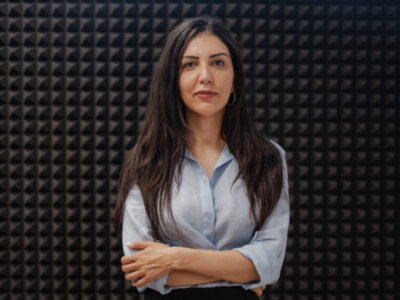
Olesia Bida is an investigative journalist with the war crimes investigations unit at The Kyiv Independent. Her work is about reporting on war in ways that protect people from further harm, and still naming crimes for what they are.

In the Uprooted documentary, she examines the stories of Ukrainian children forcibly deported to Russia from occupied parts of Ukraine. The investigation The War They Play shows how Ukrainian children, taken to Russia against their will, are forced in occupied territories to study in schools under Russian standards and take part in paramilitary movements, effectively being prepared for eventual enlistment in the Russian army. And the film He Came Back tells the stories of women affected by conflict-related sexual violence (CRSV).
In an interview for Women in Media, Olesia Bida talks about the specifics of working on war crimes, responses to stress related to both the profession and the war, people-centered approaches to sensitive topics, and her principled stance on so-called “good Russian journalists”.
In its investigations, The Kyiv Independent team not only tells stories of people harmed by war crimes, but also identifies Russians involved in committing them.

Was there a moment, an event or a story, after which it became clear that war crimes were going to be your area of work?
When the full-scale invasion began, I was working at Hromadske. In the first days, of course, we all switched to the news feed, because people urgently needed information about what was happening in the country — from train schedules to whether it was worth leaving your city. But after a while, we returned to our usual way of working, and I went back to reporting. In the first month of the full-scale war, I left Kyiv to stay with my parents. Then I came back and began traveling on assignment to liberated areas. At first, it was the Kyiv region and the Sumy region. So I kept working with sensitive subjects — death, people killed, civilians, and soldiers.
Every trip brings you a story. People tell you about the war crimes they survived. That’s when I began to feel that simply telling these stories wasn’t enough for me. I wanted to bring them to their logical conclusion — to dig deeper and understand who was responsible for what happened to this person. It took months to realize that I definitely wanted to work in a deeper format. Eventually, I left Hromadske and immediately received an offer to join the war crimes investigations team at The Kyiv Independent.
What is the hardest part of this topic for you?
Technically, the hardest thing is probably writing a script. It’s taking everything I’ve worked on for half a year, or even longer, pulling together deep research I often do with a colleague, plus hours-long interviews, and turning it into one coherent line. But from a human perspective, the hardest part is talking to survivors. It’s quite difficult to find people who are willing to testify.
In fact, I stay in touch with almost all the people I’ve spoken to over these years while working at The Kyiv Independent. For me, the hardest thing is not losing their trust, remaining a kind of support for them, no matter what.

Where is the line between you as a journalist and you as just a person?
In my work, I’m always a person — though of course I’m a journalist by profession and I follow certain standards. But it’s impossible to be a person over breakfast and then switch into “journalist mode” for an interview. No. I try to keep my approach as people-centered as possible with those I interview. And we live in the same country — we share the same backdrop. In some situations, I can allow myself to say that I understand them.
When the full-scale invasion had just begun, we were trying to find people for our reports. Many people were traumatized by their communication with journalists — and mostly they were talking about foreign reporters who were coming to Ukraine in large numbers at the time and looking for sexual violence survivors. Because of that, many people shut down; for them, it was the first and last time they ever spoke to journalists. When they told me what questions they were asked, it was clear that this was not a people-centered approach.
How and where did you learn this people-centered approach? How do you decide which questions to ask the people featured in your reporting, using that approach?
It really depends on the topic. Say tomorrow I needed to interview a soldier who has been released from captivity — I would refresh my knowledge and turn to colleagues I trust. I’d talk it through with them: what might be triggering in that kind of conversation.
Even before the full-scale war, I worked on sensitive topics with people who were grieving, who were in trauma. The general rules come from my university education, my experience, and the training I’ve taken. I often relied on the Dart Center’s recommendations, and before I started working on CRSV, I reread the Murad Code. I also attended a multi-day training with Dart Center expert Gavin Rees — we had a conversation about this topic. And I’ve had many conversations with human rights defenders and with people who survived sexual violence back after the war began in 2014. I asked them how best to structure these conversations and what I should avoid.
I always prepare for an interview. I still have a plan, and I follow it. Every interview has to have a structure — and the most important question, which unfortunately has to be asked, also has its place within that structure. My colleagues and I talk a lot about our experiences and feelings, about people’s reactions, and about whether we made any mistakes.


In 2024, you spoke publicly about how Ombudsman Dmytro Lubinets commented on the story of a girl affected by CRSV on his Facebook page. How would you assess the way state institutions communicate about war crimes and CRSV, and what most urgently needs to change?
I may be biased. But overall, it obviously feels to me like the state is not doing enough. There was a wave of momentum at the start of the full-scale invasion, when Volodymyr Zelenskyy mentioned in his addresses that there had been rapes committed by Russian soldiers in Kyiv region — and that had consequences. We also remember the way communication was handled by the then Parliament Commissioner for Human Rights, Liudmyla Denisova. And we remember how journalists were immediately invited into liberated territories — even before people had given testimony to law enforcement.
Now, as I see it, this topic is gradually becoming invisible. I know that some of those who applied for interim reparations ended up stuck in limbo, and there was no clear communication from the state about it. And whenever we work on occupied territories — regardless of what category of crimes we’re talking about — we keep seeing the same thing: there is very little information about certain groups of people who have lived through war crimes. Because of that, it can start to seem as if this simply isn’t happening. As if people on occupied territories are living their normal lives and everything is fine there. But it’s not. It’s all the result of a lack of information about what is really happening. These people often have no way of communicating with journalists outside the occupied territory, because it’s dangerous. So it hurts that they are, in fact, not being mentioned.
From what I can see, communication happens when law enforcement announces notices of suspicion in absentia against those they’ve identified as involved in crimes. Or when these people are convicted in absentia. But even if you look at this not through the perspective of state communication, but through how these stories are generally told, most often it follows the same pattern: something terrible happened, a woman lived through violence, here is her story, and then that’s it. There is hardly any talk about her path to recovery or about restoring justice.
How could that communication be changed?
There are countries that have already been through similar experiences — Rwanda or Bosnia, for example. Survivors there began speaking out later than is happening here. We’re in the middle of a full-scale war now. People are testifying, going to the police. But I still don’t see enough of these stories in the public space. And it takes significant resources to bring them into the open. In our case, for example, it took 10 months of work on the film He Came Back. I don’t know what other newsroom would have allowed me to spend that much time working on one topic.

Do you often get provocative or controversial questions — for example, in conversations about CRSV, do people try to shift the focus to “the other side” or demand a false balance? How do you react?
Unfortunately, over a year and a half, He Came Back has had only a handful of international screenings, and I wasn’t at any of them. Once it was shown in Vienna in spring 2025 for participants of an OSCE conference; another time it was shown, also during an OSCE forum, for military attachés in the fall of last year.
When we organize a screening, we need to find partners in a given country who will gather an audience and help us promote the event. There simply hasn’t been demand for screenings of this film. When we arrange for a journalist from Ukraine to travel as a panel participant, we discuss which film is best to show. Sexual violence in war is something that can feel emotionally difficult for an audience abroad — for people who would be watching it in a cinema, for example. So they will likely choose Uprooted about the children deported by Russia. Yes, it’s an incredibly important topic — the film came out almost three years ago, and we still receive requests for regular screenings. And it simply can’t be compared to CRSV as a topic. On the one hand, I can understand that: when we talk about deportation, it feels like something people can influence somehow — change something.
In 2024, we toured several U.S. states with that film, and one of the calls to action was: Call your representative and urge them to support Ukraine, because the U.S. still has influence when it comes to returning deported children. We need to keep reminding people, keep talking about deported children, because we have to bring them home. In the case of CRSV, it can feel like all we can call for is justice.
We prepared for the possibility that international audiences might ask us about Ukrainian soldiers committing violence against women. We track this, and so far, it is not systemic. From what we see, these cases are investigated — unlike in Russia, where at the time the film was published, there had been no recorded investigation of any CRSV case involving Russian soldiers.
So, on the one hand, this is painful for me — I love this film endlessly, I love this work, and I’m incredibly grateful to the women who trusted me. They are not “just” survivors of sexual violence. They are people with lives that existed before this happened, and lives that continue afterward. They recover, they have interests and hobbies. What happened to them is only one episode in their lives. It’s very upsetting that there is so little interest in the film abroad.

The Kyiv Independent’s films are often screened abroad. What myths or prejudices do you find yourself having to debunk most often?
One of the prejudices about our work is the idea that we’re biased. People ask: how can we — Ukrainian journalists living in Ukraine during the war — possibly cover anything about Ukraine? This comes up very often in post-screening discussions. We always explain that we never left the country, that we’ve lived here our entire lives. And who, if not us, knows the context best? The people we work with don’t have to walk us through the basics — when the war began, and who attacked whom.
Very often, we try not only to tell individual stories, but to explain the broader context, which is why we also go back to the events of 2014. For example, Zhenia Motorevska is currently working on the second episode of her film about Crimea — about when the annexation of the peninsula actually began. She has gone back even further, to the 1990s, to the beginning of Ukraine’s independence. In the feedback we receive — by email or in comments — people often thank us for explaining things in much greater depth. For us, that means that sometimes we also need to go to the library, read archival materials, and do quite deep research.
Russian propaganda works brilliantly. It is powerful. When I was working on the film When Water Screams about the destruction of the Kakhovka dam and the Ukrainians affected on the left bank of the Kherson region — people who, essentially, were left to drown in their homes — I watched the materials the Russian side was spreading at the time. They immediately invested a huge amount of resources to convince people that Ukraine had done it. The only way to counter that propaganda is with deeper, longer-form work — interviews that don’t last 15 minutes, but sometimes stretch for hours, or even several days.

Do you still see “good Russians” — or pro-Russian journalists — on international programs and competitions? And what can Ukrainian journalists and newsrooms do systematically to change this practice of tolerating Russians?
We absolutely cannot stay silent. I have endless respect for colleagues who refuse to take part in panels where one of the speakers is a Russian — even one of the so-called “good Russians.” They write letters explaining why this is impossible, especially when organizers don’t understand it immediately and insist on “balancing both sides.” Quite often, organizers change their minds in our favor.
I also have enormous respect for everyone who asks public questions at panels and conferences where these “good Russians” are still present. In 2024, the film about deportation won the prestigious Investigative Reporters and Editors award. I took part in one of the panels, and alongside me were editors from foreign outlets that had collaborated with Russian journalists. They had their own correspondents in Russia. There was also a journalist from Sweden who had been helped by those same Russians with information for his investigations. I remember how, during that panel, I started explaining that we do not collaborate with Russian media in any way: we have no cooperation with Russians abroad, and certainly not with those inside the country. And this Swedish journalist began trying to convince me: no, you don’t understand — there are good people, they helped me; you probably don’t have enough information. The other men were nodding along. So there I was — a young woman — and next to me were three older men persuading me that I didn’t understand enough, that I still needed to “grow into” it. After that discussion, I wrote a joint email to all of them: I wished them never to experience what it feels like to be told that citizens of the country that attacked you are, in fact, “good people.” I’ve never received a single reply.

You’ve also had other cases where you publicly took a stand. In 2022, when the Hromadske newsroom and you personally publicly said you would withdraw from the Thomson Foundation Young Journalist Award if a contributor to the pro-Russian outlet Strana.ua remained on the nominees list.
For me, it wasn’t even a question — we cannot share a place in the final top ten of a competition like that. Our position then was unambiguous. Zhenia Motorevska, who was editor-in-chief of Hromadske at the time, agreed that we would withdraw if it came to that. Maybe that gesture made it clearer for the organizers, but they responded quite quickly and removed Strana from their shortlist.
Have you or your colleagues faced online attacks or pressure because of your professional work?
When people leave generic comments like, “Oh, this isn’t true,” or “Ukrainian propaganda,” I understand that it’s most likely not real people but bots — and I don’t even respond to that. Although once I really did get pulled in. A man left a comment under the film The War They Play. I clicked through to his YouTube account: his profile picture was clearly his own photo, and there were also a few videos — his wedding, some other events. I looked into it and found he was from Brest, Belarus. So I replied, something like: well, of course you in Brest would know best whether this is true or false.
Yes, there are those broad comments: that supposedly the Ukrainian side did things like this too — why aren’t you talking about that? Or that what The Kyiv Independent published is “bullshit.”
But there was one case that really unsettled me. Under the film about sexual violence, a comment appeared saying, “This journalist is a Nazi, and so is her husband.” For me, that crossed a line. How did this person know I’m married? Who is it? Maybe it was just a random comment, but it made me feel physically unwell afterward. For me, bringing family into it isn’t just a red line — it’s a deep crimson line.
What response mechanisms does The Kyiv Independent have for situations like that?
In that case, I immediately sent the comment to my editor. We decided we would watch what happened next, and we did a quick, surface-level check of the account it came from.
At our weekly editorial meetings, we don’t regularly discuss having a clear step-by-step protocol for situations like this. But I’m sure that if there were direct personal threats, I would absolutely go to my editor first — and then to Olia Rudenko.

Have you ever felt that even very important journalistic work can’t stop the evil that’s happening in the country?
When I do my work, I actually think more about the future than the present. I’m not sure journalism can stop a war. But in my work I try to tune myself to the longer perspective. To the belief that yes, the war will end. And beyond that, justice must be done. Everyone who has lived through war crimes committed by Russians must eventually have the feeling that justice has been served.
Do you know what emotional burnout from work feels like? And does the newsroom have a support algorithm if fatigue or exhaustion hits?
Last fall, we had a psychological support program. Part of the team worked with psychologists; I did too. It helped me understand that I’m quite resilient. But it’s actually hard to separate the stress you get from living in a country at war from the stress of the job — I don’t know which one is stronger. It’s the same as trying to separate the person from the journalist. It’s difficult for me to work with a psychologist right now, while I’m still having acute reactions to the war. It probably takes time. Maybe later it will have a better effect. Because wherever you dig, it feels like ripping a bandage off a wound. You’ve stuck that bandage on, it’s holding, and maybe it’s even better, for now, to keep it on.
Psychologically, it’s easier for me to work in long-form formats than under rigid deadlines that constantly press on you. I like going deep into a topic, into people, building trust with them, and doing journalism the way I’ve always imagined it: not rushed. Very often, under high newsroom demands and strict deadlines, we lose our humanity, and we can’t listen to what a person actually wants to say. Here, I have the ability to take enough time to prepare for an interview.
We very often do pre-interviews. I couldn’t have imagined before that I’d have a preliminary conversation with someone before recording an interview. But here I often suggest we first meet, talk, and they tell me about themselves, so that we both understand whether it makes sense for us to continue working together.
I’m not ashamed of what I do. I can always have an honest conversation within the team about what we’re feeling. And in fact, my work gives me strength. I don’t know how I would be holding up right now if, during the war, I weren’t working in investigations. The end goal — to detect a likely war criminal or to demonstrate the systematic nature of a particular war crime — gives you strength and meaning to the work. And to life, actually, too.
Zhenia Motorevska wrote on Facebook that you now often host international colleagues at your office when they come to cover events in Ukraine. How do they react when they see the conditions Ukrainian journalists have to work in today — without electricity or heating, in freezing temperatures?
After I released the film about the militarization of children in October 2024, there was a noticeable increase in media attention to The Kyiv Independent’s work. Because this is another danger. What do we do about these children? They are in occupied territories — but how do we bring them back? And then there is the question of negotiations on the future of the territories occupied by Russia.

I receive requests for interviews from foreign colleagues literally every week. I hope they genuinely mean it when they say they admire our work. But they also say that it’s impossible for them to produce the kind of stories we do. Because they don’t have the same access to people and materials in Ukraine. They would need to spend a long time here and build sustained relationships with organizations that can help identify people willing to share their stories. They have to wait for people to leave occupied territories and be ready to testify — and that process is not fast. In our case, it takes months of conversations and of building a connection with someone. Foreign journalists simply can’t afford that.
As for the working conditions, Kyiv blackouts have been especially hard for me. Today, as we record this interview, after yet another Russian attack, we’ve had no electricity at home for six days. Last night, very late, I took the dog for a walk. I went outside at the same time I usually do: it was dark, -15°C, and there wasn’t a single person around. Maybe for the first time in all this time, I decided to record a video, just to keep it on my phone, to document this moment for history.
Are there stories that, in your opinion, the world is not ready to hear yet — and should journalism sometimes wait?
Recently, I found myself thinking about how much I admire Ukrainian journalists who cover corruption inside the country. Especially corruption that involves the highest political leadership. It’s probably painful to hear. And as a journalist, you always doubt whether this is the best moment to do it. But it’s good that we do, that we don’t stay silent about these issues. In truth, there will never be the best or the worst time. You just have to do your job well and publish the truth.
But if we’re talking about sensitive topics, I very often think about one particular group: CRSV survivors who gave birth to children as a result of the violence. This topic doesn’t exist in Ukrainian media at all — and yet such cases do exist. And I genuinely don’t know when we will hear it spoken about.
Almost a year ago, I was in Rwanda on a study visit with the Foundation TheDayAfter. We met, among others, with representatives of non-governmental organizations. One of them was a community of children who were born as a result of rape. Today, they are my age. They can speak about it openly and have built their own community. I don’t know whether we will ever get there. In my case, I recorded the stories of two women. But behind them stand thousands who are afraid to testify because of condemnation in their small communities. Stereotypical thinking still persists that a woman is somehow “to blame” for her rape.
What would you advise young women journalists who want to work on the topic of war, but are afraid they won’t be able to cope emotionally?
As an example, I can tell you about our director, Maksym Yakobchuk. It happened that our previous director left, and the film He Came Back wasn’t finished, so we had to film the remaining parts. Maksym didn’t want to take it on for a long time because of the emotional load. But when we finished the film, he said that this story became one of the most inspiring experiences for him.
War crimes are not only about an ending — they are also about the future. If we do investigations, we can contribute to bringing justice for these people in the future. For example, we identified the soldier who raped an underage girl, at a stage when law enforcement couldn’t find him. Now this case is being heard in court.

I get very angry when I do this work. Sometimes I can’t believe the scale of what is happening — especially with the militarization of children. It’s hard to comprehend how many resources Russia invests in indoctrinating and militarizing our children in occupied territories. It’s unimaginable. In our investigation, we show only a small part of something that is, in reality, vast and ungraspable.
There are many resources now where those who are just beginning to work with war crimes can read about how to work ethically with people affected by different kinds of trauma. As a journalist, I’m also always open to direct contact. And I would advise colleagues not to treat this topic lightly. Because we, journalists, must not become a trigger for people who have been through occupation, captivity, and war. We must never be the ones who add to their pain.
By Oleksandra Horchynska, Women in Media
Photo credit: Valya Polischuk, Women in Media
This material was made possible by International Media Support (IMS) as part of the project “United for Equality in the Media: Promoting Gender Equality Through Cooperation Between Public Organizations, Media, and Authorities” implemented by the NGO “Women in Media.” Any views expressed here belong to the authors and do not necessarily reflect those of the IMS.