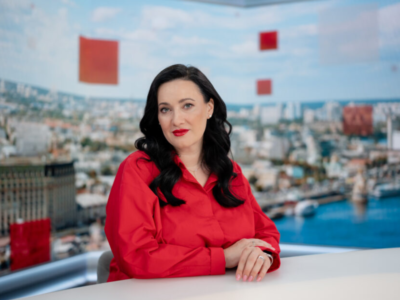
Ukrainian women journalists often juggle the responsibilities of raising children, caring for aging parents, and their demanding work, a reality that becomes especially exhausting when covering the war. Some are compelled to go on business trips, live between two cities, or even two countries.

“Women in Media” captured the stories of three journalists: Inna Varenytsia, Anastasia Bagalika, and Olha Bulkovska, who share their experiences of balancing childcare with work, candidly discussing the mobilization of men, the realities of death in war, fatigue and exhaustion, and pondering whether they deem themselves “bad mothers.”
“As if your personal heroism doesn’t count when you hire a nanny”
Anastasia Bagalika, the host of Hromadske Radio and gender coordinator of the Povaha campaign against sexism in the media and politics, has four children. The three oldest are fourteen, twelve and seven years old, and the youngest is four-month-old Melania. Anastasia’s husband and Melania’s father have been at war for almost two years. Throughout his military service, he was granted leave twice: once for 10 days and a second time for 14, during the birth of his child.
“I not only have to juggle work with raising children, but I also don’t have a partner nearby to share the responsibilities. In essence, I have to manage everything on my own – from daily life to work and childcare. This experience has greatly enhanced my organizational and managerial skills. It turns out that I can do much more than I thought. And my core skill is my ability to organize everything,” Anastasia Bagalika says about herself.

A nanny aids her with daily tasks: working Monday to Friday, she picks up the middle child from school, helps with homework, cares for the youngest child while Anastasia is at work, and also assists with cooking.
“When people ask me how I manage with four children, and I mention having a nanny, everyone’s response is usually like, “Ah, well, of course you do.” “It’s like, having a nanny somehow diminishes your personal efforts,” Anastasia shares. “But the reality is, it’s not about whether you heroically raise four children alone or not. It’s about being able to maintain your sanity while balancing everything, continuing to be a capable individual, and earning a living. It’s not a competition to determine who’s the biggest hero: those raising kids alone or with a nanny.”
Anastasia Bagalika drives the children to school in the morning herself. She explains, “On one hand, it’s become a sort of ritual, and on the other hand, it serves as a helpful distraction because I enjoy driving the car. However, when the youngest, Melania, doesn’t fall asleep during the ride, it becomes challenging to keep her entertained and prevent her from crying:
“If she urgently needs to get out of her car seat, nothing seems to work – neither songs nor fairy tales. When the older children are with her in the car, they play songs for Melania, and the entire car echoes with Little Duck, quack quack. We go to school with this accompaniment. But if luck isn’t on our side and she doesn’t fall asleep during the drive, she can become quite hysterical. She doesn’t enjoy traffic lights or being stuck in traffic jams. She must either go or not go.”

The journalist continued working throughout her pregnancy and swiftly returned to work after giving birth. Tere was no financial necessity for this – she could afford a month and a half of rest because she had a “cushion”. However, she couldn’t take that time off because a new grant project started at work in January – broadcasts about prisoners – that couldn’t be managed without her. So she had to go and work. She acknowledges, “Working all the time has become a habit.” However, she now takes Saturdays and Sundays off, which coincides with the children’s days off from school. So they can spend time together and relax. According to her, in general, everything is much easier to manage now than it was when her first child was born. The older children now also help with Melania.
When asked if she could have anticipated that her life would unfold this way when she decided to have a fourth child, she replied: “No.” Initially, both she and her partner hoped that expanding their family would qualify them for the status of a large family, which would serve as the basis for his demobilization. However, while they were in the process of preparing the necessary documents, the regulations changed, rendering their plan unattainable. This was partly because, out of their four children, only one is biologically his.
“It doesn’t work like that now. There’s currently no mobilization, nor are there enough people to replace soldiers at the front. Therefore, the opportunity that existed before to obtain a certificate of a large family and demobilize thanks to it no longer exists. These difficulties began to emerge just last fall, precisely when we were preparing to submit these documents. In the winter, when Melania was born, we obtained a certificate and tried to submit it, but it didn’t work out,” says Anastasia Bagalika.
She doesn’t work with psychotherapists, even though she acknowledges that it’s emotionally challenging. She believes that no amount of superior management can alleviate this moral difficulty. Even if the partner desires to be involved in the process of raising a child and contribute attention remotely, it proves to be very challenging:
“We don’t see each other, they don’t see each other, he doesn’t realize what it’s like to have a baby. What to do with her, how to dress her, what she eats, whether she sits or not, what she can do. And you’re constantly updating the guide: our baby now knows this and that. But the intensity of events is such that a week will pass, and he already forgets whether she can do certain things or not.”
“Even during pregnancy, my morale could be complicated due to hormones. I’ve caused scandals twice: once I quarreled with the security guard at the school where my child studies, and another time with the craftsman who was supposed to install furniture in my eldest son’s room. Despite promising to bring a mattress for the new bed by New Year’s, he delayed for three weeks and said he would do everything in early January – just in the days when I was due to give birth. And when he came to install the bed-wardrobe, he was late and explained it by saying they were “detouring checkpoints with the military recruiters.”

“I had Zhenia just two days ago when he came from near Bakhmut. I turned to this craftsman and said, “Say one more word, and you’ll simply be out of here. Do you ever consider what you are saying? It really knocked me out then,” Anastasia Bagalika recalls. She explains that she doesn’t always have the strength to react to something like this, but she forces herself to find an internal resource for it. She is convinced that if they don’t react in any way, such situations will escalate in geometric progression: “People who feel a sense of permissiveness become more confident in their actions.”
The usual routine is what saves and helps the most in difficult moments – when everything is clear and planned. Anastasia admits that if she had heard this about herself 15 years ago, she would have been very surprised, as household chores and planning were what she disliked most about motherhood before.
“It was very difficult for me. But as I learned, I realized that such things began to save me.”
“I keep thoughts of death away from me because I can’t afford them as a single mother”
“On the eve of the full-scale war, I considered moving to my parents in Severodonetsk. I wanted to distance myself from the news, engage more with various topics and projects, and occasionally attend video shoots. But when I arrived there in the winter, I realized that it probably wasn’t the safest place,” war reporter Inna Varenytsia recalls the beginning of the full-scale war. During this time, she has covered the war for ten years and managed to work with major international agencies such as Associated Press and Reuters.

A week before the invasion, she was on the set, and she vividly recalls how a mine fell just 30 meters from the team. Then she realized that it would no longer be safe. The fighting intensified in Donbas, so on February 21, Inna’s parents left for Kyiv with her young son, who was just at the age where she had stopped breastfeeding. When the major war broke out, they stayed with relatives for a while, but it wasn’t feasible for them to remain there indefinitely – they had to make a decision. In mid-March, Inna’s friends offered to settle her family in the Czech Republic, and she agreed to their proposition. She went to the Czech Republic with them but stayed in Prague for only one day. During that time, she went to the registration center for Ukrainian refugees, registered her son there, and then returned to Ukraine. For several months, Inna Varenytsia’s family lived in Prague, initially with some “friends of friends,” and later with others. Before getting permanent housing, they moved three times. Three months later, they moved to a rented apartment.
“My parents had things packed for one week; they left their home completely – now their house is occupied. My son had a lot of books, all his winter clothes. And that’s all. There was nothing more. My parents always thought that perhaps they would come back, maybe not for long,” says Inna Varenytsia.
She began to split her time between two countries: in Ukraine, where she awaited work at the front, and in the Czech Republic, where her parents and child were waiting. At first, she tried to divide her time this way: she worked in Ukraine for a month, one and a half, or two, and then she came to Prague for two or three weeks to be with her son. She says, “If it weren’t for the full-scale war, I wouldn’t have done it.”

“Now my schedule has changed a little. I am planning my trips to Ukraine and my life there as if it were a part-time job. Business trip to Donbas or the South, Zaporizhzhia, Kherson region. It could involve active shooting, but typically, after three weeks, the efficiency of work tends to decrease. Colleagues in Serbia and Yugoslavia worked in the same way. At some point, you start to lose efficiency, your eyes get tired, you can’t see the story, so you should take breaks,” explains Inna Varenytsia.
When she comes to the Czech Republic, she can sometimes take work with her – tasks that can be done remotely. “In these moments, my parents, especially my father, help take care of my child,” says the military correspondent:
“He spends a lot of time with my kid. We agree that I will need two hours on certain days. During these two hours, I schedule some conversations, plan to write requests, read the news, write letters, and so on. Putting it off until the evening, when the child falls asleep, as it turned out, is ineffective, even though I’m an owl. I just fall asleep with the baby. And maybe it’s because of fatigue, the war, trips, everything.”
In March 2022, photojournalist Maksym Levin, the father of Inna’s son, tragically passed away while covering the full-scale offensive of the Russians in the Kyiv region. Contact with him disappeared on March 13, when he, together with another colleague, went to the village of Huta-Mezhyhirska, Vyshhorod district. His body, with a gunshot wound, was found on April 1.

“I was affected by the war before, but after the full-scale invasion, it became more personal. I realized that I wouldn’t be able to work if my parents were in the occupied territory. That I could cover the topic of missing persons as long as it didn’t concern me personally. When my son’s father died, for a while I decided to refrain from filming where there are deceased individuals,” says Inna Varenytsia.
Her then employer offered her two sessions with a psychologist. That was a Ukrainian woman who has been living in France for a long time. The journalist refused; she wasn’t confident that this particular person had the understanding, empathy, and qualifications needed to address her needs.
“At that moment, it was better for me to remain silent and not discuss it. I was waiting for the right moment to find the inner resources. I couldn’t go see my son right away because I didn’t know how to explain to him that his father had passed away – although I typically speak candidly with him about everything. And that’s why I visited my son when I felt mentally prepared to talk to a young child. When I arrived, I kept the explanation very brief. We were together all the time for more than a week: we went to the playground, played, cooked together. That was what gave me strength,” Inna Varenytsia recalls.
In May 2023, Inna Varenytsia’s column titled “Instead of a Lullaby (A Scary Mother’s Tale)” was published in Livyi Bereh media. It discussed how to talk to children about the death of their father. When asked whether she has since learned to discuss it with her son, Inna Varenytsia answers, “I think I will be learning this all my life.”
She reads psychologists’ columns, specific literature, and books about death, which are designed to explain to children the concept of death. There are many words in these books that are understandable to a child, so if any words are missing, the books will help you find them.

Just be there for them and love. This is the easiest. Sometimes you don’t need to speak. Kids need to know that they are loved. That’s all. Then you need to be frank – that’s the most important thing,” reflects Inna Varenytsia. “But there are moments when I think: what is he thinking?” I can’t ask him directly because he won’t be able to express it, as he’s still very young. That’s why I’ve decided that I want to understand it more deeply.”
This is how the idea was born to create a project about how to talk with children about loss – through interviews with psychologists, conversations with adults who grew up and experienced loss in childhood, and more. This idea emerged a year ago, but Inna only recently felt ready to discuss it, so she has now begun working on it.
We also discuss whether Inna Varenytsia thinks about her own mortality, considering she works in a war zone with high risks to life and health.
“I push away thoughts of death because I cannot afford them as a single mother. I take care of safety measures as much as I can – I’m the first to run to the dugout at the slightest whistle, for example. I don’t need to be invited. Once, my colleague, friend, and I were on a business trip to Donbas, and we were discussing “what if…” We thought about making a will, or at least recording our “wishes” on video. I couldn’t bring myself to record that video. I can’t afford for that “if” to happen,” says Iryna Varenytsia.

She reflects on what motherhood has taught her. For example, setting clear deadlines, as there’s an understanding that at some point, you have to finish the work. Motherhood also teaches you to evaluate your work and value yourself:
“Women very often do not receive the same salary as men in the same position, or cannot accurately quantify the value of their work. Actually, motherhood taught me – and I’m still learning – to calculate, to articulate the cost, and to plan. And also, sometimes, to accept that it may be rejected. But then I remind myself that, well, this time is more valuable for me and the child.”
The most challenging aspect of motherhood is that there’s no opportunity to be with my child all the time. Despite Inna Varenytsia’s efforts to maintain work-life balance by allocating separate time for work and for her child, she admits that living in this mode is challenging. After all, she spends long periods without seeing her son, meaning he grows up without her presence. Therefore, her plans involve reducing the duration of business trips to spend more frequent but shorter periods with her son. Inna does not rule out that in a year, she may need to reassess her schedule or activities in general, a challenge she anticipates.


“It was difficult for me to accept when something didn’t go according to my plan. With motherhood, in reality, not everything goes according to plan. I planned to shoot documentaries or environmental stories, which I could later edit at home, allowing me to spend more time with my son. And then the full-scale invasion began. I find myself shooting and writing about the war again, delving into deeper and more complex stories. Of course, I think that I must be a bad mother. If it wasn’t for the war, I wouldn’t have left my child. I constantly find myself thinking that I don’t explain enough to him that in reality, I am always fully present with him in my thoughts, even when I am far away. But I definitely want him to know that.”
“The thought “I am a bad mom” has haunted me since the birth of my first son”
When the full-scale war began in Ukraine, journalist and West Media Forum coordinator Olha Bulkovska was with her children in her hometown of Lutsk. She has three children: two sons, Oleksandr, 23, and Dmytro, 10, and a daughter, Alina, who is 13 years old. Despite everything, she continued to work, seeking an answer to the question of what responsible media should do during the war.

Her eldest son joined the territorial defense forces, while her husband became a volunteer. Olha recalls that she was very busy with work, leaving the younger children alone in the apartment for days.
“I was torn with worry for them, especially since there were rumors circulating that there would be an attack on Volyn from Belarus. And I imagined all the horrors of the fact that shelling would begin, and they would be somewhere in danger without me,” says Olha Bulkovska. “So, I made a difficult but correct decision, and on March 2, 2022, I took them to my aunt in Warsaw, who had been living there for about twenty years. We reached Lublin. I handed my kids over and headed back to Ukraine. I was sobbing all the way back because I understood that the unknown lay ahead. And although the most important thing was that the children were safe, I couldn’t help but think about what awaits Ukraine next, when we will see each other again, and if we will see each other at all.”
The journalist recalls that in connection with this story, she heard a lot of different opinions from those around her, ranging from “why she took her kids out” to “she pushed the children away, but she should have gone with them and lived in Warsaw.” From “do you even visit them” to “when are you going to pick them up?” She tried not to react, but it didn’t always work out. The children returned after three months, and despite being cared for in Poland, they still experienced stress, which caused their health to deteriorate. At that time, the eldest son was serving in the territorial defense forces, tasked with guarding a strategically important object.
“I brought them food to the post more than once and saw reconnaissance drones flying there. I still remember that disgusting, sticky feeling of helplessness when you look at the flashing lights overhead and hear the sound of aircraft flying. And then you go home and pray that nothing will happen to your child.”

Olha Bulkovska has been working in journalism for over 20 years. At work, she describes herself as active person – quickly taking up management positions that added to her responsibilities and consequently consumed her time. When she went on business trips, others reacted in a way that made her feel guilty, questioning who she left the child with. The war intensified the struggle between “mother” and “professional” roles for her, making the balance even more challenging to maintain.
“The thought “I am a bad mom” has haunted me since the birth of my first son. The phrase sounded in my head in different voices, for different reasons. As I now understand, these pressures are mostly imposed or invented based on stereotypes that dictate a woman must excel in all roles, and that taking time for herself is not seen as a way to recuperate strength but rather as a reason for criticism. But for many years, I lived and worked with this feeling of guilt,” she shares.
Since the spring of last year, Olha’s eldest son has been serving in the Armed Forces as an aerial scout. In the summer of 2023, a weapon was dropped on their car with four soldiers. Two boys were seriously wounded by the Russians – fortunately, they survived, but are now disabled. However, two others, including Olha’s son, were not badly hurt by the missile, despite all of them being in the same car at the time of the incident. Despite being lightly wounded and against orders, they used their tourniquets to help their comrades stop the critical bleeding. This act, as they later recounted in the hospital, saved their lives.
“Later, I saw the video of that shelling. The Russians boasted about it as a “successful operation” on their Telegram channels. And no matter how much I try not to dwell on it, those terrible images always linger in my mind – especially when Sasha doesn’t get in touch for a long time, when acquaintances die at the front, and when I encounter people here in the relative rear who are confident in the correctness of their own actions and I get judgments from “evaders” or those treating the war as something distant and unclear. All that taken together is hard to bear,” Olha Bulkovska shares.
Last year, she initiated a fundraiser for a car for her son for the first time. For some time, family and friends who offered their help managed to cover her son’s needs in the military. Many well-wishers responded to the request to donate money for the car. Such support made it possible to cover many needs of aerial scouts.
The younger children are deeply concerned about their brother, so a lot of effort is made to keep them informed. Even from the start, it was evident that they worried, but they were hesitant to express their fears openly. So, their mother decided to do what was never done for her – she taught them to listen to themselves, accept their own emotions, express their thoughts, and not feel ashamed or hide them.

During the great war, Olha Bulkovska got a new position in Kyiv. Her kids stayed in Lutsk. So she lives between two cities: twice a week, she travels from home to the capital and back. Alina and Dmytro’s schedules, including school, clubs, and extracurricular activities, are managed by their father. Studying itself primarily falls under the responsibility of the children. The journalist plans to work in Kyiv until the fall, after which she will return to host the West Media Forum and resume her work in the editorial office of “Rayon.in.ua” in Lutsk.
“Life between Kyiv and Lutsk presents its difficulties, and work is no exception. And during the weekend, there’s a ton of tasks around the house that need to be tackled, which were usually spread out during the week. It’s good that I’ve already let go of the desire to be perfect. That’s why I can, without remorse, choose not to clean and instead go for a walk with the children in the forest. Or watching a movie together instead of cooking, says Olha Bulkovska. In reality, such a rhythm of life is exhausting, and sometimes there’s simply no strength left at all. On one hand, there’s fatigue, tears, and the desire to give up everything. On the other hand, there are new opportunities, knowledge, and providing for the needs of myself and my children. Including the oldest. So I balance every day, perfectly aware that my current problems are not critical at all. I try to change not the circumstances, but my attitude towards them.”
At the age of 46, Olha sought professional psychological support for the first time. She says it saved her. This was preceded by a life in the style of “I am strong, I can do everything myself,” thoughts about herself as not being a good enough mother and daughter, impostor syndrome, multiplied by worries about the war and her eldest son.
“I brought myself to the point of exhaustion and despair, which almost pushed everything else out of my head. Therefore, feeling like it was the end, in the autumn, I applied for psychological support from the Women in Media NGO. And I got it. Now I still work with the same professional, but within the scope of another project. Little by little, week by week, we sort through everything that is in my head, distinguishing between what is real and what is invented or imposed. I am learning to live with the real me, not to conform to other people’s expectations, to accept help, and not to be haunted by mistakes. To commend myself for successes, address real current problems, not those conjured by my imagination.”
Olha adds that it’s not easy, but there are already changes, and they help her stay grounded in reality. Despite the war, anxiety, difficult work, and personal moments, there is a lot of good, positive, and resourceful things. This gives her the strength to keep moving forward, to live, to work, and to believe in victory, knowing that the path to it is long and difficult.
This material was made possible by the New Democracy Fund (NDF) and International Media Support (IMS) as part of the project “Breaking Down Barriers: Bringing together public organizations, media, and state bodies to achieve gender equality in the media space of Ukraine,” implemented by the NGO “Women in Media.” Any views expressed here belong to the authors and do not necessarily reflect those of NDF or IMS.