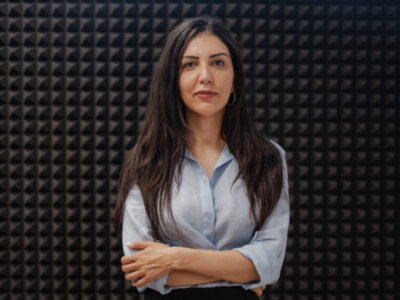
Former Deputy CEO of Ukrinform and current Deputy Editor-in-Chief of the online publication LB.ua, Maryna Synhaivska, discusses moral and ethical dilemmas, the quality of journalism education, and the importance of gender policies in the media.
Maryna Synhaivska is a Ukrainian journalist and editor who served as Deputy CEO at the Ukrinform news agency for nine years.

At the agency, she oversaw news releases, operational analytics, subscription projects, the press center, and the website. After Oleksandr Kharchenko and Maryna Synhaivska joined, Ukrinform became the only state media outlet to secure prominent positions in ratings for compliance with professional standards since 2015 and was included in IMI’s list of quality media.
She left on May 10, 2024, at her own request and became Deputy Editor-in-Chief of LB.ua by early June 2024.
In an interview with Women in Media, Maryna Synhaivska discusses self-censorship during the war, burnout in the profession, and the moral and ethical challenges faced by editors, emphasizing the need for Ukrainian journalists to prioritize their mental health.

Can you tell us about your work at LB.ua? What are your current responsibilities, and what are your professional plans for the near future in this position?
My position at LB.ua is nearly identical to my role at Ukrinform — Deputy Editor-in-Chief. I handle, let’s say, development-related issues. I am no longer primarily focused on the creative process, although I am still involved in it to some extent. My main task is to increase LB.ua’s visibility. This media outlet has a 15-year history and features quality content and talented authors. Today, we are focused on developing our social media presence and launching a fully-fledged YouTube channel with various programs, interviews, and live updates.
Additionally, we plan to develop new thematic projects alongside our existing ones. For example, the New Country project is already a year old, and on August 20, we are starting a new season. In the spring, we launched the Health section and updated Sports, and in June, the special project Territory of Culture was introduced. We won’t reveal the new projects just yet, but we hope they’ll start working in the fall. Currently, our focus is on finding talent for new projects and securing resources to support technical processes and other needs.
What impact has the war had on the Ukrainian media market, particularly regarding gender distribution in editorial offices? Is there a noticeable shortage of professionals due to the mobilization of men into the army?
Journalism has traditionally been a profession with a significant presence of women. As far as I can remember, women have always made up the majority of editorial teams. Women might make up about two-thirds of editorial teams, but they are not as prevalent in management positions. At my former job at Ukrinform, we analyzed the gender distribution in management positions across various editorial offices, and it was evenly split — 50% men and 50% women.
At LB.ua, women also predominate in the editorial office, holding various positions. This is partly due to men being mobilized and going to the front. We face a personnel shortage not only because of the war but also due to a general decline in the workforce, as many have left the country since the start of the full-scale invasion.

Many young, active individuals who could contribute are now gone, resulting in a significant shortfall. I believe every editorial office is facing challenges in finding qualified professionals. I anticipate that soon there will be a need to advocate for the presence of men in teams, as more women enter the field and explore new professions and roles. In particular, in technical roles that were previously dominated by men, such as positions related to YouTube, there are now many women filling these roles, as the men have gone to fight.
I would say there is a general shortage of personnel and journalists, both at my previous job and here. We are actively searching to hire more, as there are few qualified candidates available.
What is this connected to? Did people move into other professions?
Many people are experiencing burnout. For example, when searching for SMM specialists, we found that those who previously worked in media often burned out and transitioned to other industries with lighter workloads and, as I understand it, higher salaries. This is partly because media jobs are not very well-paid. So, when I ask even the SMM professionals I know to return, they decline.
The media involves managing a large flow of information and constant workload, whether in news or reporting. It is emotionally challenging work, often involving the risk of retraumatization — dealing with traumatic content not out of choice but necessity. As an individual, you can choose not to watch the news.

Our work also serves as a form of salvation during times of war, as it is socially important and meaningful.
What is the first piece of advice from psychologists? Avoid watching the news, isolate yourself, and steer clear of negativity. But when events like July 8, 2024, occur, journalists have no choice but to take action and go, for example, to Okhmatdyt, regardless of their personal preferences. It’s a whole different level of responsibility and stress, to put it simply. Journalists have no choice. They have to. It is their job to cover critical topics that are stressful, involving conversations with people who have been hurt or are grieving their losses. It’s genuinely challenging work. On the other hand, our work also serves as a form of salvation during times of war, as it is socially important and meaningful.
When discussing how to work effectively, the first thing I emphasize to both management and employees is the importance of adequate rest. There should be a structured work schedule that ensures employees have days off to rest and recover. Without this, they risk burning out and leaving the profession, as many already have. That’s true.
Regarding personnel: How would you rate the level of training for students and graduates of journalism universities? I have heard that it is often considered insufficient for starting full-time work in the media.
I would say that this is not true for everyone. However, when we work with universities that request internships for their students, we encounter a common issue. For example, some media outlets might agree to take 5-6 students, but only four of them are physically present; the rest work online. We tried this approach once in 2022, but it was very challenging for the editorial office. Since the student was not physically present, she was not fully involved in the process and lacked direct supervision. Consequently, it was difficult to provide meaningful mentorship, and the student often ended up producing only one piece of remote work — such as an interview or a report — which was typically of poor quality due to her limited skills.


The main problem with our universities is that they focus primarily on theoretical teaching and lack practical experience. I don’t see university newspapers, radio stations, or television programs offering hands-on opportunities for students. Such opportunities should be available, but they often aren’t, or they exist in a limited form where everything is managed by hired personnel. Students should be writing and publishing from their first year. Creating media outlets at the university level on free platforms is not difficult.
At one of the universities where I served on the examination board for three years, I consistently emphasized this point. Unfortunately, universities have adopted a different approach: students in their first and second years go on brief two-week internships, while in their fourth year, they complete a more substantial four-month internship at a media organization. Essentially, all their practical training is transferred to us, the organizations that host these internships. Another factor is that many of the specialists teaching at journalism universities are not active practitioners in the field themselves.
I worked at Borys Grinchenko Kyiv University for two years before the [full-scale] war began. I was involved in agency journalism with students, teaching them how to write news. In the first year, we spent four months writing and rewriting, constantly refining their skills.
“Gender Equality Issues Often Arise Where We Least Expect Them” Interview with Maria Frey, a Board member of Suspilne
Some of those students eventually came to work at Ukrinform, and they were well-prepared — trained by me specifically for our processes, standards, and rules. When students are only taught theoretically that news answers the five Ws — who, where, when, what was said, and what was done — and are not given the opportunity to write it themselves, the learning doesn’t translate effectively.
During the full-scale invasion, I encountered a very condescending attitude towards less successful student projects during exams, with the reasoning being, “You have to give a good grade because it’s wartime.”
At that time, I told the teachers: you’re being very lenient now. These students, if they want to enter the profession, will eventually end up in challenging situations like explosion scenes. They need to be psychologically prepared for this. They need to be able to write effectively and communicate well with people. Accordingly, they need to be carefully prepared.
The problem is that many students lack dialogue skills and struggle to formulate their own opinions. I have observed that young journalists, during their first interviews, often lack training in conducting conversations, formulating questions, and providing clarifications, which hampers their ability to engage with their interviewees effectively. As a result, all their practical training ends up being provided by the media organizations that take them in.

When I was in the ITR program, we visited Sweden and toured the university in Kalmar. There, students work in a professionally equipped studio, create reports from the streets of the city, and these reports are then picked up by central television. It’s a completely different approach to learning. To be honest, they are much happier there because they see meaningful results in their work. For us, the sense of purpose is very formal and lacks practical application, which is a significant issue.
It seems to me that journalism should recruit individuals who are already trained specialists. Journalism should be pursued after completing a bachelor’s degree, with people who have expertise in fields such as language, biology, mathematics, or political science. These individuals could then acquire journalistic skills, an understanding of journalistic genres, and a professional toolkit during their master’s degree. In my experience, the best journalists often come from diverse backgrounds such as cybernetics, history, or political science. These are individuals who enter the profession with different expertise. After all, a journalist is someone who continues to learn throughout their career.
What moral and ethical dilemmas have you encountered in your work?
Of course, during the war, we faced a number of challenges. When Bucha was liberated and the first journalists were allowed in, the exhumation of bodies of local residents killed by the Russians began, revealing shocking images. According to Google’s rules, we are prohibited from posting such graphic content, as it could lead to complaints. Even in peacetime, we received complaints when, for example, we posted photos or videos of high-profile road accidents. Do you remember the story of Olena Zaitseva from Kharkiv, who ran over pedestrians with her car? Google actually banned such materials, and we received complaints that forced us to hide this content.
But we need to show the world the full extent of the cruelty occurring in our country. At the same time, we experience the opposite effect: people are tired after two and a half years and are not interested in reading or watching such news. That’s true.
It’s no secret that traffic on websites is declining. People are looking for something different, but it isn’t available. Our lives are filled with constant stress and challenges, with stories about events happening here and there. And you have to work with it, because this history is ours and it must be preserved.

On the other hand, in this situation, you try to find even the smallest ray of hope or positive example — like a watermelon growing near the front line in the Kherson region — to show that, despite everything, life in Ukraine continues. Remember the Kakhovka HPP disaster? It seemed like it was beyond repair. Yet, a forest grew back, Ukrainians settled the area, started growing cucumbers, and found ways to recover. So, this is our strength: we have a tendency to recover and rebuild.
The first months of the [full-scale] war were a daily test: deciding what to post and what to withhold. Later, agreements were established between the media and authorities stating that we should publish reports of hits on civilian targets after at least three hours, and on critical infrastructure after a day. Unfortunately, very few media outlets adhere to this rule. In this context, Telegram channels are squeezing us out, competing with the media and drawing away readers. Nevertheless, we refrain from sensationalism.
The topic of journalists “causing harm” is very painful for me because journalists are simply reflecting reality. However, self-censorship is very important right now. Each of us must make personal moral decisions about what we can or cannot publish. When you adhere to your internal principles and rules, it becomes easier to work effectively and without problems.
I wanted to ask about censorship and self-censorship during a full-scale war: what challenges have you faced in your work?
Again, I’ll refer to my experience at Ukrinform, where I worked for nine years. When our editor had questions about the appropriateness of certain content, he would turn to me directly, and we would decide whether to post it, considering all restrictions, including legislative ones. Generally, we tended not to post content like photos of critical infrastructure.

If we recall the first months of the full-scale war, the local authorities’ public channels caused more harm than the media. They disclosed details such as where missiles were intercepted and the locations between which they were shot down. It was possible to calculate the exact location from where the missiles were shot down. However, this issue has since been addressed. Of course, we can’t monitor all civilian witnesses who post content online. However, media outlets that use these videos must carefully consider the potential harm they might cause. Is publishing this content truly important, or will it cause more harm than good?
Now, there are many civilian topics related to mobilization, MMC assessments, and the work of recruiting centers. The impact of your material depends on how well it is balanced and whether it presents all points of view and positions from different parties.
We need to show the world the full extent of the cruelty occurring in our country. However, we often see the opposite effect because people are fatigued.
The worst part is that journalists are now restricted in their access to information, including civilian information. Now, when you send requests, you often receive no immediate response, as you once did. Instead, you get a formal letter with excerpts from the department’s charter. No one knows how long the war will last. We have been at war for ten years, and we may continue to live with it for some time longer. However, the rules for the proper functioning of the information field need to be adjusted — war cannot be used as a blanket excuse for everything.
What is the current reputation of journalists? Do you think media professionals care about it now?
I cannot speak for all journalists. Reputation encompasses your readers, your influence, your revenue, and your trust. Without trust, you cannot develop. Of course, some “yellow” media might disagree with me on this. Sometimes, it involves completely vile content that isn’t true, yet there are many people interested in reading it. This highlights a major discussion in our modern world of contradictions.
When the government changes, so do the rules of the game. Media outlets may try to align with various political forces to serve their interests. During the war, media are often forced to focus on survival, and when you discuss standards, you might hear that you’re out of touch with reality. This is because, ultimately, media need to support their employees and make money, which can lead to a more lenient approach to content. And it’s all very complicated. However, media outlets that adhere to standards do not disappear as quickly. Consider propaganda resources like NewsOne and NASH TV channels. They disappeared without much notice. Time proves that standards help media to live long.
“Gender policy is clearly an important aspect for journalists. However, it is not only about promoting women’s rights — it involves covering any gender-related issue, regardless of who is involved.”

You’ve already touched on the topic of standards, so I’d like to discuss why gender policies are important as part of editorial policies.
I wouldn’t discuss gender policy in isolation from editorial policy, because editorial policy cannot exist without incorporating gender policy.
Personally, I devoted years to this issue. Back in 2016-2017, Ukrinform and I were trained by “Povaha: Campaign Against Sexism.” We invited experts who pointed out mistakes in our news, such as when we unintentionally produced content describing “a beautiful blonde who headed the district administration.”
In principle, there are quite a few women visible in the media. I remember times when women fought for the right to work in fields like mining or diving, even when such roles were previously forbidden to them. But the war changes the situation. Today, we see calls for women to learn to drive the metro and take on jobs traditionally considered “men’s work.” Because such a need arose.
I really appreciate The Guidelines on Gender in Editorial Policy, developed by Women in Media and the Commission on Journalistic Ethics, as they provide very clear rules for covering difficult issues, including conflict-induced violence. In particular, it outlines how to conduct interviews, when to pause, and how to coordinate materials with individuals who have experienced violence. It is very important. When you are familiar with it, you will work properly. Therefore, gender policy is clearly an important aspect for journalists. However, it is not only about promoting women’s rights — it involves covering any gender-related issue, regardless of who is involved.
Is the gender aspect addressed in LB.ua’s editorial policies?
Yes, it is present in our editorial policies. We submitted our editorial policy for examination, and included a connection with aspects related to gender issues. Now, no editorial policy is complete without addressing gender issues. This is an important step as we integrate more with European standards. We need to adhere to EU rules if we want to align with our current trajectory. Because “traditional” sexism in our public life should definitely decrease.

Why is it important for female editors to be active and visible in the media community?
It seems to me that it’s an individual matter. If someone is ready to express themselves and cannot remain silent, they will share their opinion on various issues. It is not something that can be taught or encouraged. Although I know that some media outlets, when hiring a top editor-in-chief, explicitly require them to appear on television, participate in broadcasts, and represent the editorial office as a visible figure. And each person who takes on this position weighs whether they can meet those expectations.
Editors have a lot of work, even without the added pressure of publicity. I think it also depends on the type of personality and the ability to be visible and handle criticism. Being a public figure can bring a wave of criticism, including from bots and trolls, and you need to be prepared for it.
I cannot say whether publicity is bad or good. To be honest, there are times when I don’t write at all because I simply lack the strength. And there are times when I can’t keep quiet and end up getting involved in things I shouldn’t.
Speaking of hate, have you encountered any such experiences directed at you?
Personally, I have not encountered targeted hate accusing me of wrongdoing, but the position of heading such a large media organization as Ukrinform was constantly associated with the fact that any slight mistake on the website would result in widespread tagging and criticism on Facebook. That means you are responsible for every comma, every word, and every topic — and you have to answer for them. If it’s a mistake, you acknowledge it, thank them for pointing it out, and correct it. If it’s an ideological disagreement, you defend your opinion and engage in discussion.
You were a participant in several programs for Ukrainian media women from the NGO “Women in Media,” including receiving funds for psychological and medical assistance. Can you share some feedback on how it helped you?
Women in Media is a unique and comfortable platform for me, as it has united thousands of women in the profession and is highly beneficial. Even if you don’t post anything yourself, just reading others’ posts —where someone might give advice on using the latest technologies, artificial intelligence, or encryptors — you can take note of it, save it, and find it helpful in your work.
This socio-humanitarian aspect, which allows Women in Media to provide psychological and medical support, is really great. It’s like a small trade union. I hope this will scale up in the future.

In my opinion, two key aspects of working with the media are crucial now. First is the physical safety of journalists, including proper equipment, first-aid kits for those heading to the front, and medical insurance. Obtaining such insurance for journalists today is a significant challenge. Those working in combat zones are typically covered only by the International Insurance Fund for Journalists under the Suspilnist Foundation. As the editor at Ukrinform, I encountered a situation where I contacted various insurance companies to inquire about coverage for journalists. Unfortunately, none of the Ukrainian insurance companies were willing to provide even basic life insurance. This is a nationwide problem. It’s also worth noting that foreign journalists who come here are often already insured, and their frontline teams frequently have ongoing communication with psychologists. It’s not about whether you want it or not — it’s essential to be stable.
And the second aspect that needs to be considered is psychological support, which is a necessity for the entire society. Media professionals need such support, whether they are working on the front line or based in Kyiv. Because when there are shellings and explosions outside your window, you can’t sleep all night due to the adrenaline rush, and then you have to go to work in the morning and keep working day after day. It is very difficult.
Media professionals are living people with families and children; they experience not only work-related stress but also the multifaceted challenges of personal life and family concerns. The work of organizations like Women in Media, Suspilnist, and Lviv Media Forum in providing psychological support is invaluable. However, it’s also essential to educate people on how to use these resources effectively. I always advocate for seeking psychological support, though many people are not ready to admit they need it. However, a stable journalist performs better.
You were also seeking ways to provide psychological support for a colleague. This year, Women in Media allocated funds for individual consultations through the “Take Care of Your Health” program.
When you live near a “critical infrastructure site” and your windows are broken three times in 2-3 years due to constant attacks, the need for support is clear. It’s reassuring to have someone speaking about it and to know where to turn for help.
You mentioned above that foreign journalists who come to Ukraine to work during the war are all insured. We once discussed this issue with my colleagues during strategizing for Women in Media: journalists from established organizations like the BBC or Associated Press work with insurance but Ukrainian media professionals who travel with them as fixers do not have such guarantees. And if something happens to such a journalist, neither she nor her family will receive any compensation…
Now the war has taught me, as a leader, to attend tactical medical courses — not just to learn how to apply a tourniquet, but to note what should be included in a first-aid kit for someone traveling to the front. And then you still need to fill that first aid kit.
I once calculated that if you include everything needed — good tourniquets, thermal blankets, occlusive bandages, and bandages — the cost for one first-aid kit can reach hundreds of dollars. Few journalists have such a first-aid kit unless they frequently travel to the front. Generally, these are provided by various organizations; for example, thanks to the Institute of Mass Information, journalists have received high-quality jackets, CAT tourniquets, and other essential equipment. Providing journalists with first-aid kits that include low-quality Chinese tourniquets, which break after the first use, is problematic. It would be better not to provide such kits at all.


Unfortunately, compared to foreign media, our media is underfunded. We don’t have many vehicles capable of reaching the front line. We lack communication stations and solar panels. Everything is coming together gradually for those who work in dangerous conditions.
I saw that the issue of insurance for journalists working in the war was raised by Yaroslav Yurchyshyn, head of the Committee of the Verkhovna Rada of Ukraine on Freedom of Speech. In the comments under his Facebook post, I wrote that the issue is not with editors not wanting to insure their journalists, but rather that insurance companies, including state-owned banks with insurance arms, simply do not provide coverage. He responded that “we are working on it,” and that the NBU is seeking ways to support insurance companies with incentives to provide coverage for journalists. However, I believe the issue could be addressed more effectively by establishing a dedicated fund to insure all media professionals. Because if we place the responsibility solely on insurance companies, they will likely find numerous reasons to refuse.
This material was made possible by the New Democracy Fund (NDF) and International Media Support (IMS) as part of the project “Breaking Down Barriers: Bringing together public organizations, media, and state bodies to achieve gender equality in the media space of Ukraine,” implemented by the NGO “Women in Media.” Any views expressed here belong to the authors and do not necessarily reflect those of NDF or IMS.