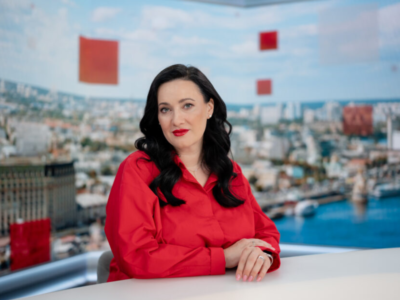
A conversation with sports journalist Kateryna Makarevska about covering the 2026 Olympics, taboo topics in sport, and gender stereotypes.

Kateryna Makarevska is a journalist at Suspilne who specializes in covering sports news and events. She has worked in sports journalism since 2016. After the XXXI Summer Olympic Games in Rio de Janeiro, Brazil, she joined the sports desk of the Segodnya newspaper as a junior editor. Working there, she immersed herself in the sports beat, trying different formats and approaches.
Later, she spent some time freelancing and became interested in gender issues and socially oriented topics in sports. In 2021, right as the XXXII Summer Olympic Games were taking place in Tokyo, Japan, she joined Suspilne, which was still a young media outlet at the time, with a team that was only beginning to take shape.
Today, Kateryna is one of Suspilne’s on-air professionals covering major sporting events, including this year’s XXV Winter Olympic Games, which are currently being held in Italy.
“Unfortunately, I still haven’t had the chance to work on the ground at the Olympic Games themselves. For now, I’m covering them only from Kyiv. But in 2024, I traveled to the Paralympics for the first time. It’s also planned that I’ll go to the Paralympics taking place in March this year in Milan–Cortina, just like the Olympics,” Kateryna says.
In her conversation with Women in Media, she talks about how she combines sports topics with social issues in her work, and reflects on the role of women in sports journalism in Ukraine.
Versatility and learning on the job
Having a dedicated specialization and working as a sports journalist in Ukraine is a great privilege, Kateryna Makarevska says. For the most part, that kind of focus is something only those covering men’s soccer can afford. Other sports journalists must be versatile, just like she does.

“I work with different topics. Of course, among ourselves, we know that if it’s this kind of news hook, I’ll be better equipped to handle it, and if it’s another kind, someone else will. So we try to make sure we still have some areas of specialization. But it still turns out that we work on a bit of everything.”
Sports journalism as a separate specialty is offered by several Ukrainian universities. For example, it can be studied at the master’s level at Taras Shevchenko National University of Kyiv, as well as at Borys Grinchenko Kyiv Metropolitan University. However, Makarevska explains that non-academic opportunities for training or improving one’s skills in this area of journalism in Ukraine are far from widespread. So she had to learn everything in practice, in the newsroom. It helped that she had been interested in sports since childhood.
“It became easier for me to figure some things out because I was already interested in them—I just needed to learn how to present them properly in my pieces. So I learned to write as a separate skill, and to understand sports as another. Then somehow it all came together,” the journalist recalls, speaking about how she started out in the profession.
The most important secret, she says, is simply to love what you do. And that applies to any field.
The social dimension and taboo topics in sports
“Now it’s even hard for me to say exactly how it happened. I came to it gradually, organically,” Kateryna Makarevska says when asked why she decided to focus specifically on social issues in sports. She explains that she was always surprised that in Ukraine, in the context of sports, people rarely talk about topics like gender equality, LGBTQ+ issues, and feminism—the way they do abroad, where, for example, Black women athletes speak up about these things.
“I’ve always felt that sports can’t exist in a vacuum—there are social problems there too, and they can’t be ignored,” she adds. “And maybe it was only after Russia’s full-scale invasion of Ukraine that we finally started seeing, so to speak, statements from athletes that go beyond sports. At these Olympics, we saw a statement like that from Heraskevych.”
During the 2026 Olympic Games, Ukrainian skeleton athlete Vladyslav Heraskevych appeared in public wearing a ‘helmet of remembrance’ featuring images of athletes killed in Russia’s war against Ukraine. The International Olympic Committee disqualified Heraskevych, saying the helmet allegedly violated Olympic rules.
Today, Kateryna Makarevska is interested in exploring uncomfortable and at times even taboo topics in sports that are rarely discussed. For example, before the full-scale war, one such topic was the so-called “apolitical” behavior, when many athletes continued traveling to Russia for training and competitions.
The issue she says is most often swept under the rug now is violence in sports, including sexual violence. In Ukraine, there are still too few cases where people have spoken about this publicly. It has not reached a broader scale—even though violence itself is an “ever-present problem”:
“I’ve been trying to cover this topic for a very long time, but it’s hard to find people who are willing to speak. If more people started talking, maybe it would set off a kind of chain reaction. Just like Heraskevych speaking about the war now—because of him, more and more people start supporting it too, because they see an example: someone is already doing it,” Makarevska reflects.
She adds that she personally knows of several cases of violence in sports, but she cannot report on them because the people involved in those stories have not spoken publicly. Still, she says it is painful to see that these people remain in sports and even build careers: “And I know there’s a lot of darkness there, unpleasant things that are destructive for sports.”
Another issue that, in her view, still receives too little coverage in Ukrainian sports today is Russification—the impact of Sovietization on Ukraine and the Soviet system that has still not been fully rooted out.


Covering the Olympics and women in sports journalism
Among the key qualities needed to cover sporting events on the scale of the Olympic Games, Kateryna Makarevska names stress resilience:
“You’re doing all the same things, except the intensity is multiplied by ten. You have to work more and produce more content. You also have to be versatile in terms of formats: not just writing, but being able to work on camera, collaborate with the digital team, and be ready to go live at any moment.”
The journalist admits that at first it felt extremely difficult, like a “crash test,” a test of endurance, especially since she describes herself as an introvert. However, she now feels more confident working at that pace.
“I’m glad I have this opportunity. For me personally, I realized that as a woman, it’s important to be present, to be visible, in sports journalism, to work at events like this, and to show that we exist. To put myself out there, not fall into impostor syndrome, and keep growing,” Kateryna Makarevska emphasizes. She says there are far more women in Ukrainian sports journalism today than there were in 2016, when she was just starting out in the field. And these journalists are highly professional:
“Yes, I’m in a bit of a Suspilne bubble. But even within our newsroom, the team has expanded, and it makes me happy that there are many women on the team—journalists, hosts, and women working behind the scenes as well. I’d also like to see more of us in leadership roles. But I think we’ll get there.”
In particular, female students come to Suspilne for internships, and many of them are interested specifically in the sports desk. Some later stay on as staff.
Reflecting on how men perceive women in sports journalism, Kateryna Makarevska says some of her colleagues have encountered skepticism from men. This was especially true for women who tried to write about soccer or boxing—sports stereotypically seen as “male.” Some editors-in-chief at certain outlets could be somewhat patronizing toward such journalists. She recalls one example:
“I know an editor who wasn’t sure whether women should be hired for the news feed. He thought it was a high-stress job where you have to do everything fast, and that a woman might not be able to handle it. But then, after working with several women, he realized that wasn’t true at all. Now he’s changed his mind and actually insists there should be more women on his team. I’m happy when people change their assumptions.”

Even if a man is a feminist and supports gender equality, he still won’t be able to fully understand certain issues or nuances related to women, the journalist stresses—simply because he doesn’t have that lens. For example, the language used in sports. Sports are often divided into “sports” and “women’s sports,” as if men’s sports are the default:
“Why do we say ‘soccer’ and ‘women’s soccer’? Why is there just ‘the national team’ and ‘the women’s national team,’ but no ‘men’s national team’? It’s normal that someone might not even think about it. Why would they, if it doesn’t affect them? I might not understand the male lens either. That’s why I’m glad editors are at least open to dialogue and different perspectives.”
The mobilization of men due to full-scale war affects the gender balance in sports newsrooms in Ukraine. The journalist says some employers now find it more advantageous to hire a woman rather than a man, or to hire someone younger. There are risks that if you hire a man, mobilization could leave the position vacant again in a few months:
“Yes, there are more women and more young people. But we have to admit that many of these changes are happening because they’re forced. And I would like it to happen because people genuinely want it, because of openness and progressiveness.”
Global context and role models
Comparing Ukraine with the rest of the world, Kateryna Makarevska suggests that the problem of women being underrepresented in sports media is also relevant in other countries. For example, in the United States, the most popular sports are overwhelmingly male-dominated:
“It’s an even bigger gap than we have, because sports there are more developed, they’ve been developing for longer. Because of that, the situation is worse: men’s sports have risen so high that it’s very hard for women’s sports to compete now. But I do see the efforts being made to bring more women in. For example, it’s not just that fully women’s discussion panels are organized when women’s soccer is discussed—women are also joining discussions about men’s soccer.”
Asked whether she has any role models among women in international sports journalism, Makarevska points to American journalist Christine Brennan. Brennan has worked for leading outlets including USA Today, ABC News, CNN, PBS NewsHour, and NPR. She specializes, among other things, in figure skating and also focuses on social issues within the sport.

“She talks a lot about violence in sports, and she’s one of the few who asks athletes uncomfortable questions when she interviews them. For example: why are you supporting someone who has been accused of violence, and so on,” Kateryna Makarevska explains. “These are topics athletes usually aren’t used to talking about—they’re more comfortable discussing the sport itself, often relying on prepared lines like, ‘we kept going, and finally we got here.’ But when the questions are more complicated and they have to think about reputation, it gets harder. And I like that kind of example of women’s journalism.”
This material was made possible by International Media Support (IMS) as part of the project “United for Equality in the Media: Promoting Gender Equality Through Cooperation Between Public Organizations, Media, and Authorities” implemented by the NGO “Women in Media.” Any views expressed here belong to the authors and do not necessarily reflect those of the IMS.