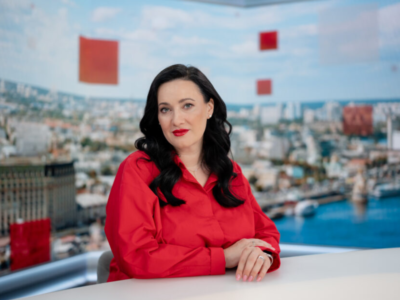
Anastasiya Ravva, Executive Producer of the media company Espreso, reflects on women’s leadership, the risks of artificial intelligence for newsrooms, and gender policies in the media.
In September 2025, Anastasiya Ravva, Executive Producer of Espreso, became one of the participants of the “Women Leaders in Media — the Ukrainian-European Support Program” by Women in Media.

In August 2024, Espreso introduced gender equality policies for all brand platforms. Why was this important to you? How long did it take to reach this step?
We are a media outlet that was born in the first days of the Revolution of Dignity, in the first days of Maidan, which stood for Ukraine’s European path. In fact, we are a media company that supports European values and the Euro-Atlantic course of our country.
When I say that we support this path, it’s not only about being physically within the borders of the European Union or the Schengen zone — it is, above all, about values. Gender equality, human rights, freedom, and democracy have always been crucial for our media.
I honestly don’t know why we hadn’t adopted these policies earlier, why we hadn’t made them part of our editorial framework. But this was a very important step for us, and a very organic one for Espreso.
I am deeply grateful to Women in Media, the OSCE, and the Commission on Journalistic Ethics, who developed these policies as a separate guide. In 2024, we adapted them as part of our editorial policy. It gave us a strong foundation.
Have you noticed any change in how the audience or advertisers perceive the channel since these policies were introduced?
We produced a series of reports about women at war, because we were frankly outraged by the way public discourse focused only on “our boys.” This created a false impression that war is exclusively a male domain. In reality, about 80,000 women are serving in Ukraine’s Defense Forces. It was essential for us to highlight this, and that’s how the series came to life.
Later, we received a proposal to publish a book. We produced the first series on our own and with support from a few partners. But for the second series — both the reports and the book — we were approached by a commercial client, a mineral water company. They knew about our gender equality policy, saw that we consistently highlighted women’s role in society and the military, and proactively offered to finance the continuation of the project.
This is a clear example: advertisers really do pay attention to a media outlet’s values. For large companies that also follow equality and inclusivity policies, it is important to partner with like-minded organizations.

It’s obvious that adopting policies is not enough; you also need a plan for implementation. How do you monitor compliance with these policies?
Honestly, this is a challenge. As is often the case in media, we lack resources, people, and funding. So far, we have not created a formal system, but we are trying to monitor it internally. We keep records of invited speakers. We also work within the team to explain why it is essential to keep searching for and inviting women, even for topics of war, where the tradition is that military experts and spokespersons are mostly men. But our editors genuinely look for new speakers, recall those they already know, and invite them.
We cannot calculate all this mathematically; we simply don’t have that capacity, but we keep a constant eye on it.
Are there international practices that Ukraine should adapt to make the media more inclusive and accessible for different groups of the population? Perhaps some of these you have already implemented, or are you planning to?
Without a doubt, international experience in this area is extremely valuable. In many countries, issues of media accessibility — from subtitles to special formats for people with disabilities — have long been part of the standards. In Ukraine, this remains a challenge, primarily due to limited resources. This requires investment in technical solutions and additional staff. For example, providing audio versions of website materials would require a significant upgrade of the platform. We understand this task and see it as part of our long-term strategy.
At the same time, we are already taking practical steps. On our YouTube channel, all materials are available with automatic subtitles, and for some content, we add professionally prepared subtitles ourselves. It is a small but important step towards inclusivity.
Do you plan to introduce specific policies on the use of artificial intelligence?
Yes, we are considering this. Artificial intelligence is already being used both privately by our editorial team and more broadly within the company. For example, we use AI to create Ukrainian voiceovers for videos sourced from Russian media, to explain how Russian propaganda works. But we always disclose that artificial intelligence was used, so that the audience is aware. Still, this does need proper regulation. We need to have clear rules inside the newsroom: how to work with it, what is acceptable and what is not, what is ethical and what is not.
It is also necessary to develop policies specifically regarding writing texts, because, in my opinion, media texts must be created by people, not by artificial intelligence. We currently have internal agreements within the company, but not formalized policies on how to apply them, or how to inform our audience about this, which is also very important.
For now, we simply haven’t had the time to sit down and write these rules, but they are definitely needed.

Have you personally encountered threats posed by artificial intelligence?
Of course. I think all media face this now, because there are so many different fakes being generated with AI: images, videos, deepfakes. Every day, it becomes harder to tell them apart with the naked eye. That’s why we work with specialized software, applications, and websites that help us identify such content.
There was an incident when our TV channel came under a cyberattack. Hackers broke into our broadcast and aired an AI-generated video featuring President Volodymyr Zelenskyi. So far, that has been the most serious threat of this kind. Since it was a cyberattack and the video appeared in our broadcast without authorization, our only option was to react after the fact. Still, our technical team did a good job, and we took corrective measures after this incident. Unfortunately, no one is fully protected from such risks.
Have you experienced challenges related to the mobilization of men?
In fact, this started affecting our media back in 2014, when some of our staff volunteered to join the military. Naturally, the biggest wave came in 2022 and 2023. After the full-scale invasion began, part of our team, including one woman, joined Ukraine’s Defense Forces as volunteers. Around twenty of our employees were mobilized, and they are now serving either in the Armed Forces or in the National Guard.
Sometimes it happens unexpectedly, and you have to accept that a staff member will need to be replaced because mobilization will not spare anyone. This really does have an impact, creating a staffing shortage. It is particularly critical in technical positions, since men tend to make up the majority in those roles.

Does your media organization have mobilization exemptions for employees? And in your view, should media professionals be eligible for exemptions?
I believe so, because the work we do is also important. I don’t like phrases like “information front” or “economic front,” but in reality, media outlets do perform a crucial role during wartime, especially in the information space. Employees, therefore, should have certain guarantees.
Our company is a national broadcaster with a license covering all of Ukraine, so we are recognized as a critical enterprise, and part of our staff are exempted from mobilization. Unfortunately, we cannot reserve everyone because there are legislative restrictions.
How does your newsroom balance high professional standards with care for the team’s safety and mental health?
Honestly, I think we do too little, and we could do more. These are times of enormous pressure: constant shelling takes a heavy toll on the team’s morale. And, of course, the workload has not decreased with the war — it has only grown, and events unfold at breakneck speed.
We’ve had several collaborations with different organizations that provided psychological support. Those were both individual consultations and mental health screenings for the team as a whole. It was a very cool experience. I think we should repeat it again and again.
Some grantmakers also arranged retreats for our team members, which worked really well too. Ideally, I would like to give people more opportunities to rest, to take vacations. But unfortunately, it does not always work out the way we would like.

Do your employees often take breaks or leave the profession altogether due to burnout?
I wouldn’t say it happens very often, but from time to time it does. We even have cases where people quit not because they wanted to leave us specifically, but because they wanted to change their profession altogether. They burn out from the intensive workload and from the kind of information they deal with, so they go to have a pause. It is really difficult to write about losses, shelling, deaths, abducted children. Unfortunately, not everyone can cope with that.
I often joke that we might be the only media outlet in Ukraine where people can return two or even three times. We’ve had cases when people left, then came back, then left again, and came back once more. I always tell everyone: if you ever decide to return to Espreso, we will always welcome you, because once an Espreso team member, always an Espreso team member.
How do you support your female employees who go on maternity leave but plan to return to work at the company?
We do our best to support women from the Espreso team who go on maternity leave, and to guarantee them that they can return to work when they are ready. Of course, we also make all the necessary payments required by law.
In my experience, everyone has come back after maternity leave, some colleagues even returning within a few months. We always understand that a small child needs care, so we discuss the workload that each team member can handle. Many positions allow for remote work, so even with a six-month-old baby, it is possible to start working again.
In fact, media are not just a brand, a sign, a name, or a logo — they are people. Without people, without the team, there is nothing. It is truly important for us to retain our people, to give them opportunities to grow, and to make them feel comfortable at our media company. So, we do our best, within our financial and other capacities, to support the whole team.

This year, you are participating in the “Women Leaders in Media — Ukraine-EU Support Program” by Women in Media (implemented in cooperation with the European Centre for Press and Media Freedom (ECPMF) and supported by the Federal Foreign Office of Germany — ed.). What does “leadership” mean to you personally?
For me, leadership is first and foremost about responsibility. Taking responsibility for yourself, for the product you create, for the audience, and for your team. Leadership is not about being the boss who stands on top and orders everyone around. It is about equality, trust, and joint decision-making. We always discuss important issues, our strategy, where we are heading, and what we are doing. I believe that a leader who cannot listen to their team is not really a leader. The time for such leaders has long passed. It seems to me that women are now setting the tone for this new kind of leadership. The more women leaders are involved in different processes, the more organically and naturally they will develop.
Why do you think such programs, aimed at supporting women leaders, are important for women in the media?
Because they create a community, they bring us together — we are there for one another. We can share our experiences, our struggles, and we can compare notes. Sometimes one head is not enough to find a solution; you need two, three, four, or five heads.
For me, such programs are about a comfort zone, about people who think in the same direction as you. That’s why I am very grateful to be part of this team, and I believe Ukrainian media will definitely benefit from such networks.
Have you ever faced gender discrimination, sexism, or ageism as a woman leader in your professional career?
I got my first managerial position at the age of 22. At that time, I often heard skepticism: that it was too early, that I had too little experience to manage even a small team. I see this as a manifestation of ageism. Such comments were unpleasant, but they did not stop me.
Over the years, when I became a top manager of a large media organization, I no longer heard such things. I think this is not only about experience but also about inner confidence. I am focused on results, not on how my work is judged by people whose opinions are not based on professional criteria.
And I want to emphasize separately: within our team, any form of discrimination — by age, gender, or any other trait — is absolutely unacceptable. We are a newsroom built on mutual respect and support.

Do you have personal mentoring stories — cases where you supported other female journalists and it made a real impact on their careers?
In fact, there are many such stories. For me, it is particularly important that women on our team have opportunities to grow within the organization. At Espreso, it often happens that interns who joined in entry-level positions later grew into managerial roles.
There were also cases where we became the very first workplace for young journalists — the first entry in their employment record was at Espreso. Today, in many Ukrainian media outlets, you can meet people who started their professional path with us. Some of them now hold managerial positions. We always try to provide a strong foundation — both professional and human. Because for me, the team is not only about working together, but also about shared values.
How do you see the role of women in shaping new ethical standards of Ukrainian journalism — now and after victory?
I see women’s role in Ukraine’s development overall as extremely significant — in every field, not just in media.
Today, women leaders in media are already shaping new standards: they stand for transparency, inclusivity, balanced representation, and they address topics that for a long time remained invisible. After victory, this role will only grow. We will have to rebuild a society that will be deeply traumatized, and women’s presence in the media will be key to restoring trust, reaffirming values, and laying the foundation for a new ethics.
I am convinced that the future of Ukrainian journalism will be fairer and more humane precisely because more women’s voices will contribute to its development. This is not about a “female” or “male” perspective — it is about equality and balance.

What values, in your opinion, should form the basis of a renewed media system so that it is more just and inclusive?
For me, the fundamental values are independence, transparency, inclusivity, and accountability to the audience. We need to build a media system that reflects the diverse voices of society and gives a platform to those who are usually unheard.
If I had to highlight one core value, it would be respect. Respect for people, for everyone — regardless of gender, age, or social status. This is the basic principle that must be at the heart of all decisions. Because in the end, media do not exist for abstract “audiences,” but for real people — who need to be heard and valued.
By Oleksandra Horchynska, Women in Media
Photo credit: Valia Polishchuk, Women in Media
This material was made possible by International Media Support (IMS) as part of the project “United for Equality in the Media: Promoting Gender Equality Through Cooperation Between Public Organizations, Media, and Authorities” implemented by the NGO “Women in Media.” Any views expressed here belong to the authors and do not necessarily reflect those of the IMS.