
Inna Lysak - attack 27.05.2026
Місто фіксації онлайн-атаки
DniproДата онлайн-атаки
27.05.2026Зафіксовані види онлайн-атак
Source of Threat
Social media usersСоціальна мережа, сайт чи інший онлайн-простір онлайн-атаки
YouTubeOn May 27, 2026, the YouTube channel Suspilne Dnipro published a video titled “Is This Zinchenko? The Father of the Man Accused of Farion’s Murder, Who Is Defending Ukraine, Shares His Version.” Journalist Inna Lysak interviewed serviceman Fedir Zinchenko, the father of Viacheslav Zinchenko, who is accused of murdering former member of parliament, linguist, and public activist Iryna Farion.
Later, Inna Lysak reported that she had faced online attacks following the publication of the interview. She shared several screenshots of such attacks in a Facebook post.
“Fierce antagonists — those who believe Zinchenko murdered Iryna Farion and those who do not believe the official version — finally reached a historic agreement in the comments under our interview. Namely, that I am guilty in the eyes of both sides of the conflict. And honestly, somewhere between being called a ‘Lviv whore’ and a ‘Moscow agent,’ I completely lost track of who exactly I am supposedly working for, because there are now more versions in the comments than there are in the case itself,” she wrote.


Signs of technology-facilitated gender-based violence (TFGBV) were also recorded in the comments section under the YouTube video. These included accusations of unprofessionalism and claims that the journalist was “bought” or acting in someone’s interests. Examples include:
- “You disgusting woman, when the government and political situation in Ukraine changes, I’ll see what happens to you.”
- “If the journalist had attended the court hearings, she wouldn’t be asking stupid questions. ‘Suspilne’ is one of those channels that only presents one position because they are fed by the state.”
- “Listen, you bought-and-paid-for skin, were you there, did you see it yourself? Where is your brain? Oh right, you drank it away 😂. I’ve never heard of a hitman waiting for the victim. Seriously? Or maybe you killed her yourself — how about that version?”
- “To come to a father at the front line only to smear both him and his son? Where is your impartiality and objectivity? Twisting everything around is apparently the highest level of journalism. It’s sad that our country has such so-called ‘truth tellers.’”
In a comment to Women in Media, Inna Lysak said that, in addition to public comments, she had also received several private messages, including threats that she would allegedly be “reported to the Security Service of Ukraine (SBU).” She added that she does not consider herself a victim of the attack, as years of working in journalism have taught her how to filter audience reactions to journalistic content.

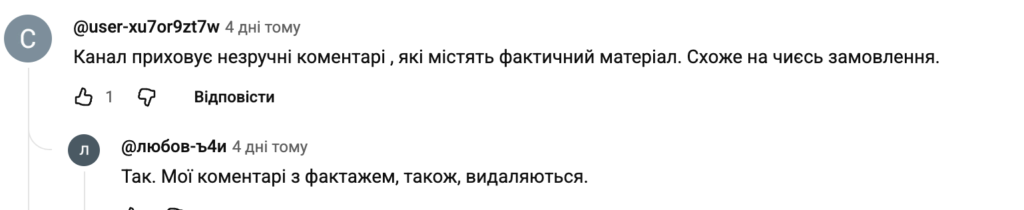
“A reaction means the story was important, and I never doubted that. And if neither side of the ‘conflict’ could clearly determine whose side we were on, as their comments demonstrated, then that is further proof that we did everything right. Real journalism is not about pleasing people or taking someone’s side,” the journalist commented.
This case demonstrates clear signs of technology-facilitated gender-based violence (TFGBV), particularly a combination of online defamation, gendered disinformation, misogynistic abuse, gendered threats, and reputational attacks. Accusations of unprofessionalism, bias, corruption, and serving the interests of political actors are a common tactic used to discredit women journalists by attributing hidden motives or external control to their work. Labels such as “Moscow agent,” alongside unfounded claims of political affiliation or manipulation, constitute forms of gendered disinformation and online defamation aimed at undermining trust in the journalist’s professional credibility.
The case also contains elements of intimidation and harassment. The use of gendered insults, including the term “Lviv whore,” shifts criticism away from the content of the interview and toward the journalist’s identity as a woman. Private messages threatening consequences or promising to “check” her through security services further contribute to a hostile environment intended to pressure, intimidate, and silence a woman journalist. Taken together, these actions reflect a broader pattern of TFGBV designed to damage professional reputation, discourage participation in public discourse, and create psychological pressure on women working in the media.
Report an online attack
If you are a woman journalist who encountered an online attack or witnessed such an incident, we would appreciate your contribution. Please report this case to help us identify threats and protect the rights of women in the media. Fill out the form, share key details, and join us in creating a safer information environment.
Fill Out the Form