
This spring, more than 40 Ukrainian women journalists received support to look after their health: they were reimbursed forpreventive medical checkups, doctor consultations, and necessary medical supplies tailored to their individual needs. The initiative was implemented in partnership with the European Centre for Press and Media Freedom (ECPMF).
Caring for health is not only a question of journalists’ personal well-being but also a crucial precondition for the resilience of newsrooms and the quality of the information society receives.

Acknowledging that one’s reserves are not endless
“Fatigue, sleep deprivation, chronic stress — these are unfortunately our constant companions right now, and they take a toll on our health. Let’s be honest: do we always go to the doctor, even when we feel we should?” says Olena Movchan, editor of the Kordon.Media website in the city of Sumy and one of the program’s participants.
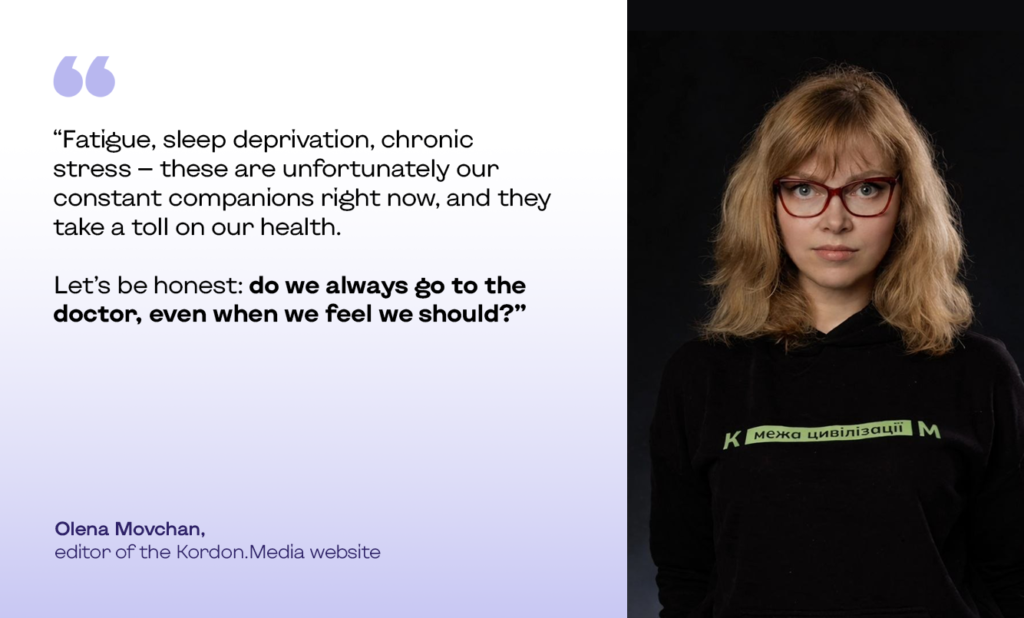
This year, she was able to undergo the necessary examinations and obtain specialist consultations thanks to the “Taking Care of Our Health” initiative from Women in Media NGO.
The program’s terms set a clear deadline for using the support, so, as the journalist notes, postponing the not-always-pleasant doctor visits simply wasn’t an option. And it was precisely this, in her words, that finally pushed her to take care of herself
“I’m still living in my hometown and still part of the coolest team — Kordon.Media — just a few kilometers from the front line. How easy or hard that is, there’s no need to tell the locals, because everyone is in the same conditions, and no matter how much you tell those who are far away, they still won’t understand,” Olena Movchan says in her feedback on the program.
Her physical health, she says, periodically gives out: the knee “taps out,” her vision darkens, she get dizzy. That’s why, she stresses, it’s important to listen to your body regularly and to go for preventive checkups:
“But let’s be honest: there’s always either no time, or no motivation, or something else. Plug in any reason you like — they all apply. So a heartfelt thank you to Women in Media for the chance to take part in the Taking Care of Our Health program. I made use of this opportunity and I’m very pleased.”
The apartment complex where Alina Shevchenko, a camera operator and editor at Suspilne, lives ended up near the impact site during one of the recent missile strikes on the capital. She was asleep at the timeand was jolted awake by the missile flying overhead.
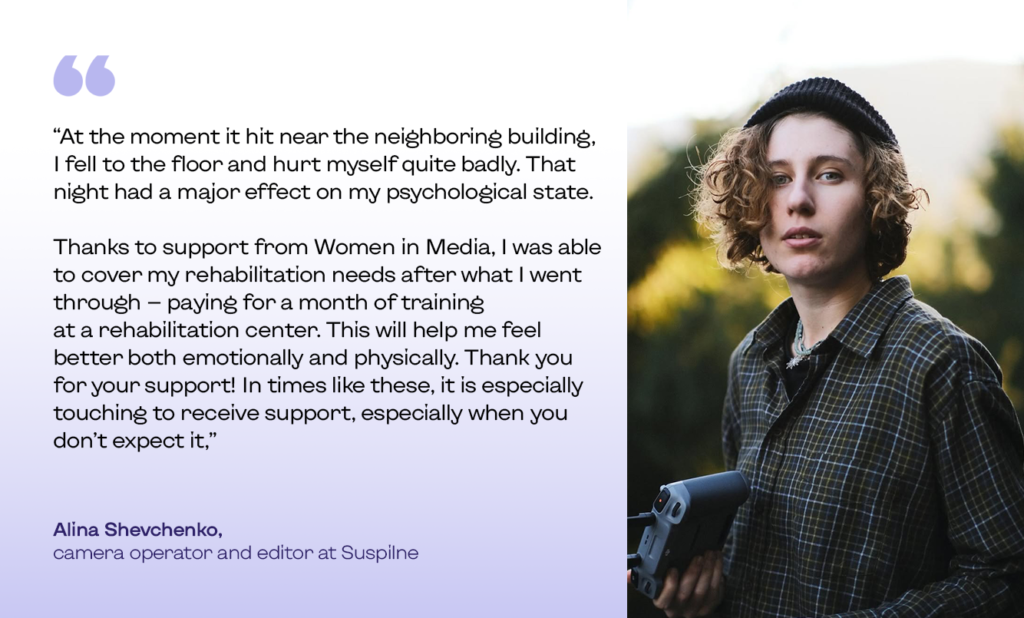
“At the moment it hit near the neighboring building, I fell to the floor and hurt myself quite badly. That night had a major effect on my psychological state. Thanks to support from Women in Media, I was able to cover my rehabilitation needs after what I went through — paying for a month of training at a rehabilitation center. This will help me feel better both emotionally and physically. Thank you for your support! In times like these, it is especially touching to receive support, especially when you don’t expect it,”Alina Shevchenko says.
Anastasiia Krupka, a journalist with The Ukrainian Week from Lviv, also took part in this wave of the Taking Care of Our Health program. Here is how she describes her reflections on the project:
“While I was waiting my turn at the clinic, I watched the people around me and thought about how many of us only come in once we can’t bear it anymore. Because before that, there was no time, or no chance, or something else. But honestly, this is the basics — without it, you can’t really do good work, or even live properly.”
That, she notes, is exactly why it’s so important for employers, media owners and newsrooms to create conditions in which staff can take care of themselves — both physically and mentally — without obstacles. Conditions where you can calmly go to the doctor, take a pause, look after yourself should be the norm.
“Thank you to Women in Media for raising this topic and helping to build a culture of responsibility and care.” the journalist says.
Tetiana Semakovska, executive editor at Bakhmut IN.UA, was also among the program’s participants. She calls this support timely and very important:
“Working in media comes with a lot of responsibility and emotional pressure. At this pace, looking after yourself keeps getting pushed aside, even when you know you need to. That’s why this program wasn’t just a chance for me to get help — it was also a reminder that you can’t keep putting your own health and energy off until later. What’s especially valuable is the approach itself — you get to choose what you actually need, without having to explain yourself or jump through hoops. It’s about trust, respect for the participants, and real care — not box-ticking support.”
For her, the program is also about feeling that you’re not left alone with everything you’re carrying:
“When you’re used to supporting everyone else — your audience, your team, the whole information space — and then someone shows up to support you, that means a huge amount. I think initiatives like this are incredibly important for media women, because they don’t just help individual participants — they shape a new culture in the industry: a culture of looking after yourself, of paying attention to how you’re actually doing, and of accepting that your energy isn’t endless.”
A culture of self-care
“We talk a lot about how Ukraine needs to build a culture of medical checkups. And honestly, I see it again and again — we just don’t have one. For some people, going in for a checkup ‘for no particular reason’ is literally a strange idea. Like, why bother when nothing hurts? Meanwhile, it can quite literally save your life,” shares Kateryna Honcharova, a journalist at RBC-Ukraine.
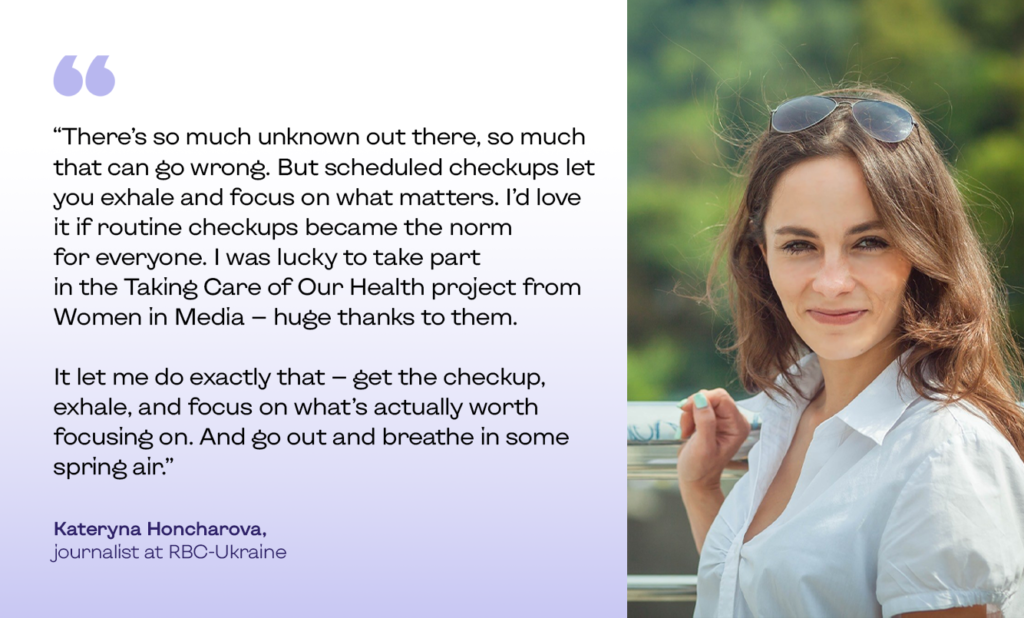
About herself she says she’s one of those people who needs a sense of control. Of course you can’t control everything. But there’s something we can influence — taking care of our health. What often puts people off here are the queues, the long waits for appointments, and the fact that the state only covers part of the examinations, while the cost of medical services keeps climbing:
“There’s so much unknown out there, so much that can go wrong. But scheduled checkups let you exhale and focus on what matters. I’d love it if routine checkups became the norm for everyone. I was lucky to take part in the Taking Care of Our Health project from Women in Media — huge thanks to them. It let me do exactly that — get the checkup, exhale, and focus on what’s actually worth focusing on. And go out and breathe in some spring air.”
Iryna Harnets, a host on Radio NV in Kyiv, also speaks of the program as a chance to slow down, stop, and focus on herself.
“Broadcasts, news, interviews — important, all of it matters. Pin down the main point, talk it throug work it out, analyze it. Every day. And everything else gets pushed to later — life, health, rest. Turns out it doesn’t work like that. Exhaustion, mood swings, no strength to get out of bed — ‘come on, everyone’s like that,’ ‘we’re living through times like these!’ And then it turns out not everyone is, and we shouldn’t be,” Iryna Harnets recounts. “Thanks to this program, I was able to stop for a second, take a deep breath, and think about myself. About the fact that my body has its limits, and that looking after yourself isn’t a luxury — it’s a basic need.”
Iryna Harnets has a message for colleagues just starting out in media:
“You’re young and active — at 20 it feels like you can handle anything. But listen to yourself and to your body. Don’t brush off the hormonal swings, the emotional ups and downs, the exhaustion Because at 40, all of that will be much harder to cope with. I’m so grateful to the Taking Care of Our Health program and to Women in Media for the chance to take care of myself. And I want every woman to remember: first of all, we have to matter to ourselves. Not after work, not after we file the piece, not after the next trip or the edited interview — right now, and always.”
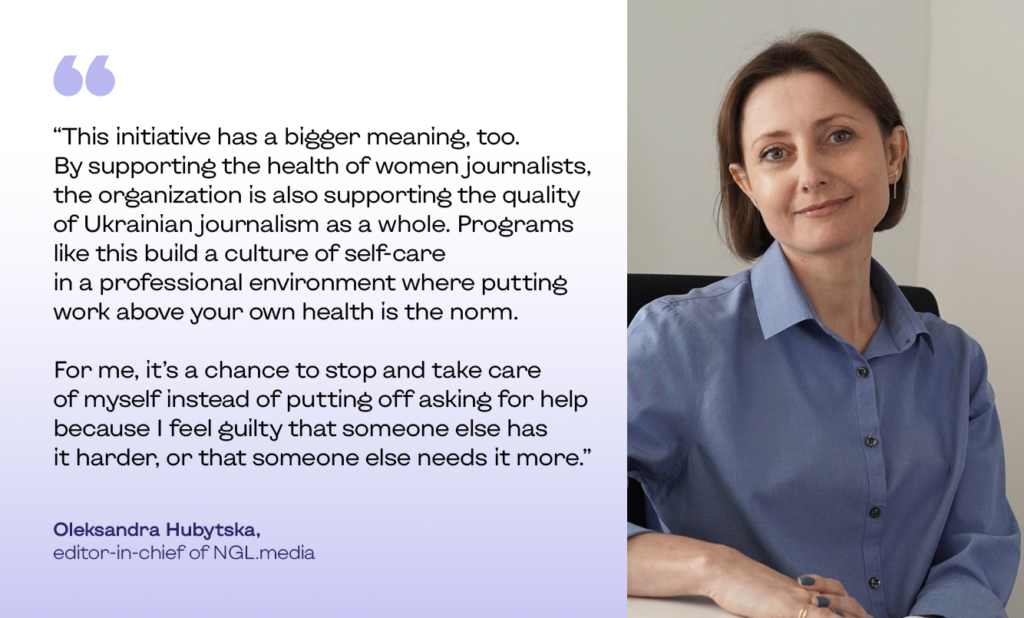
Oleksandra Hubytska, editor-in-chief of NGL.media, also speaks about the constant stress that comes with working as a journalist in Ukraine: stress combined with physical and emotional load and constant deadlines leaves its mark on your health. At the same time, most women journalists don’t have health insurance or the means to see a doctor in time. That’s why, in Oleksandra Hubytska’s view, this program isn’t just useful — it’s vital:
“This initiative has a bigger meaning, too. By supporting the health of women journalists, the organization is also supporting the quality of Ukrainian journalism as a whole. Programs like this build a culture of self-care in a professional environment where putting work above your own health is the norm. For me, it’s a chance to stop and take care of myself instead of putting off asking for help because I feel guilty that someone else has it harder, or that someone else needs it more.”
Kateryna Semysal, a digital team specialist at Suspilne Poltava, says what mattered to her in the program was finally being able to give enough time to her health without burning through her main reserves. She’s been a blood donor for five years now — which makes her own state of health all the more important.
“A deadline — and I got it done in a few days. Right now, after the program, I’m in treatment and feeling much better. Sometimes the things you’ve been putting off forever get sorted out really quickly when the timing and the support are right.”
Oksana Onyshchenko, editor at ZN.UA in Kyiv, shares that the support she got through the program came at a really tough time for her — when she needed rehabilitation after an injury.
“Right when I was sitting there trying to figure out how to handle it, I got an invitation to the program. The money made it possible for me not to put off treatment and to focus on recovery. But just as important, maybe, was the feeling of being supported. That I am not alone in a hard moment. I’m so grateful to everyone who made this happen,” she says.
She calls the idea of creating a health program specifically for women journalists “really great” and emphasizes: in our profession, it’s easy to put yourself off “for later” because of the habit of working under constant pressure.
“When I’m sick, I want to be a kid someone takes care of”
One of the most common examinations participants in the Taking Care of Our Health program choose, once again, is an eye exam. The eyesight of media women can take a hit from constant computer work, stress, and excessive workloads.
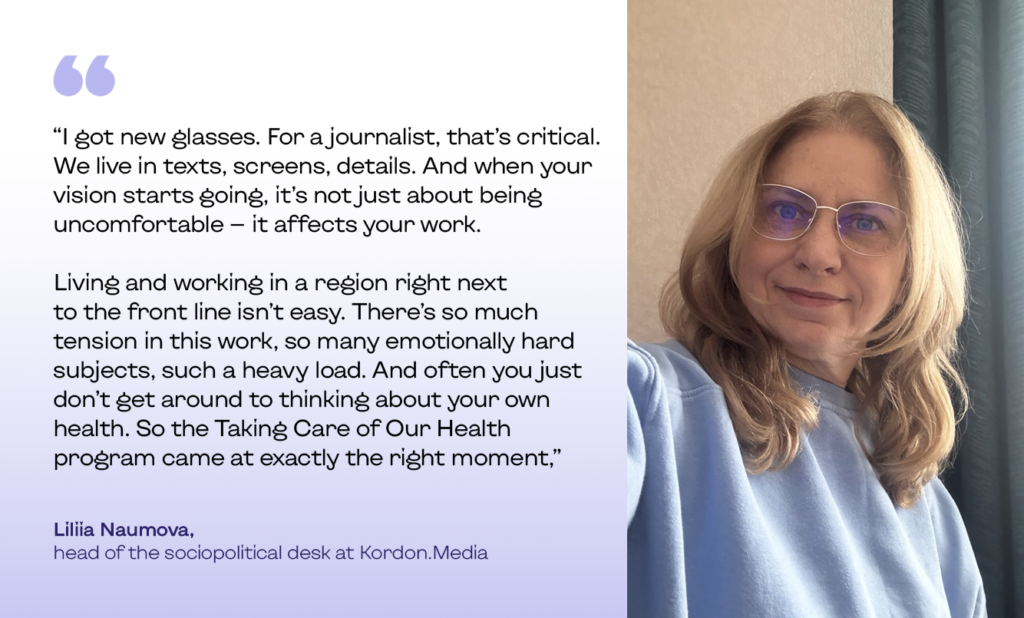
Liliia Naumova, head of the sociopolitical desk at Kordon.Media in Sumy, posted a photo of herself in new glasses. She’d needed to replace them for a long time, she says, but it kept getting put off.
“I got new glasses. For a journalist, that’s critical. We live in texts, screens, details. And when your vision starts going, it’s not just about being uncomfortable — it affects your work. Living and working in a region right next to the front line isn’t easy. There’s so much tension in this work, so many emotionally hard subjects, such a heavy load. And often you just don’t get around to thinking about your own health. So the Taking Care of Our Health program came at exactly the right moment,” she says.
For her, this program isn’t just about the medical side — it’s also about attention and care, about being seen. To tell important stories and work for people, journalists need to have something to draw on. And this project tops that up.
Oleksandra Stasyshyn, a correspondent at the My-Ukraina TV channel from Lviv, also went to see an ophthalmologist. She recalls the story: problems with one of her eyes began back in February 2022. At the time she went to the doctor and did the initial diagnostics, with the final verdict to come after further tests. Her appointment was set for February 25, 2022. The day before, on February 24, the full-scale war broke out in Ukraine — and so that appointment never happened.
“My eye eventually stopped twitching on its own, as if it understood there were bigger things to worry about. Four years went by. My vision wasn’t getting any better, and somewhere inside I knew: I had to finish what I’d started. But there was always something ‘more important’ than a trip to the eye doctor. And then the world decided for me — a random post, a form, an appointment — and a week later I had my first pair of glasses. Now I can clearly see not just the problems but also the letters. Don’t repeat my mistakes. Take care of your eyes. And thanks, Women in Media, for the nudge,” says Oleksandra Stasyshyn.
An eye checkup was also among the things chosen by Inna Varynytsia, a war photojournalist with Lb.ua. After long stretches of travel, assignments in the field, and wearing heavy body armor, the Taking Care of Our Health program got her started on a new habit — going for massages. Her ophthalmologist had told her how useful that can be, too: tension in the neck muscles can be exactly what makes vision deteriorate.
“Last week, during a lecture-interview, students asked me what my pharmaceutical (medical) background has been useful for. To understand myself better. We spend our whole lives trying to understand our body and our soul. Who we are and why we live. The body sometimes breaks down — and the soul does too, by the way — and in those moments, even with a medical background, we end up defenseless. When I’m sick, I want to be the kid somebody takes care of. It matters when someone takes your hand and leads you where you need to go, explains what comes next, what you can do, and what the risks are,” Inna Varynytsia says.
It’s important to have a choice — including the choice of doctor, she adds. But that kind of choice — of doctor, of treatment, or just of a checkup — costs money.
“And what costs even more is the kind of support where someone almost takes you by the hand and walks you to the appointment, or pays at the moment when you can’t afford to spend on yourself. The help from Women in Media and the Taking Care of Our Health program is priceless in that sense. Being strong and healthy is expensive. You can save on it if you go to the gym and have your checkups in time.”
Not all participants are ready to share detailed public feedback about their participation in the Taking Care of Our Health program — and that’s entirely understandable given the sensitivity of the topic, notes Oleksandra Horchynska, project manager at Women in Media NGO. In private feedback, though, participants share just how important and timely this support has been for them.
“The media women we support tell us that, thanks to this initiative, they’re managing to catch serious health problems and start treatment in time. Often these are things they had no idea about, because they simply hadn’t been to a checkup in a long time. We keep reminding women journalists that taking care of yourself is a necessity — especially given the constant stress we’re all living under right now. Our bigger goal is to build a culture of care inside newsrooms as well. Because the physical and psychological state of media professionals has a direct effect on their ability to work — and therefore on the quality of information society receives. In that sense, taking care of journalists’ health is also about the resilience of the media and the trust of the audience. And that’s something employers should not forget,” Oleksandra Horchynska says.
The project implemented by NGO Women in media is a part of the Voices of Ukraine/SAFE programme coordinated by the European Centre for Press and Media Freedom (ECPMF). Voices of Ukraine/SAFE is implemented within the Hannah Arendt Initiative with the support of the Federal Foreign Office of Germany.