

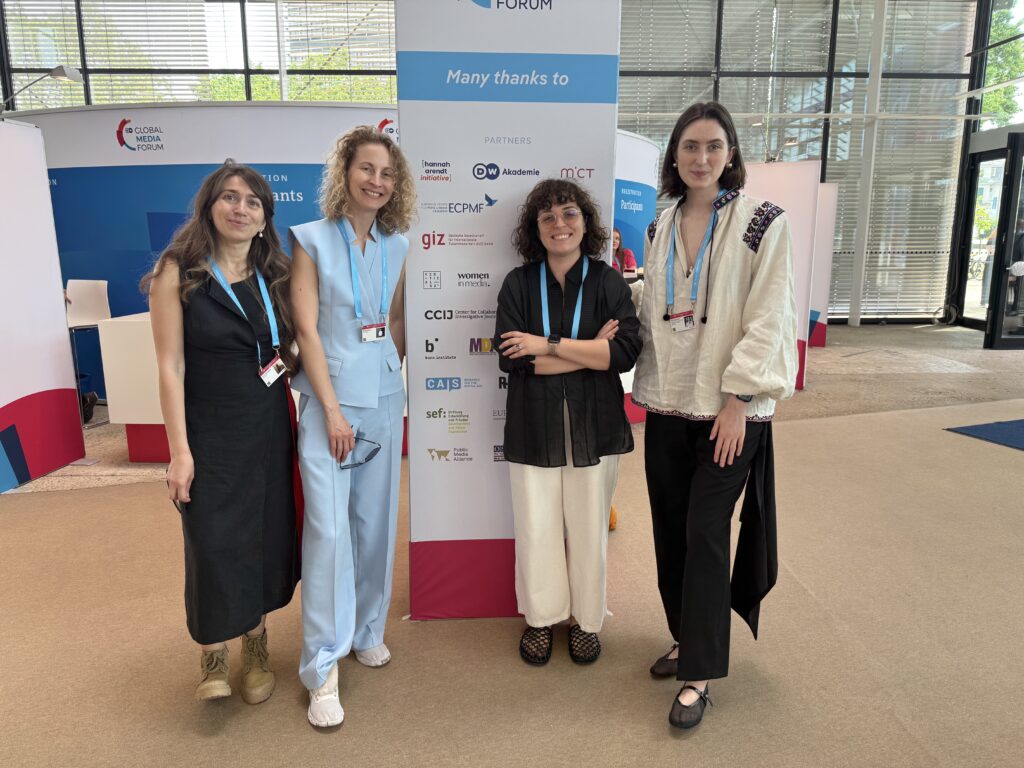
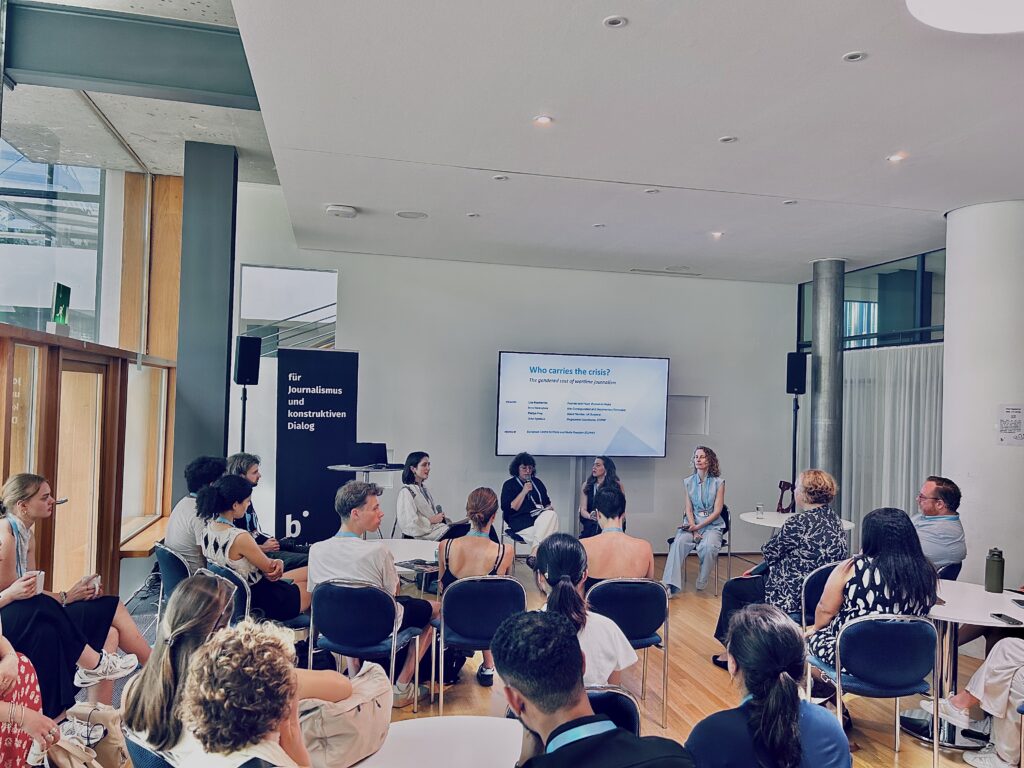
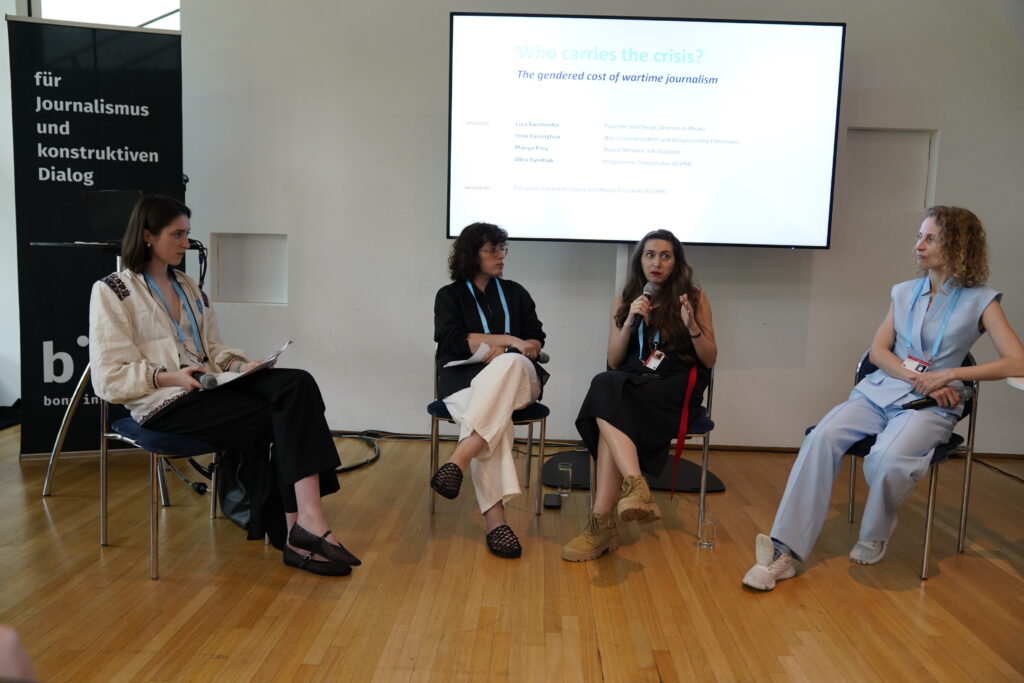
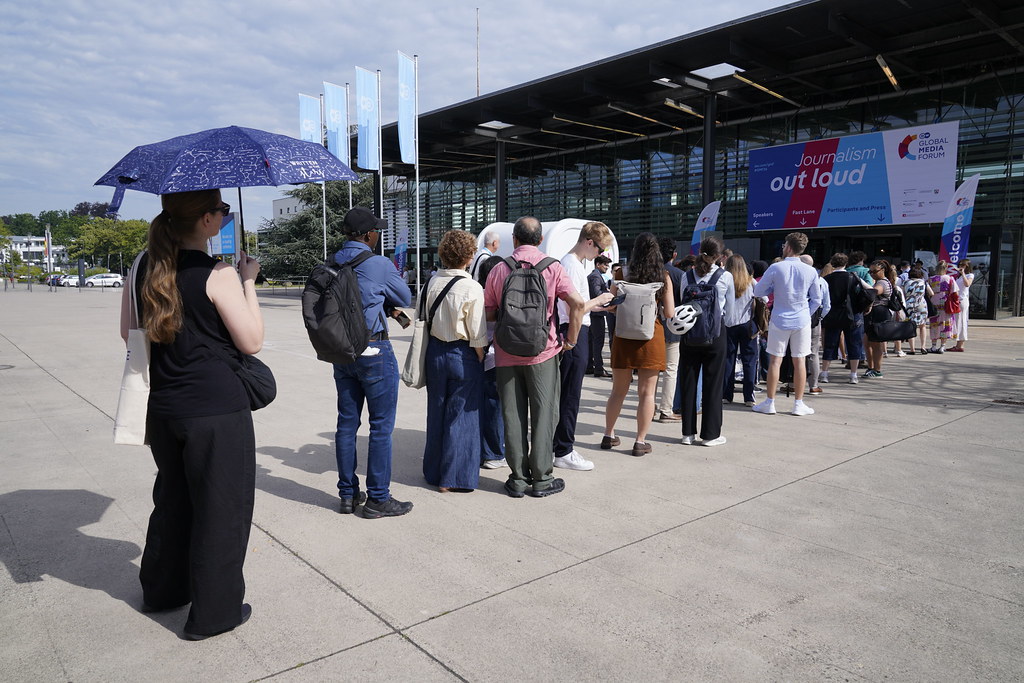
Journalism in wartime isn’t only about frontline reporting. It’s also invisible labor, caring for teams, juggling the profession with caregiving duties, and the fight for safety and the right to be heard. That was the focus of the panel discussion Who carries the crisis? The gendered cost of wartime journalism, held as part of the international conference Journalism Out Loud at the DW Global Media Forum in Bonn.
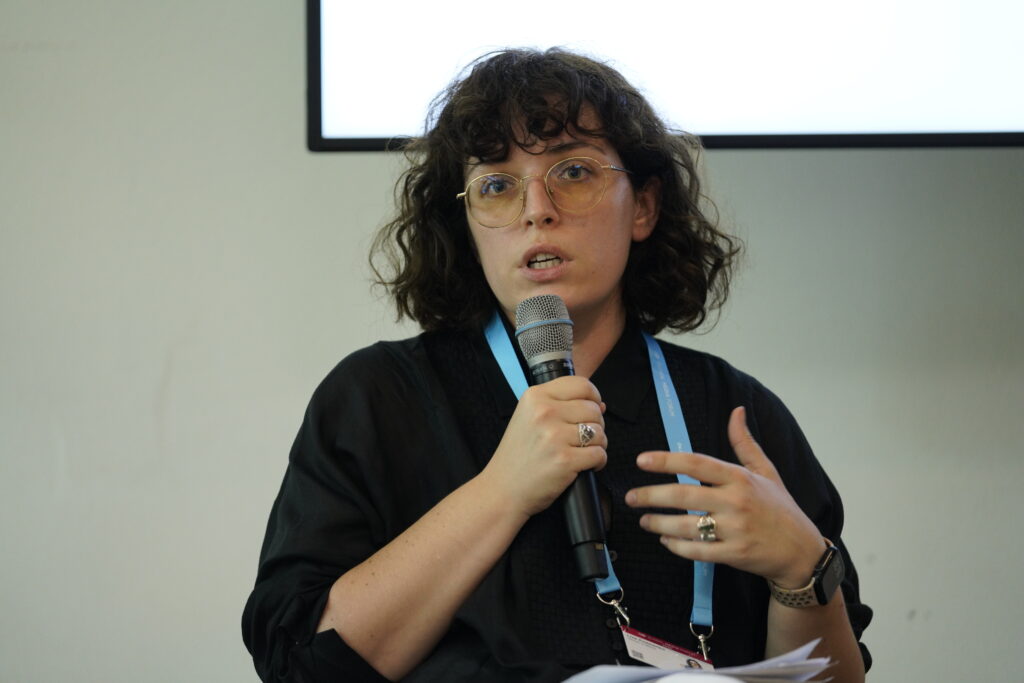
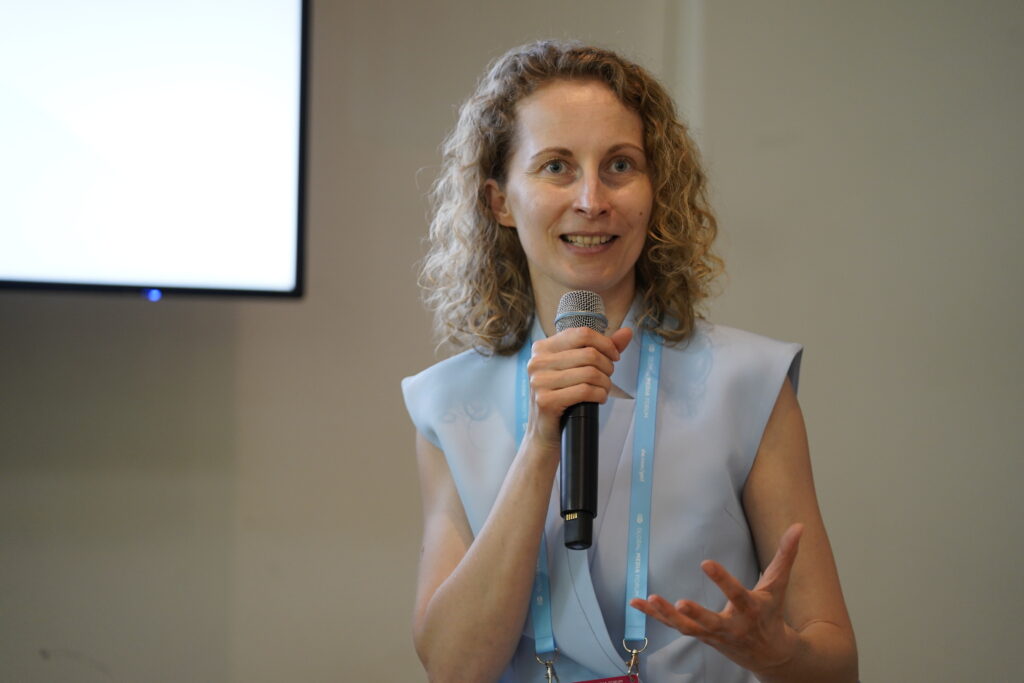
The panel was organized by the European Centre for Press and Media Freedom (ECPMF) together with Women in Media NGO. Taking part in the discussion were Liza Kuzmenko, head of Women in Media; Mariya Frey, member of the Managing Board of Suspilne; and war correspondent and documentary filmmaker Inna Varenytsia, with the conversation moderated by ECPMF programme coordinator Olha Syrotiuk.
Opening the discussion, the moderator stressed that Ukrainian women journalists today work not only on the front lines or in newsrooms. They also handle crisis management, provide psychological support to their teams, combine their professional work with unpaid caregiving, and at the same time face new gender-based digital threats. It was precisely this “invisible” side of journalistic work that became the central theme of the panel.
Ukrainian media have become a women’s sector, but the system hasn’t changed yet
The first to speak was Liza Kuzmenko, head of Women in Media, who presented the findings of the annual Gender Profile of Ukrainian Media, which the organization prepares together with the National Council of Television and Radio Broadcasting of Ukraine.
According to her, women today hold around 77% of reporting and correspondent positions in Ukrainian media. However, this figure alone is not yet evidence of gender equality having been achieved.
“If you look at leadership positions, the situation is already different. In large national media, where resources, influence, and visibility are concentrated, leadership positions far more often remain with men,” Liza Kuzmenko noted.
To show the international audience the scale of the change, Mariya Frey proposed a thought experiment.
“Imagine that tomorrow 60–70% of the men in your countries suddenly disappeared from their jobs. Would schools stop working? Hospitals? Government institutions? Would the news stop coming out? That’s exactly what happened in Ukraine after the start of the full-scale invasion. Institutions kept working because women took on the main burden.”
She believes, this opens up an opportunity not just to increase women’s representation in the media, but to rethink the very principles by which newsrooms operate.
“The question is no longer whether more women work in journalism. The question is whether we’re changing a system that was built for decades around a different experience, or just asking women to adapt to it.”
Invisible labor that almost no one counts
Liza Kuzmenko devoted a separate part of her presentation to the findings of the study on the situation of women in the media.
According to Women in Media NGO, half of women in media spend three to four hours a day on unpaid caregiving, and another roughly 20% spend from five to eight hours a day.
She gave the example of Anastasiia Bahalika, a journalist at Hromadske Radio who works as a radio host, is raising four children, looks after pets, and whose husband serves in the Armed Forces of Ukraine.
“She says: with one hand I’m making dinner, with the other I’m planning the broadcast.”
According to Liza Kuzmenko, it’s precisely this reality that often remains invisible to employers. Far from all newsrooms have work-life balance policies or other mechanisms that would help staff combine their professional work with family responsibilities.
She also stressed that support for women can’t be one-size-fits-all.
“Women are not a homogeneous group. Women journalists with disabilities, older women, members of the LGBTQI+ community, or women from rural areas have different experiences and different needs. That’s exactly why inclusive newsrooms have to take the principle of intersectionality into account.”
Online violence is changing along with the development of artificial intelligence
Another theme of the presentation was the new forms of technology-facilitated gender-based violence.
Liza Kuzmenko pointed out that artificial intelligence is increasingly being used to create fake content, gendered disinformation, and smears against women journalists who work on topics of war, corruption, human rights, or gender equality.
She spoke about the case of Hromadske Radio journalist Mariana Chorniievych, who, during a live broadcast, received a letter threatening to create a pornographic deepfake using her photograph.
According to Liza Kuzmenko, the goal of such attacks is not only to intimidate a particular journalist, but to force her into silence.
She emphasized that although technology is developing very quickly, legislation and law enforcement practice, both in Ukraine and in the European Union, are not yet keeping pace with the new challenges.
Gender policy only works when you measure it
Mariya Frey, member of the Managing Board of Suspilne, spoke about the experience of implementing a gender policy at Ukraine’s largest broadcaster.
According to her, after the start of the full-scale war it became clear that the document alone was not enough.
“A policy is where we want to get to. Data is what’s happening right now.”
That’s why Suspilne created an interdisciplinary working group that began analyzing gender balance, career advancement, pay, representation at international events, and other indicators.
Mariya Frey stressed that gender inequality is showing up openly less and less often. It can only be seen once an organization begins to systematically analyze its own processes.
Invisible labor inside newsrooms
One of the most emotional moments of the discussion was Mariya Frey’s story about “invisible labor.”
She described how she organized a birthday gift for a colleague, coordinated with all the members of the board, collected the money, and managed the whole process. But when her own birthday came, no one even wished her a happy birthday in the work chat.
“That’s when I realized just how much invisible work women do.”
According to her, this kind of labor includes organizing team events, supporting colleagues after losses, and creating an atmosphere of trust and mutual help — tasks that are almost never written into job descriptions but require significant emotional resources.
She also shared examples of practical changes at Suspilne — from conducting a gender audit to rethinking the timing of corporate events, supporting parents with children, and even such seemingly simple decisions as stocking offices with feminine hygiene products. In her view, it’s precisely these small but systematic changes that gradually create a more inclusive work environment.
Work on the front line remains a men’s space
War correspondent and documentary filmmaker Inna Varenytsia spoke about her own experience of working on the front line since 2014.
According to her, women still often have to prove today that they’re capable of working in combat conditions. At the start of her career, it took her weeks to get permission to work directly in the trenches, and after the birth of her son and the start of the full-scale war, she essentially had to go through that whole process again.
She also stressed that modern warfare has substantially changed the safety rules for journalists. Because of the widespread use of drones, the high-risk zone has expanded considerably, and decisions about journalists working on the front line are often made by people who have never worked in Ukrainian combat conditions themselves.
Support has to be more than just words
At the end of the discussion, Liza Kuzmenko presented the support programs run by Women in Media.
One of them — “Taking Care of Our Health” — helps women journalists gain access to medical services while also showing newsrooms that caring for staff health should be part of the editorial culture.
The second initiative is aimed at supporting caregiving work: the organization reimbursed the costs of a nanny or of care for older relatives or relatives with disabilities so that women journalists could attend a professional event or training.
“Women journalists shouldn’t have to choose between professional development and caring for their loved ones,” Liza Kuzmenko emphasized.
Journalism needs not only courage, but systemic change
The panelists agreed that the war has made women’s contribution to journalism even more visible, but at the same time it has exposed problems that existed before: the unequal distribution of unpaid labor, insufficient support for fatherhood and motherhood, technology-facilitated online violence, barriers to career growth, and the inadequate consideration of women’s needs in editorial policy.
Ukraine’s experience shows that media resilience depends not only on the flexibility of journalists, but also on media organizations’ readiness to rethink their own approaches to management, safety, equality, and staff well-being. These very changes are now becoming an integral part of the future of journalism — both in Ukraine and far beyond its borders.