
Valeriia Kovalinska - attack 16.06.2026
Місто фіксації онлайн-атаки
KyivДата онлайн-атаки
16.06.2026Зафіксовані види онлайн-атак
Source of Threat
UnknownСоціальна мережа, сайт чи інший онлайн-простір онлайн-атаки
TikTokA video is circulating on TikTok from the account @petizjwsvkt, “Petitions of Ukraine,” which uses the likeness of TSN presenter Valeriia Kovalinska to spread messages about mobilization and the activities of Territorial Recruitment and Social Support Centres (TCRCs).
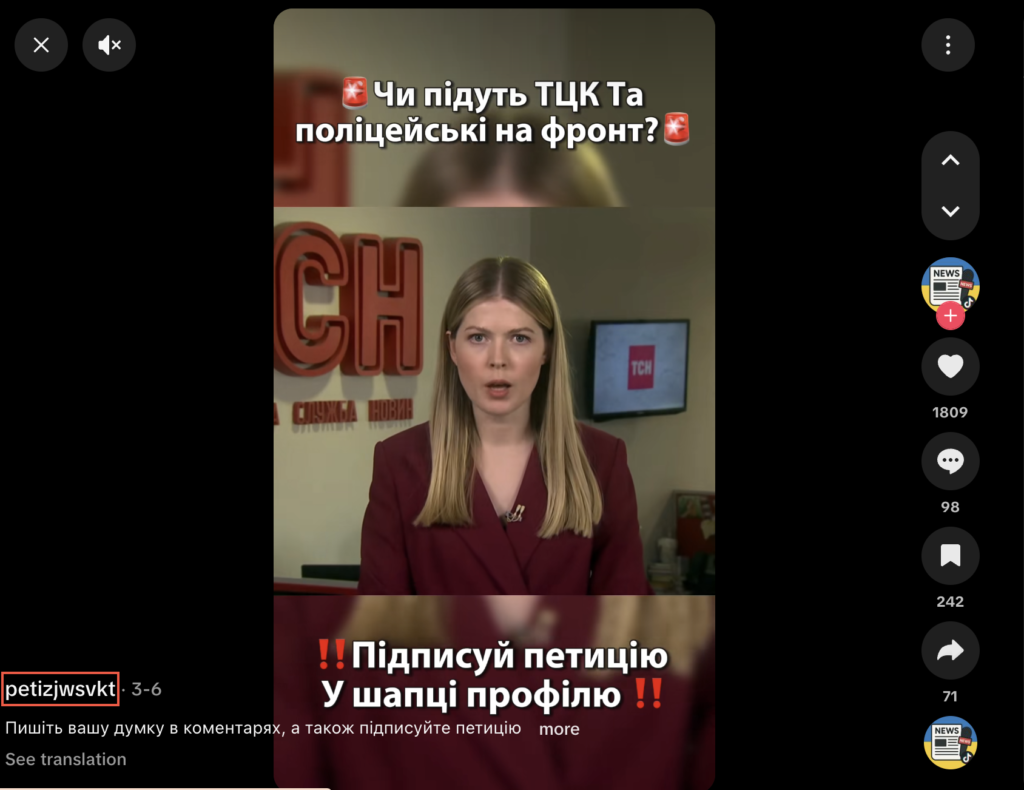
The video was published on June 3, 2026. In the caption, the creators encourage users to: “Share your opinion in the comments and sign the petition in our profile,” using the hashtags #Ukraine #TCC #Zelenskyy #petition.
The video is designed in the style of a television news report. It features a studio with the TSN logo, while a presenter resembling TSN host Valeriia Kovalinska delivers information related to mobilization. The video also includes on-screen captions reading: “Will TCC officers and police officers go to the front line?” and “Sign the petition in the profile bio.”
The analysis identified several indicators commonly associated with content created or modified using artificial intelligence technologies.
Among the most noticeable signs are unusually stable facial expressions, limited head movements, uniform lip synchronization, and a lack of natural emotional reactions while speaking. These characteristics are frequently observed in videos generated using digital avatar creation tools or AI-driven speech synchronization technologies.
At the time of the analysis, the account @petizjwsvkt appeared relatively new but had already accumulated more than 2,000 followers. The video itself had received around 100 comments, indicating significant audience engagement.
Some users appeared to perceive the video as genuine news content and actively engaged in discussions about the topic. In the comments section, users expressed support for the messages conveyed in the video without questioning its authenticity.
For example, one user wrote: “We are already tired of waiting! Our soldiers need support every minute.”
Another commenter stated: “I support this and there should definitely be rotations of no less than one year, because some people have been defending the country for four years while others think someone else should fight instead of them.”
Such reactions may indicate that at least part of the audience perceives the video as a credible message from a journalist or a news outlet rather than content showing potential signs of AI-generated manipulation.
Particularly concerning is the use of the likeness of a real journalist and TSN presenter, Valeriia Kovalinska. The combination of a recognizable television host, the visual style of a news broadcast, and a socially sensitive topic may create the impression that the information originates from a trusted media outlet or directly from the journalist herself.
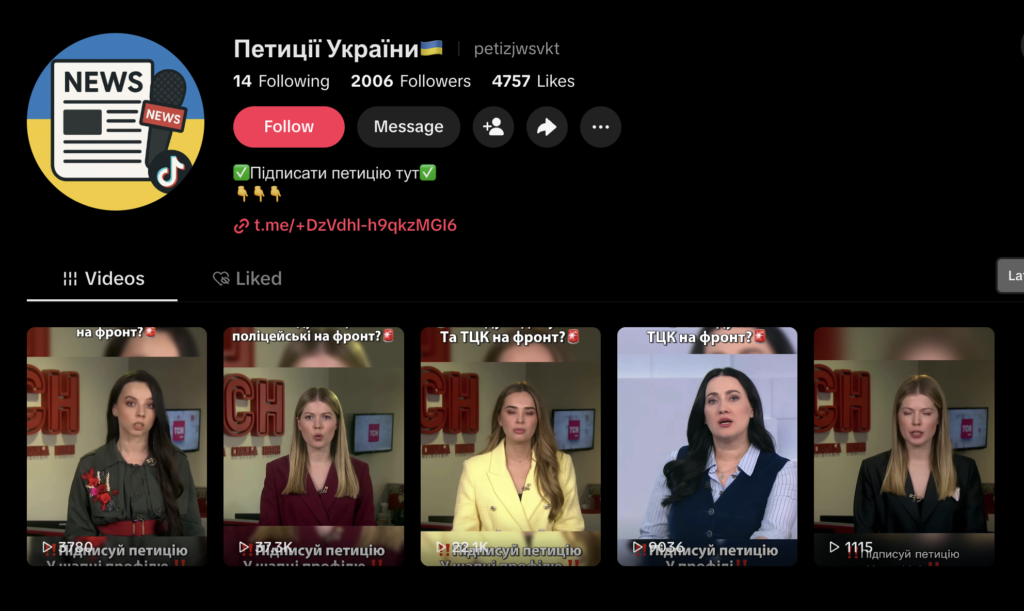
The issue extends beyond a single video featuring Valeriia Kovalinska. The TikTok account “Petitions of Ukraine” (@petizjwsvkt) appears to systematically use the likenesses of various television presenters to promote petitions on the platform.
The account’s videos feature several recognizable presenters from the 1+1 television network, including Solomiia Vitvitska, as well as other news anchors. Most of the videos follow a similar format and repeatedly encourage viewers to “Sign the petition in the profile bio.”
The use of journalists’ likenesses in synthetic content without clear disclosure of its origin is one of the challenges that has emerged alongside the rapid development of generative AI. Such practices can mislead audiences, undermine trust in the media, and exploit journalists’ reputations to promote particular narratives or campaigns.
This is especially concerning during wartime, when issues related to mobilization, military institutions, and government policies are frequently targeted by manipulation and information influence operations.
Previously, NGO Women in Media, in partnership with UNESCO, examined the use of AI to create and distribute content featuring the likenesses of Ukrainian women journalists. The study, When AI Turns Hostile: Gendered Threats Against Ukrainian Women Journalists, found that generative technologies are increasingly being used to produce content that can mislead audiences and erode trust in professional journalism.
Among the 119 women journalists surveyed, one in fifteen (7%) reported having personally experienced AI-generated online attacks, while an additional 16% said they had observed such attacks targeting their colleagues.
Report an online attack
If you are a woman journalist who encountered an online attack or witnessed such an incident, we would appreciate your contribution. Please report this case to help us identify threats and protect the rights of women in the media. Fill out the form, share key details, and join us in creating a safer information environment.
Fill Out the Form