
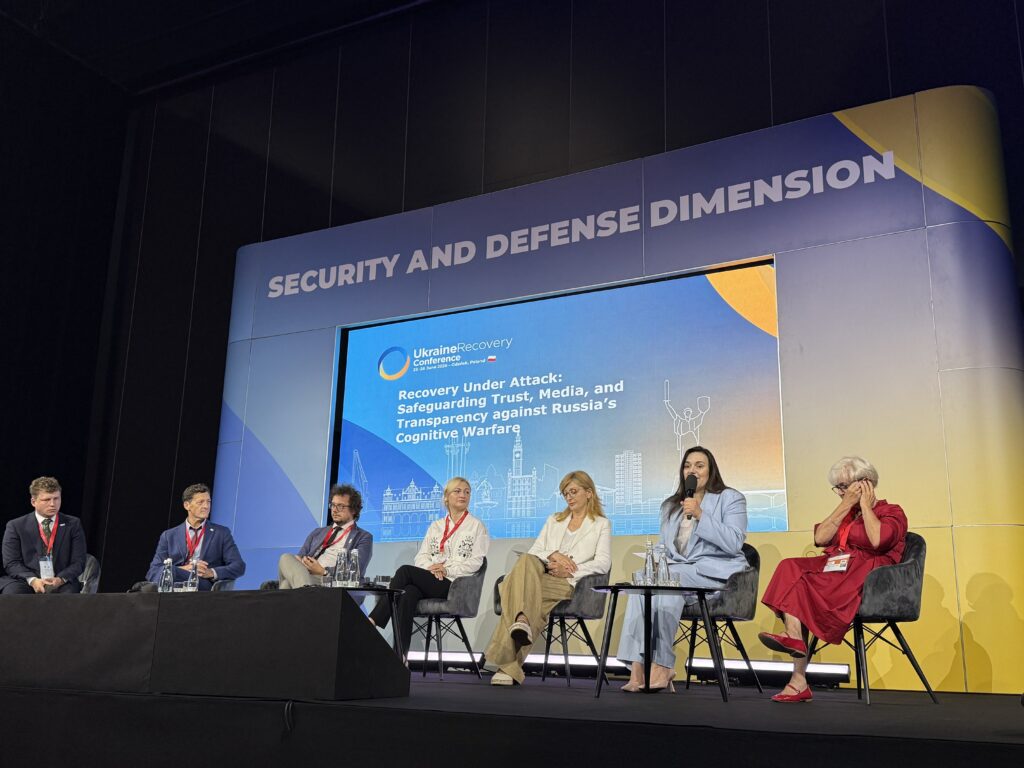
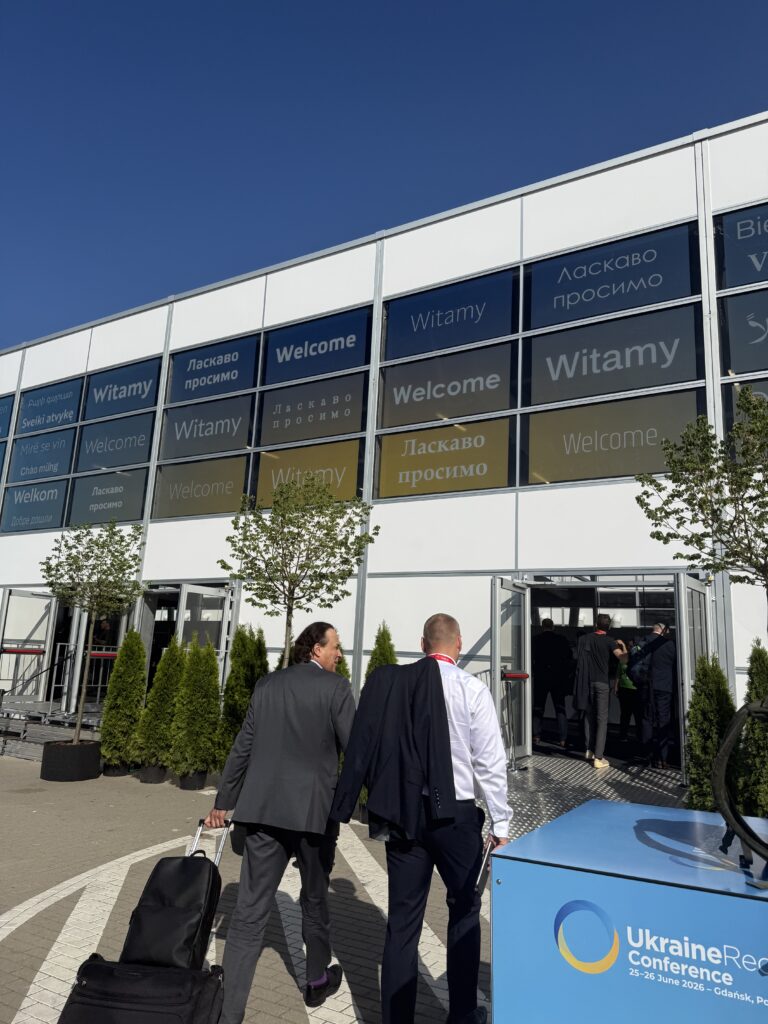
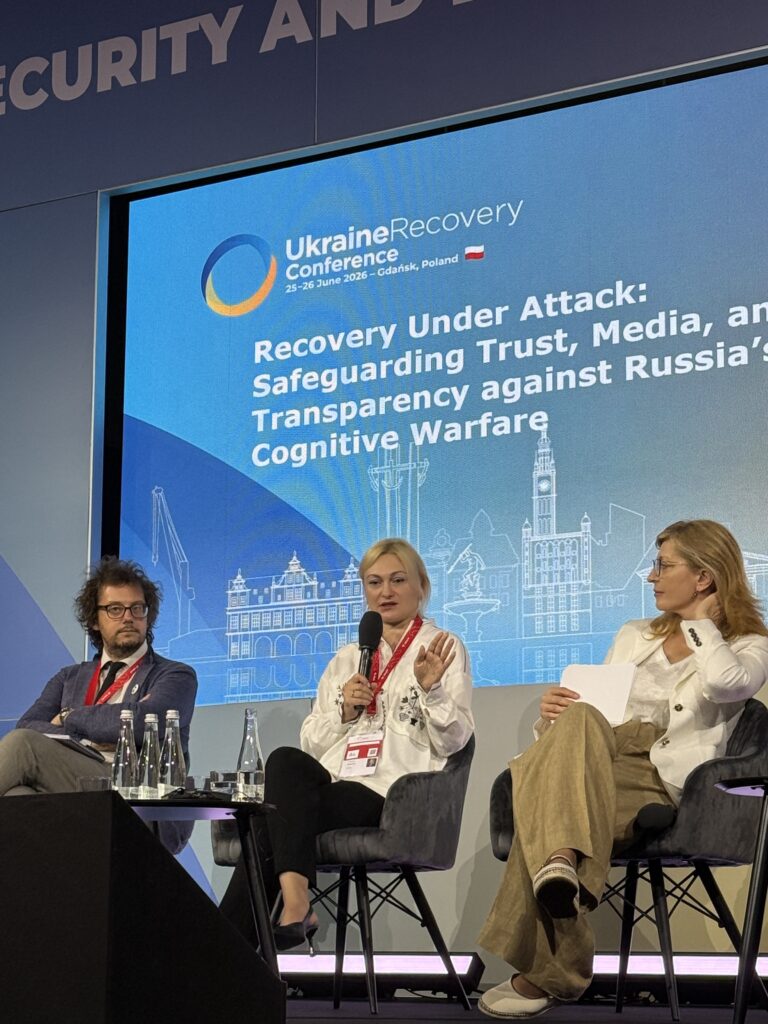
During the Ukraine Recovery Conference 2026 (URC 2026) in Gdańsk, a panel discussion titled “Recovery Under Attack: Safeguarding Trust, Media, and Transparency against Russia’s Cognitive Warfare” brought together policymakers, international organizations, and media experts to discuss the role of independent journalism, information integrity, and resilience against Russia’s cognitive warfare as an essential part of Ukraine’s recovery.
The panelists stressed that rebuilding Ukraine is not only about reconstructing roads, bridges, or energy infrastructure. Equally important are public trust, independent journalism, and a resilient information environment.
The discussion featured Tetiana Berezhna, Deputy Prime Minister of Ukraine and Minister of Culture and Strategic Communications of Ukraine; Ekaterina Zaharieva, European Commissioner for Startups, Research and Innovation; Joanna Kluzik-Rostkowska, Member of the Polish Sejm; Yevheniia Kravchuk, Member of the Parliament of Ukraine; Thibaut Bruttin, Director General of Reporters Without Borders (RSF); and Tony Borden, Founder of the Institute for War & Peace Reporting (IWPR).
Information Security Is Also National Security
Opening the discussion, Tetiana Berezhna emphasized that international conversations about Ukraine’s recovery often focus on damage to energy systems, transport, and housing infrastructure, while the destruction of the country’s media sector receives far less attention.
According to the latest Rapid Damage and Needs Assessment (RDNA), losses to Ukraine’s media sector already exceed USD 2 billion. At the same time, Russia has committed more than 950 crimes against journalists, 131 media workers have been killed, and 29 journalists have been abducted. These figures demonstrate that Russia is deliberately targeting freedom of expression and the public’s right to access information.
Berezhna also warned that Russian propaganda seeks to undermine international trust in Ukraine by spreading narratives about alleged corruption and the misuse of international assistance. For this reason, strong independent media are an essential element of Ukraine’s national security.
Russian Disinformation Is a Threat to All of Europe
European Commissioner Ekaterina Zaharieva stressed that Russia’s information warfare threatens not only Ukraine but democratic societies across the European Union.
She noted that while the Kremlin has refined its propaganda methods over decades, artificial intelligence has significantly increased both the speed and scale of disinformation. Russia exploits every socially sensitive issue—from the COVID-19 pandemic to the war in Ukraine—to erode trust in democratic institutions and reduce public support for Ukraine across Europe.
The Commissioner highlighted examples of foreign interference in European elections and argued that resilience must begin in schools by strengthening media literacy and critical thinking.
She also outlined several European Commission initiatives supporting independent media, fact-checking organizations, and democratic resilience. However, she acknowledged that current support remains modest compared with the resources Russia invests in propaganda. According to the figures she cited, Russia’s propaganda machine produced around 600 disinformation items per day in 2024, but with the expansion of AI technologies this number exceeded 20,000 pieces of disinformation per day in 2025.
Cognitive Warfare Is a War for People’s Minds
Polish MP Joanna Kluzik-Rostkowska argued that Russia recognized information as a weapon decades ago, while democratic countries have only recently begun to fully understand the scale of this threat.
She explained that alongside kinetic warfare there is cognitive warfare—a war for people’s minds—using disinformation, cyberattacks, and sabotage to divide societies.
According to Kluzik-Rostkowska, one of Russia’s primary objectives is to fuel anti-Ukrainian sentiment in Poland, deepen internal political divisions, and weaken European unity. Building societal resilience against information attacks has therefore become an increasingly important priority.
Journalists Have Become One of Russia’s Deliberate Targets
Yevheniia Kravchuk, Chair of the Temporary Special Commission of the Verkhovna Rada on the Protection of Journalists’ Rights, stressed that attacks against journalists are systematic war crimes rather than incidental consequences of military operations.
She noted that television towers were among Russia’s first targets during the full-scale invasion. In occupied territories, journalists are persecuted, threatened, forced to collaborate, or replaced by Russian propagandists. Occupation authorities have even stolen the identities of Ukrainian newspapers by publishing propaganda under trusted local media brands.
Kravchuk also emphasized that wearing a “Press” vest no longer guarantees safety. Instead, journalists have increasingly become deliberate targets. Today, Ukrainian journalists are not only informing the public but also documenting war crimes, making them a direct threat to Russia’s attempts to control information.
She called for dedicated support programmes for regional media, relocated newsrooms, and journalists working near the front line.
Ukraine’s Recovery Requires Strong Independent Media
Thibaut Bruttin, Director General of Reporters Without Borders (RSF), argued that while authoritarian regimes wage information wars through propaganda, democracies can only respond through independent journalism.
He stressed that Ukraine’s recovery cannot be complete without a dedicated recovery programme for its media sector. According to RSF estimates, Ukrainian media will require approximately €30 million annually over the next three years to maintain a sustainable independent media ecosystem. In response to declining international donor funding, RSF is advocating for the establishment of an international fund to support Ukrainian media.
“Trust Is Critical Infrastructure”
One of the panel’s strongest messages came from Tony Borden, Founder of the Institute for War & Peace Reporting.
He argued that trust is just as essential to recovery as roads, bridges, or energy infrastructure.
According to Borden, independent journalism strengthens transparency in reconstruction spending, reinforces public confidence, and helps international partners trust that recovery resources are being used effectively.
He also pointed out that investing in Ukraine’s media sector is remarkably cost-effective: rebuilding independent media would require less than one-tenth of one percent of Ukraine’s overall recovery costs while generating disproportionately high public value. Borden warned that Russia’s information warfare will continue even after the end of active hostilities, making long-term support for Ukrainian media indispensable.
The panel concluded that Ukraine’s recovery cannot succeed without protecting the information space, strengthening independent journalism, and investing in public trust. These elements are fundamental to democratic resilience and to the country’s long-term recovery.
Liza Kuzmenko, Head of the NGO Women in Media, attended the panel during Ukraine Recovery Conference 2026. Her participation was made possible within a project implemented with the support of International Media Support (IMS).